Showing posts with label The Shadow. Show all posts

Monday, July 30, 2018

Pulp Review: The Eyes of the Shadow


Street & Smith had a hit on their hands with the Shadow, and the second issue of Shadow Magazine hit stands in July of 1931 featuring The Eyes of the Shadow.

The story concerns itself with Bruce Duncan, who's rich uncle Harvey recently passed, being awakened in the night from a foggy sleep to see an ape-like creature stealing something from a hidden safe in his bedroom.

Harvey Duncan had saved a Czarist general during the Russian Revolution. The general had hidden away a large fortune, and had promised it to seven men who had helped him greatly, and Harvey was entrusted with the secret messages that would summon the men to a meeting place when the time came to distribute the reward. That was what was stolen from Bruce's room that night.

Worried, Bruce seeks out an old acquaintance of his uncle's, Isaac Coffran, who might know about Harvey's situation.


Meanwhile, Harry Vincent, agent of the Shadow, has a chance encounter on a train with Steve Cronin, a gangster and hired killer from the The Living Shadow. Cronin doesn't recognize Vincent, so the agent follows Cronin to Harrisburg, PA and tries to worm his way into Cronin's current scheme. Cronin suspects something, and saps Vincent, leaving him to die at a railroad crossing, but fate delays the train, allowing Vincent to wake up in time to drive to safety.

Pieces of a puzzle begin forming. Several prominent men have disappeared over the course of several weeks, each secretly one of the heirs to the Russian general's fortune. Meanwhile, Bruce stumbles into a trap laid by the sinister Coffran...


Expanding on the first story, Harry Vincent remains the real protagonist, with fellow agent Claude Fellows and Bruce Duncan acting as secondary viewpoint characters. The beginning establishes that weird crimes are the domain of the Shadow, and a murderous ape-man is a solid way to set the tone.

Without delving into the juicy plot details, I can tell you that the story has several excellent set-pieces. Bruce Duncan being saved from a death trap house by his Hindu servant Abdul and Harry Vincent (and the Shadow) and a thrilling showdown in rural Pennsylvania that starts with an abandoned cemetery and ends with a watery grave.

The real showstopper segment is in the middle though, with the Shadow tailing Coffran's henchman into a criminal hangout and willingly walking into a trap where he brings a gun to a knife fight, and has to survive several dozen armed thugs. Its great.

It marks the first appearance of the Shadow as Lamont Cranston, wealthy young man about town. While Walter Gibson's pulp stories would eventually reveal that Cranston was not the real identity of the Shadow, the 1937 radio show would run with the idea. Another difference with the radio version, which depicted the Shadow as a bodiless voice, is how this story takes great care to emphasize the Shadow's eyes blazing with righteous indignation when he's on the prowl. It'll be interesting if this character trait continues or if Gibson later abandoned it in favor of something else.


Its probably purely coincidental that the first story where a dark avenger of justice is revealed to secretly be a wealthy playboy also features a rich young man named BRUCE. Pure coincidence. Surely

Is The Eyes of the Shadow good? Hell yes. Its a brisk, action packed thriller that ramps up the supernatural side elements of the Shadow while also making him more human, and placing much of the important action in small town Pennsylvania is a great change of pace from the concrete jungles of New York City. Totally recommended.

Sunday, August 20, 2017

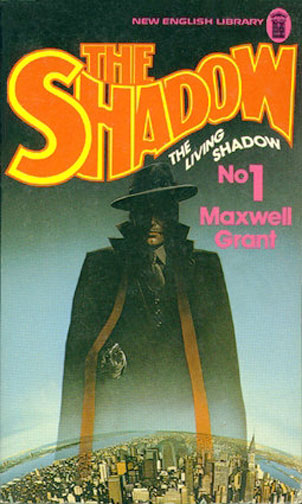
Pulp Review: The Living Shadow


The origins of the Shadow are an interesting, and appropriately twisting gyre of early cross-media promotion.

Once upon a time, Street & Smith published a pulp mag called Detective Story Magazine. On July 31, 1930, Detective Story Hour premiered on the radio for adaptations of stories from the magazine, and to shill other Street & Smith publications. The narrator of the show was a mysterious voice known only as The Shadow (a clever piece of marketing itself).

It worked, but not exactly as expected. The Shadow's sinister charisma had audiences going to the stands to buy magazines, but they weren't asking for Detective Story. They wanted The Shadow. Which didn't exist.

Street & Smith were smart enough to see a demand hungry for a supply, and hired up-and-coming mystery writer (and former reporter, stage magic afficionado, and crossword puzzle writer) Walter B. Gibson, to create a character whole cloth out of nothing more than a voice.

Under the pseudonym Maxwell Grant, Gibson would go on to write 300 Shadow novels, so it worked out pretty well.

Shadow Magazine Volume 1, issue 1 appeared on stands in April of 1931, featuring The Living Shadow, Gibson's first published Shadow story.

What follows is pulp as hell.


We meet suicidally depressed Harry Vincent on a bridge in New York. He got a letter from his old girlfriend back in Michigan dumping him, and so like a bitch, he jumps.

Fate intervenes in the form of the Shadow, who yanks him back onto the bridge and offers him a deal: Harry's financial woes are forever taken care of, but he has to obey any and every command of the Shadow's. Or they could go back to the bridge and Harry goes over the railing again. Harry's life belongs to the Shadow now, and decides his old life is dead anyway, so he eagerly agrees to become an Agent..

It doesn't take long. Harry is introduced to another Shadow Agent, intermediary Claude Fellows. Harry is sent into a nearly fatal disastrous investigation of a fence operating out of a tea shop in Chinatown. Re-shuffled to a murder investigation in Long Island that's got the police stumped.

Mystery! Investigations! Misdirection! Disguises! Murder! Car Chases! Fistfights! Deathtraps! Crossword Puzzles! About the only thing it doesn't have is estrogen. Margo Lane wouldn't appear in radio until 1937 and in the pulps until 1941.

Anything else would give away the plot, and it takes some very clever turns.


What's more important is that it establishes the Shadow as a character: He has a mysterious drive to punish evil-doers and is fabulously wealthy. He says that he can spend the lives of his agents if he wants to, but goes to great lengths to help and protect them in danger. He is a master of disguise beyond normal physical limitations. He can travel convincingly through shadows and its never made clear if its supernatural or not. He has his trademark laugh. These last bits move the story from a master detective with enough prep-time hax to make Batman blush (makes sense, since Batman's the bastard son of the Shadow) into supernatural fantasy.

What's even more amusing is that at one point, Harry Vincent is instructed to tune into the radio at a specific time and channel to hear his next orders from the Shadow. It is a blatant nod to the the Shadow's real-life radio presence and a brilliant piece of cross-media marketing.

Imagine being a loyal listener of the show and finally reading the Shadow's print stories only for it imply that at any time, you, yes YOU, could hear instructions from the Shadow to help him in his crusade on crime. Really tickles the tympanic membrane, doesn't it?


As an introduction, The Living Shadow succeeds, such that Street & Smith would publish it again in hardcover the next year and there would be numerous reprints over the years. Its not the Shadow and his mythos fully developed, hell, the Shadow's identity as Lamont Cranston or Kent Allard isn't even established yet. Yet there's enough there to be unmistakably The Shadow, and its fun as hell.


Highly recommended. 

Monday, July 10, 2017

Twofer Review: The Shadow (1994) and The Phantom (1996)


Russell Mulcahy (the director of Highlander) adapts Walter Gibson's pulp hero The Shadow, with Alec Baldwin in the title role as Lamont Cranston. The plot centers around Shiwan Khan (John Lone), last surviving descendant of Genghis Khan, and powerful mystic, arriving in New York with a dream to conquer the world. The plot involves something about a bomb, but honestly that gets lost in the shuffle.

Still, the cast is very solid, with Penelope Ann Miller, Peter Boyle, Ian McKellan, Tim Curry, Jonathan Winters, and a small cameo from James Hong. A solid adaptation of the Shadow, it hits on a lot of character beats and traits like Margo Lane, the network of agents, his dual .45s, even his sinister long-nosed appearance when he's in full Shadow costume.

There's some origin stuff about Cranston being an opium kingpin in Asia at the start before beginning his mystical journey which is completely unnecessary and Shiwan Khan's plot feels like it loses cohesion along the way (I want to conquer the world, but I also want to blow up New York City!). The good outweighs the bad, however, and it hits all the right notes on the Pillars of ADVENTURE.


Crazy pulp elements: Khan's goons wear armor and run around 30s NYC with crossbows and swords. A flying, intelligent CGI dagger with a bad attitude. Shiwan Khan smuggling himself to the US in a coffin just so he can mind control a security guard into killing himself. Actually, most of what Shiwan Khan does. He's pretty fun.


Another 90s adaption of a pulp hero, Lee Falk's hero The Phantom was directed by Simon Wincer (Free Willy, Quigley Down Under, several episodes of The Young Indiana Jones Chronicles). The plot centers around Kit Walker (Billy Zane) as a two-fisted masked avenger who prowls the African jungles as the Ghost Who Walks having to deal with an American businessman and gangster, Xander Drax (Treat Williams) who's searching for several mystical crystal skulls scattered across the world that will give him unlimited power. And can shoot lasers. Mostly lasers. Knowledge was their treasure, you know.

Again, the cast is very solid, with Kristy Swanson, Catherine Zeta-Jones, James Remar, and Patrick McGoohan in key roles. Pacing is great, location shots are lush, and the physical stunts and effects are pretty incredible. Zane's also really charming in the lead role. It gets a little odd when the Phantom has conversations with the ghost of his dead father that only he can see, but its an excuse to have McGoohan on screen, so I don't mind as much. The Shadow nails the glitzy and grimy aesthetic of 30s New York, but overall The Phantom is a little more fun and the plot holds together tighter.

Crazy Pulp Elements: An all-female squadron of flying pirates. Xander Drax throwing a spear through a man at a meeting in his office. A trapped microscope stabs out a man's eyes. Phantom's horse and wolf clearly communicating with each other to figure a way to get him out of a scrape.


It turns out the pseudo-Pulp revival thing from the 90s was actually pretty good. Both of these movies are solidly entertaining, have heroic heroes, villainous villains, beautiful women, handsome men, exotic locations, tight pacing, and meaningful peril. They're not relevatory or what you might call “modern classics,” but they're leagues better than most modern dreck passing itself off as Action-ADVENTURE.