Showing posts with label Fantasy. Show all posts

Sunday, April 25, 2021

Old Video Games: Lure of the Temptress


Classic point-and-click adventure games have two titans that loom large because of just how many successes they had: Sierra On-Line and LucasArts.

This isn't about them.

Other adventure game developers existed alongside those titans. Some of them, like Revolution Software, continue to exist, outliving both of the big two.

Best known for the Broken Sword series of adventure games, Revolution was founded in 1989 by British game developers Charles Cecil, Tony Warriner, David Sykes and Noirin Carmody.

Cecil and Warriner got their start in the mid-80s working at Artic Computing, an English studio active during the British microcomputer boom (think systems like the Sinclair ZX Spectrum, Commodore 64, and Amstrad CPC). Artic folded in 1986 and after a few years working at other companies, Revolution was founded.


1992's Lure of the Temptress was the company's first product: a fantasy point-and-click adventure game slightly reminiscent of King's Quest and with a cheeky sense of humor reminiscent of The Secret of Monkey Island, though less wacky and more British in its comedy. Released for the Atari ST, Commodore Amiga, and MS-DOS computer systems, it was a solid hit for the company and paved the way for more ambitious projects.

The game's setup is told in a gorgeous intro cinematic that explains that a good king had united the land and on a hunting trip, hired the peasant protagonist, Diermot, to flush out game for them. Suddenly, the unnamed king learns of an evil sorceress named Selena who has conquered a town and threatens the kingdom. The king's men ride to battle, only to be cut down by Selena's orc-like henchmen, the monstrous Skorl. Diermot is captured during the battle, and awakens in a prison cell, where the game begins.


Revolution developed the Virtual Theatre engine for their games, which aside from the regular pointing and clicking, also allowed the NPC characters populating the world to wander around and interact with each other for greater immersion than simply standing in one place waiting to be talked to by the protagonist.

This is good and bad because while the verisimilitude is appreciated, the game also has you track down specific NPCs to talk to in order to proceed, and it can be frustrating trying to track them down.

After escaping the dungeon with the help of a jester named Ratpouch, Diermot has to explore the village of Turnvale, its castle and a nearby cave to find a way to stop Selena from conquering the rest of the kingdom.

The interface is quite good. Left click to look at something, right click to bring up a menu of options like talking, pulling, using, etc). The game also gives you companions that can follow you around and Diermot can even give them somewhat complicated orders which are necessary for some puzzles.


Unfortunately, the character pathfinding, at least on the DOS version available on GOG.com for free, is a mess. Its very finicky getting an NPC follower to do something because you have to stand right next to them at exactly the right spot to trigger the dialogue. Not impossible, just irritating.

With the stakes of an evil sorceress with an army of monsters threatening the kingdom, the actual scope of the game is quite small. Cozy, even. Turnvale is a nice little town, which is good, because you will spend a lot of time walking back and forth across it. The townspeople all have engaging personalities, and even ones like Gwyn, the town gossip who has no direct bearing on any puzzles, provides story hints and clues if you keep talking to her.

As a protagonist, Diermot is a lunk, but a likable one. Ratpouch is funny for a little while, then his pathfinding wears out its welcome as he constantly ends up underfoot.

The GOG version uses the SCUMMVM emulator to run, which apparently has buggy audio and there's an annoying alarm bell sound that played constantly in the town as I was exploring it. Apparently the issue doesn't happen if the game is run in DOS-Box. From what I've seen online, the Amiga version seems to run the best with the best sound, but I have no experience with Amiga emulation to have a firsthand opinion on it. This being an early 90's game made by a brand new studio with hardly any budget, there is no voice dialogue in any of the versions.


The writing and artwork are solid in all the versions I've seen, and the game has a very quaint and cozy atmosphere that allows the tone to jump between flippant dialogue with a Conan the Barbarian type of adventurer in a bar to trying to save an innocent shopkeeper from being executed by the Skorl. Like Sierra games, Diermot can get game overs in many ways, but its not the parade of Save-Die-Reload Save that King's Quest has. Only a few puzzles have built in limitations like time limits you don't necessarily know about, like the wine barrel puzzle, but overall its fairly forgiving for an early 90s adventure game.

Lure of the Temptress was a hit in England and paved the way for Revolution to make bigger games, like Beneath a Steel Sky and the Broken Sword series. Its a pleasant little game with some ambitions that occasionally exceed its grasp, like the NPC pathfinding. The writing and art style are good, the music isn't great played through SCUMMVM, but it wasn't a dealbreaker. I liked it, but it wasn't mind blowing. It is freeware, so I definitely recommend it, at least for a try.

Friday, January 04, 2019

2019: Moving Forward by Looking Back

Look at that smile!

Since everyone in my writing circle seems to be doing a “welcome to 2019” thing, I figured I might as well do the same. And its a way to do some dusting around here.

The blog has lain fallow for a couple months, but for good reason. I'm working on a Mech Space Opera taking influence from a lot that I've learned (and also un-learned from my academic indoctrination) and putting into practice. Its going to be big. Its going to be sweeping. Its going to come in at a reasonable page count instead of a doorstopper. Its going to be contrary to every major Science Fiction franchise in the West that's devolved into meaningless goo over the last twenty years. Its going to be four books, to start. I'm about halfway done with the draft of book one, and the few eyes that have laid upon it, are stoked. Its like “Red Dawn” meets “Buck Rogers,” but that's just a starting point.

I'm hyping this up because a) I should probably do that some more when it comes to my own work, and b) I'm legitimately excited to write this story. In a lot of ways its a throwback love letter to the 80s sci-fi that shaped me like Star Wars was a throwback to the 40s sci-fi that shaped George Lucas. Its going to be nuts, and once I have more details hammered out after the first draft, I'll start doing lore posts for it.

As for the broader world of science fiction and fantasy? I probably won't be talking too much about that, because it would be beating a dead horse. Doom has already befallen every major franchise under the sun owned by a massive corporation. The video game industry is barreling toward a major crash for the big publishers, and it looks like Hollywood and Music are also going that way. Barnes & Noble is on its last legs, and when it goes, Big Publishing is going to have a reckoning too.

In short, Hell has come to Frogtown.


So what do I think is actually going to arise this year?

Horror. I think Horror is going to get more experimental and weirder as talent flees the sinking ships of mainstream SF/F. Probably more throwbacks, too, but not failures like the Mummy reboot reboot reboot.

Fantasy. Probably going to see a decline as everyone cringes away from Harry Potter. The interesting stuff is going to be in the short story market.

Science Fiction. This is going to be a battleground, and I'll be there. Both Pulp SF and Hard SF (represented by Star Wars and Star Trek, respectively) are in extremely dire straits, and the spoils are ripe for new blood to take advantage of audiences that are starving for optimistic space adventures. Nick Cole and Jason Anspach are doing a lot of great work with Galaxy's Edge, and I expect that series to grow by leaps and bounds, but its a wide-open galaxy out there, waiting to be conquered.

Westerns. I've noticed Westerns have been quietly coming back to book shelves over the last two years or so. I think it'll stay mostly underground, but I think Westerns are going to slowly keep building momentum, especially as Middle America ponders things like national identity and what it means to be an American.

Yesterday on Twitter, I ragged hard on the Battlestar Galactica reboot as being boring, subversive trash that was the root of modern (visual) SF being needlessly gritty with unlikable characters and no payoff to anything. It was a good convo, with some insightful back-and-forth. Over the course of the rant, I linked to a 2004 essay written by Dirk Benedict, the original Lieutenant Starbuck from Battlestar Galactica in the late 70s.


I suggest reading it because Benedict is quite eloquent in it, and every single observation that he lays out is 100% relevant to the state of entertainment in 2019. And this was written fifteen years ago. 

There's a lot to meditate on there moving forward into the new year.

Saturday, September 15, 2018

Pulp Review: Tarzan of the Apes


A Princess of Mars put Edgar Rice Burroughs on the map, but it was the second story he published in 1912, Tarzan of the Apes, that solidified him has an adventure story writer. Tarzan was also serialized in the All-Story, then later published as a novel in 1914. It was a smash, and Burroughs would go on to write over twenty novels in the series. 1918 would see the first two silent movie adaptations of the character, and Tarzan movies would appear in every single decade since up to now. (It makes sense. For Tarzan all you need is a muscular guy on a jungle set instead of the special effects bonanza that is Barsoom)

The story begins with an Englishman, John Clayton, Lord Greystoke, sent to Africa in the 1880s to investigate claims of abuse of black natives by another European colonial power. Accompanied by his wife, Alice, the humanitarian mission never begins, since a mutiny on their ship leads to the couple being marooned on the western coast of Africa. Eking out a living, they give birth to a son, but tragedy takes both parents away. As fate would have it, the baby, also named John, would be adopted by Kala, a she-ape of the tribe who's chief, Kerchak, killed the elder Greystoke. They're not gorillas. The book makes it clear that they're more of a missing link species that has developed its own rudimentary language.


Named Tarzan by his adopted tribe, the boy grows up to become an apex predator. Weaker than the apes, but stronger than any normal man, Tarzan's greatest weapon is his clever mind and the eventual discovery of his parents' beach hut, where he slowly begins to learn using tools and even teaches himself to read English.

A tribe of cannibals, driven deeper into the jungle by colonialist firepower, settle near the area and one of their hunters kills Kala. Tarzan avenges her and begins to raid their village from time to time for supplies and pranks, as they think he's some kind of jungle spirit.

As he grows to maturity, another group of explorers is marooned at the same beach. A professor Archimedes Q. Porter has led an expedition to discover lost gold, succeeded, and the crew turned pirate on him and his family. Among the marooned are Jane Porter, the professor's lovely daughter, and William Cecil Clayton, Tarzan's cousin and heir to the Greystoke estate. Stunned at seeing other people that look like him, Tarzan's attraction to Jane draws him away from his simple jungle life and into the affairs of mankind.


There is a LOT going on under what is, on the surface, a straightforward tale of jungle adventure. The beginning taps into the same vein of classic adventure stories like The Swiss Family Robinson, Robinson Crusoe, Treasure Island, and Captains Courageous. As Tarzan grows, Burroughs frequently meditates on nature vs nurture themes, and how even removed from any human contact or experience, Tarzan's human qualities set him apart from everything around him. He is the noble savage; clear of mind and decisive, clever but needlessly cruel, a peak physical specimen, uncorrupted by the needless complications of civilization.

As for the topic of race, Tarzan's antagonism toward the cannibal tribe comes from a personal place: they killed his adopted mother. Esmeralda, Jane's black servant, frequently falls into “Lawdy lawdy” stereotypes, but she's also one of the few who understands the danger of the situation. Professor Porter and his colleague Samuel T. Philander are even worse stereotypes: the bumbling academics who are too stupid and oblivious to function in real danger. The two of them wander off into the jungle one night, get hopelessly lost, and argue about the merits of Moorish civilization while a lion patiently follows them around until Tarzan rescues them. Its played for laughs, but hammers home their uselessness. 


William Clayton isn't a bad man, but he's something of a fop and a soft fellow who wilts when real pressure arises. Civilization has made him weak. The only people, white or black, who aren't treated as weak or villainous are Tarzan, his dead parents, Jane Porter, and Lieutenant D'Arnot, a French officer who shows up later in the book to help Tarzan enter into Western Civilization.

Action sequences remain a highlight of Burroughs' style, with a believable escalation from Tarzan killing a gorilla with a rusty knife at the age of 10 to driving a car and swinging around Wisconsin in the middle of a forest fire. That happens, and the road to how Tarzan gets from point a to point b is a roaring good time, and it ends on one hell of a cliffhanger.


If it were just a solid action-adventure story, it would be worth it, but Burroughs works in some deep thinking as well that adds another dimension to the story.

Absolutely recommended.


That glorious Neal Adams cover art from the 70s deserves its own showcase. Wowza.

Saturday, September 01, 2018

Pre-Tolkien Fantasy: The Abominations of Yondo and The Voice in the Night


Finishing up the Pre-Tolkien FantasyChallenge, I'm going to roll the last 2 reviews into because the stories are quite short.

Clark Ashton Smith (1893-1961) was considered one of the Big Three writers of Weird Tales (the others being his friends Robert E. Howard and H. P. Lovecraft). Despite outliving either of them, he's fallen into relative obscurity, despite his contributions to both Lovecraftian Horror and Sword & Sorcery.

The Abominations of Yondo was published in April, 1926 in Overland Monthly and Out West Magazine, a California-based magazine with publication going back to 1868. It had published such authors as Mark Twain, Bret Harte (who was its Editor in Chief during its early years), Willa Cather, Jack London and John Muir. In short, it was respectable.

The nameless narrator of Abominations finds himself released into the desolate wasteland of Yondo by the cruel Inquisitors of Ong. Having been tortured for an unknown blasphemy, he narrates his journeys through a strange desert and his encounters with weird creatures, broken ruins, and horrifying monsters until his resolve breaks and he flees back the way he came.

This is mood piece, and a strong one at that. We have no idea who the narrator is, nor what his crime was. Ong is described as a lion-headed god, but that's all we learn about him or his Inquisition. The occupants of Yondo are even weirder in this wasteland at the literal edge of the world. Who they are, what they are, and why they are is all left to the reader's imagination as the narrator flees through this nightmare world.

There is absolutely nothing comparable to “standard” Tolkien-derivative fantasy within it, but the monsters are maddeningly Lovecraftian, while the cult of Ong would fit right in with Howard's Hyborean Age.


Finding a good cover of this specific issue of Blue Book was not feasible, so here's the Toho movie poster instead. 


The Voice in the Night was published in the November 1907 issue of Blue Book Magazine (essentially Redbook's cooler sibling that ceased publication in 1975, and a competitor of Argosy). Its author, William Hope Hodgson (1877-1918) was an adventurous figure in his own right. Sailor, bodybuilder, and photographer, he returned to England and enlisted during World War I and was killed in action at the Fourth Battle of Ypres at the age of 40.

Like many of his short stories, The Voice in the Night is set at sea, where land-based humans are especially vulnerable. In it, the crew of a schooner in the North Pacific are hailed by a rowboat begging for food. When the narrator tries to shine his light out, the rowboat paddles out of view. Promising to put away the light, the captain of the schooner sends out a box of foodstuffs. The mysterious rower returns, and relates his sad story.

He and his fiancee were abandoned by the crew of their ship and forced to make a raft. Coming upon an island covered in strange gray fungi, they also find a derelict ship moored there. The fungus grew on the ship in tall piles, but they were able to survive on the ships' stores for a while. Until the fungus started growing on them. Whenever they clean it off, it grows back. Fleeing to a patch of beach untouched by the fungus, but overcome by hunger, both eat some of it, and find it difficult to resist eating it.

Realizing that they cannot ever return to civilization because of how contagious this stuff is, they resolve to quietly meet their fate on the island, and the rower commends the crew of the schooner to God for their generosity toward him and his fiancee. In the morning light, the narrator on the schooner catches a glimpse of the rower as a covered in gray fungal growths and barely recognizable as human.

Addictive gray fungus with unstoppable growth that ultimately consumes whatever it grows on is horrifying enough, but there's a deep layer of Christianity that gives the doomed couple dignity. When approached by the ship, the man actively avoids coming into contact with them, to avoid contamination. When the fiancee is infected, she knows they can't leave the island for the good of humanity. Rescue is impossible, but the two face their impending deaths with a signature British stiff upper lip and belief in the ultimate mercy of God.

Just imagine anything like that getting released through a major traditional publisher these days.

Curiously enough, The Voice in the Night would serve as the basis for the 1963 Ishiro “I Created Godzilla” Honda movie Matango.

Liberties... were taken.


What's been most interesting to me about this exercise has been in how the lines of what is "Fantasy" get blurred the further back in time you go. Weird fiction, horror, ghost stories; those are all integral parts of what Fantasy is. Tolkien certainly knew this when creating Middle-Earth, but he wrote The Lord of the Rings in a conscious effort to create a quintessentially English Epic (in the Beowulf sense). Magic was weird and rare in his works, but the dwarves and elves and hobbits and orcs are, basically, people. They have histories and cultures, songs and art. They're funny-looking humans, in a lot of ways. 

That's fine, because Tolkien was a smart guy and knew that what he was doing was the exception, and not the rule. Fantasy itself is a no-limits kind of genre. Everything is possible within it, if its presented convincingly enough. 

The problem arises from those who wanted to be the next Tolkien. Ponderous doorstoppers with twenty book series that lie unfinished at their creators' deaths, Dry and dusty histories of the world and long names with gratuitous hyphens and apostrophes chained within them. The elves, and the dwarves, and the orcs, and the hobbitshalflings are all pretty much the same as how Tolkien wrote them but without the weightiness. And with Tolkien undergoing the slow process of erasure by the Modernists that poison the genre, the way forward isn't through the evolutionary cul-de-sac of Epic Fantasy that would like to forget its own founding father for the sin of being Catholic. 

It needs to reclaim horror from the ghetto of jump scares and generic serial killers. Fantasy needs to start telling more ghost stories and unexplained just-so stories. If Fantasy is to grow, it needs to get WEIRD again. 

Friday, August 17, 2018

Pre-Tolkien Fantasy: Rip Van Winkle

Classics Illustrated because the actual first edition was from a time before cover art

Alexandru over at Barbarian Book Club posted a challenge on his blog: Review three fantasy short stories from before Lord of the Rings' publication date of 1954 and spotlight the similarities and differences in them. (And share the challenge, which I'm doing with you right now.)

My recent deep dive into pulp literature has me reading tons of pre-Tolkien SFF, so rather than dust off another Robert E. Howard story so soon after a bunch of Conan and Solomon Kane, I figured I'd dive deeper. Regress even harder, if you will.

So I went to the Nineteenth Century.


The Sketch Book of Geoffrey Crayon, Gent. was a short story and essay collection published in serial format between 1819 and 1920, a full century before Edgar Rice Burroughs was writing his early John Carter and Tarzan stories. Written under the pseudonym “Geoffrey Crayon” the book was the first international blockbuster for Washington Irving (1783-1859).

Essayist, historian, author, traveler and diplomat, Irving was a cultured man who harbored a deep love for the Hudson River Valley of New York State. The Sketch Book features a varied collection of stories, fictionalized real-life events, travelogue essays and so forth that are written in a smooth, easygoing style that rolls off the pages with endless charm. However, only a few of the stories within qualify as fantasy, and they are two of his most famous pieces.

Written under the literary conceit of being “discovered” by a (completely fictional) historian named Diedrich Knickerbocker, Rip Van Winkle and The Legend of Sleepy Hollow have become fixtures of the American literary folklore, but they're both complete fantasies, made up, as far as I could determine, by Irving himself.

Rip Van Winkle tells the story of the eponymous Dutch-American colonist living in a sleepy village along the Catskill, err, Kaatskill Mountains. Rip is a kind and gentle man, but lazy. Always willing to help other people out with stuff, but never able to get his own affairs in order, his condition isn't helped by his formidable harridan of a wife, who scolds and scolds and scolds him endlessly.

His only real companion is his dog Wolf, and his only real escape is to run away into the mountains to hunt or fish. On one such hunting trip, he gets high up into the mountains one autumn day, and as the sun begins to set, he hears his name being called. A strange man in outdated clothes is carrying a keg up the mountain, and beckons Rip to help him. The two carry the keg to a clearing where several more men in similarly outdated clothes are playing a serious game of ninepins, their stern leader resembling famed explorer Henry, err, Hendrick Hudson. Silently drafting Rip to be their bartender, he eventually gets into the booze himself, and quickly falls asleep.

Henry Hudson, Catskills Ninepins Champion: All Year, Every Year

He wakes to find his musket rusted, his dog missing, and his joints aching. Working his way back down the mountain, he finds the village completely different. Buildings are changed, the portrait of King George over the village inn is replaced with someone called George Washington. After some confusion, Rip learns he's been asleep for twenty years and he missed the entire Revolution.

Its not all bad for him, though. He's reunited with his grown children, learns his wife died years ago, and he's now reached that age where sitting around the local inn as a town patriarch telling stories and drinking won't get him in trouble.


The story has mythological antecedents with tales of the King Under the Mountain popular in the German Alps and with countless stories with similar plotlines going back as far as ancient Greece of a mortal man stumbling upon a magical revelry and then losing years of his life. Much like Tolkien, Irving was dipping into history and myth and bolting it on to his story. Also like Tolkien, he used poetry to add texture and mood to his pieces.

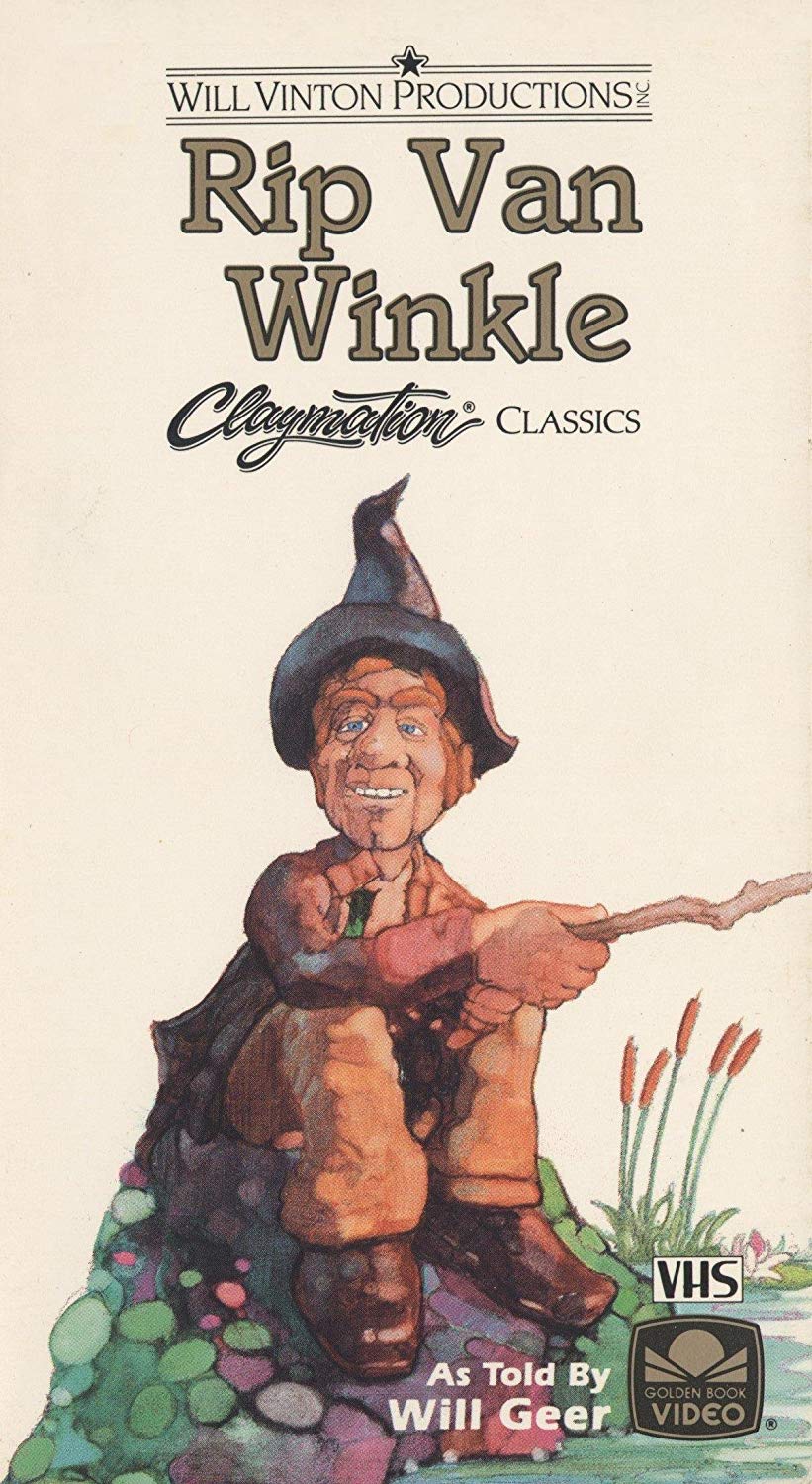
Unlike Tolkien, there isn't much of a conflict here. Rip Van Winkle is told as a folk tale, an episode in the life of a small town. There is no great conflict (aside from Rip's shrewish wife). Rip is merely living his day-to-day life until chance draws him into the Weird and it changes his life forever. The stakes are very small here. Most adaptations of the story, like Will Vinton's 1978 Claymation version, have to add some kind of conflict to wring out a runtime. 

Come for the fairy tale, stay for the prog-rock acid trip

Like Tolkien, the simple pastoral life is elevated, and Rip himself would fit right in with the good folk of the Shire. Irving goes to great lengths to describe the Hudson River Valley in loving detail that settles over the reader like a warm blanket. Its folksly and very, very comfortable.

Rip Van Winkle is a charming, incidental story that has a lot of small details going on under the surface of what is seemingly a lost folktale. Its short, and absolutely worth your time.


Monday, August 06, 2018

Pulp Review: Red Shadows


Before Conan the Barbarian swaggered onto the stage, another Robert E. Howard character graced the pages of Weird Tales. Debuting in the August 1928 issue, Red Shadows introduced the world to the unflinching morality of Solomon Kane.

Solomon Kane is a wanderer, a Puritan living in a dark 17th Century world full of evil monsters and worse men. Driven by a burning sense of purpose to punish evil, Kane comes across a young woman dying in the French wilderness. She names her killer, a bandit captain named Le Loup, and with a single sentence, Kane sets out to avenge this nameless woman's death.

“Men shall die for this.”


And die they do. Kane tracks the bandits to their hideout, killing them off-camera one by one like he's Jason Voorhees, until he's able to storm it and confront Le Loup. The bandit tries to bribe him and is shocked to find Kane uncorruptible. A fight ensues and Le Loup escapes.

Years later, Kane lands in Africa. He has tracked Le Loup to the jungle where he is captured by a local tribe of cannibals, but finds an unlikely ally in N'Longa, a powerful ju-ju man and sorcerer.


While the world of Solomon Kane is considerably grimmer, it is incredibly atmospheric. Its an excellent horror setting of heartless villains and mysterious monsters living in the shadows where the most dangerous creature in it is a good man. Action, blood, and magic abound in the story, but what differentiates Kane from Conan is that while Conan is a freebooting adventurer looking to get rich and doing the right thing in the end because he's a decent guy deep down, Solomon Kane deliberately wanders out into the world looking for evil to smite because he's already decided to do the right thing. Also, there is no way in hell that Solomon will have extramarital sex with a scantily clad temple maid. While the Conan stories are tremendously great fun, there is something deeply satisfying about watching Solomon Kane go about his bloody business.


Robert E. Howard didn't write bad stories, and I completely recommend Red Shadows as an introduction to Solomon Kane.


Saturday, July 21, 2018

Appendix N Review: The High Crusade


An English baron, Sir Roger de Tourneville, is mustering a force to aid King Edward III in his wars in France.

And then a Wersgor spaceship arrives over the small town in Lincolnshire where Roger is mustering. The little blue men inside the scoutship attack, the English storm the ship and kill all but one of the aliens, and Sir Roger gets a bright idea: force the surviving alien, Branithar, to fly the English force to France, and from there they can fly to the Holy Land. Sounds great, right?

Unfortunately for them, Branithar has other ideas, and plots a course for Tharixan, a Wersgor colony world, and thus, Poul Anderson's 1960 novel The High Crusade begins. Originally serialized in Astounding/Analog Science Fiction and Fact, it was published as a novel by Doubleday that same year.


Like Three Hearts and Three Lions, the story is told within a framing device. In in, an expedition from Earth comes across a curious historical record of how a bunch of Medieval Englishmen became the first humans to travel the spaceways. The main narrative is told by Brother Parvus, a scholar and clergyman accompanying Sir Roger's wild adventure.

The Englishmen, being medieval, are flabbergasted by the alien technology they encounter, but Roger counters with a deep cunning born in a feudal court system, and a tireless bravado that borders on recklessness. Outnumbered and outgunned by the hostile Wersgorix, his greatest advantage is his boldness in seizing the initiative and outmaneuvering the rigid “advancements” of the aliens. They are so used to impersonal, long-range warfare that when the English draw them into close quarters, the outcome is invariably the same.


The goal is to return home to Earth, but as the hope of that dwindles, Sir Roger's drive pushes him to conquer Tharixan, which strains his relationship with his wife, Catherine. She seeks succor in the company of the handsome young Sir Owain Montbelle, and you can guess that there are going to be problems.

The High Crusade is commonly billed as a satire, and in many ways it is. The idea that a bunch of Medieval Englishmen can be ripped away from Earth and go about conquering a mighty space empire seems silly. It is silly, when described that way.


And yet, the strength of the novel is that it plays everything completely straight. There is no single trace of irony, nor a smirk at the audience that this is as absurd as it sounds. It is committed to the kayfabe and that's how the story is able to work.

Because the story is told with a straight face, it absorbs the reader into it, and it transforms from a “ha ha, Deus Vult in space” concept into a swashbuckling adventure story about a nobleman forced to rise to the position of a conqueror. The climax of the story isn't the conquest of the Wersgorix Empire, but is rather about resolving the crumbling marriage of Roger and Catherine. With sword fighting.


I can't recommend The High Crusade enough. Its an absolute joy to read, both as an action-comedy and as well-done speculative fiction. Anderson wrote a sequel called Quest in 1983, and there was a movie adaptation in 1994 by Roland Emmerich, which is apparently terrible.


Monday, June 25, 2018

Old-ish Video Games: Two Worlds


2007's Two Worlds is a strange, buggy, unbalanced mess held together with code and Polish profanity. And yet I find it oddly compelling.

Developed by Reality Pump (a Polish company established in the 90s and more recently famous for the glitchy, broken meme factory Raven's Cry), Two Worlds comes across as a copycat of Elder Scrolls IV: Oblivion, which released a year earlier.

The similarities are strong. Both are non-linear open-world high fantasy games with a main quest that's mostly optional. Both take place in a mostly temperate forest terrain with touches of the exotic on the fringes. Both have factions you can join. Both have a magic system that can be abused if you know what you're doing (those are the best magic systems).

Whereas Oblivion casts you as a firefighter stamping out hell-portals opening up all over the country because a doomsday cult wants to summon their god, Two Worlds starts with a more personal approach.
The hero's sister is kidnapped by a doomsday cult that want to resurrect a dead god. Totally different.

The major difference is that the nameless protagonist, is a complete idiot. His sister is kidnapped in the opening cutscene because he leaves her, wounded and bleeding next to a tree, so he can investigate the safety of an abandoned hut. When the conspirators approach him to blackmail him into working for them in order to rescue her, he takes it at face value. When he's able to contact his sister telepathically at various sites and learns of the quest to resurrect a dead god, he writes it off as hokey superstition, despite being able to be leveled up as a wizard. When it becomes obvious that collecting the artifacts the cult wants would be disastrous, he goes along anyway. One of the artifacts is actually powering the defense of an innocent city against orcish attack and when you kill the guardians and take it, the orcs invade the city and kill everyone in it before you exit the dungeon (you can apparently abuse the magic system and resurrect the cityfolk with a leveled up spell, but there's no story reason to do so).

Don't feel too attracted, that's supposed to be the player character's sister.

Blockhead protagonist aside, the combat controls are clunky, horse controls are clunkier, the map is not overly thought-out despite being rather large (there's only one river, the big one dividing up two major zones), and the English voice over acting is amazingly awkward. I went for a heavy fighter type of build and the penultimate boss was murdering me despite my high level, so I cheesed him with a low level cold spell that I beefed up thanks to the overpowered magic system. The ending glitched out on me and took me right back to the main menu without showing the cutscene, so I had to reload a save.

And yet.

And yet there's something to this video game equivalent of a B-Movie. The map is big. The environments are quite scenic, the soundtrack by Harold “the guy who wrote Axel F” Faltermeyer is kind of great, and while some of the zones are clearly undercooked (the swamp, the snowy area, the desert tucked away in one corner and so on) riding around and exploring remote corners is bound to turn up something interesting: A quest line, a dungeon to clear out without any attached quest, bandit camps, orc patrols, stone dragons that can be cheesed because you have a faster attack rate and can get them into a stagger loop as you pound on them without taking a hit. There are monsters that only exist in smaller areas. I was riding around on a skeleton horse. There was an entire city I never entered because it was locked. There were giant gates in the middle of the map I never figured out how to open.

In short, it has mysteries that reward exploration.

I wouldn't go so far as to recommend Two Worlds as a good game. There are many like it that do the same things it does with polish and balance, but I did have fun, which is the entire purpose of a video game.

Wednesday, May 02, 2018

Appendix N Review: The Warlord of Mars


Edgar Rice Burroughs returned to Barsoom in 1913 to write The Warlord of Mars. Continuing from the cliffhanger ending of Gods of Mars, the story was serialized in the pages of the All-Story Magazine incarnation of Argosy, and later published as a novel in 1919.

Dejah Thoris and Thuvia of Ptarth are still imprisoned in a strange prison within the bowels of the Temple of the Sun with the treacherous Princess of the Holy Therns, Phaidor.

Not one to simply sit and wait out the year before the door opens again, John tries in vain to find a way in, and comes across a conspiracy between Thurid, a Black Martian of the First Born who bears a deep grudge against Carter since an embarrassing defeat in Gods of Mars and Maitai Sheng, leader of the White Martians and high priest of the cannibalistic Holy Therns.

The conspirators open the prison and spirit the women away, with John Carter and his trusty calot Woola giving chase, first to the equatorial jungle on the other side of the planet where the Red Martian city of Kaol holds sway, and then to the frozen north, where an entire race of Yellow Martians has been locked away from the rest of Barsoom by natural fortifications, and the cruel Salensus Oll rules as Jeddak of Jeddaks.


This feels like a shorter story than the previous two, but that could be the rocket-fast pace of the chase that takes up the bulk of the book, culminating in a titanic battle for the city at the North Pole of Mars, where every ally that John Carter has ever made comes to his aid. Mighty Tars Tarkas of the Greens, Thuvia the Princess of Ptarth who can sooth wild animals with her voice, Thuvan Dihn, Lord of Ptarth who has been searching for his daughter, Xodar the new chief of the Black Martians, Carthoris the son of John Carter and Dejah Thoris, Kantos Kan of Helium, Tardos Mors and Mors Kajak, the lost lords of Helium (and Dejah's father and grandfather), and Talu of the Yellow Martians. There are even some Therns who have allied with the forces of Helium who show up.

Much of the second half of the book is wrapping up story threads and giving satisfying conclusions, but the most satisfying development comes in how Phaidor grows as a character by the end in a touching scene.


Then the final chapter is a victory lap as John Carter makes his way back to Helium with Dejah Thoris where he is then put on trial for his heresy in the Valley Dor. Its a fake out, of course, and the statute of limitations on spoilers is long gone on a story from a century ago, so I'll tell you that John Carter is crowned Jeddak of Jeddaks by a unanimous vote of all the people he's forged together into his alliance over the past three books and it ends with John taking Dejah into his arms and kissing her.

Its about as FLAWLESS VICTORY as you can get in fiction, and it is completely and truly earned. John Carter has gone through hell and back across an entire planet, fighting anything and anyone who would stand in his way. He's been captured, tortured, thrown off of multiple buildings, thrown off of Mars entirely, and always kept coming back. Not for conquest, though he does that and ends centuries of racial hatred along the way, but for love.


Its a deeply satisfying conclusion to the initial trilogy and it hints at future adventures among the next generation of heroes, with Carthoris and Thuvia drawing close to each other. Indeed, there would be 8 more books in the Barsoom series.

Absolutely recommended. If you want to raise good boys, give them Harry Potter. If you want to raise good men, give them John Carter.


Monday, April 30, 2018

Appendix N Review: Black Colossus

Margaret Brundage knew how to sell the hell out of a cover


Returning now to Hyborea, Robert E. Howard's Black Colossus was published in the June 1933 issue of Weird Tales.

It begins, not with Conan, but with Shevatas, master-thief of Zamora (the land where Tower of the Elephant took place) who is exploring a sand-buried ruin of a city called Kuthchemes in the deep deserts south of Koth. By accident he awakens the undead sorcerer-king Thugra Khotan. The Liche-like Thugra, who oversaw horrific blood sacrifices in the name of Set, goes right back to trying to conquer the world. Now assuming the disguise of Natohk, the Veiled One. First on his list of conquests is the small kingdom of Khoraja, and its nubile princess Yasmela.

Tormenting and taunting Yasmela at night through his sorcery, the princess seeks solace in Mitra, the god of her Hyborean ancestors. Guided by a disembodied voice, she is directed to go out into the streets of her city alone at night and put her trust in the first man she meets.

The instructions are bizarre, but desperate for help, Yasmela does so, and so finally Conan of Cimmeria enters the story, who is currently employed as a mercenary.

After a negotiation that was equal parts paranoia and sexual tension, Conan is made commander of Khoraja's army, which then marches forth to meet the hordes of Natohk on the edge of the desert.


What follows is a titanic battle sequence that remarkably fits perfectly within a short story. Its incredible. There is humor, humanizing details for random grunts, and actual tactics that Conan employs to take advantage of the terrain. And rivers of blood, of course, because this is Conan after all.

Through heroic effort, Conan is able to win the field, but Yasmela is taken by Natohk back to Kuthchemes where he intends to take her for himself. Conan gives chase and confronts the sorcerer in his lair, and the way the story ends deserves to be discussed, so here's the recommendation before the SPOILERS start: Its a straightforward story that is deceptive in its simplicity. Its also a rip-roaring good time. Absolutely recommended.


SPOILERS

The fight with Thugra Khotan at the end is hilariously one-sided. The undead sorcerer postures and threatens with a giant black scorpion, but Conan kills him with a single blow by throwing his sword into his chest.

From there, he rescues Yasmela and wants to take her away from this horrid place, but she's the one who initiates the romantic encounter. Thugra had obviously intended to ravish her, but now Yasmela, who has been the actual protagonist of the story who got things moving (Conan has been merely reacting to situations thrown at him), decides that Conan has earned her embrace.

“No!” she gasped, clinging with convulsive strength as barbaric for the instant as he in her fear and passion. “I will not let you go! I am yours, by fire and steel and blood! You are mine! Back there, I belong to others – here I am mine – and yours! You shall not go!”

Here, in this ancient ruin, Yasmela is above any societal obligations befitting her rank and sex. Here, away from civilization, she is able to choose her sexual partners according to her own will, and she chooses Conan. A lot is conveyed about her character in these last few paragraphs when she is freed of the specter of Thugra's unholy lust.

The story caps off with Conan and Yasmela implied to have consensual sex in the chamber of the evil sorcerer-king that Conan just killed to prevent from raping her. That is the most Alpha Chad ending I think I've ever read. Its a wild ride.