This one's a real hidden gem of deceit
and twists and Humphrey Bogart turning in a solid performance in a
lesser-known noir from 1947. It's Dead Reckoning.
Bogey
plays Rip Murdock, former army captain and war hero. He's in a place
named Gulf City looking for his wartime pal Johnny, who mysteriously
hopped off a train in Philadelphia rather than receive a Medal of
Honor from Uncle Sam. The two are supposed to meet, but one fiery car
crash later, that's not going to happen, and Murdock runs afoul of a
local mobster named Martinelli (Morris Carnovsky) and the woman
Johnny was involved with. And what a woman Coral “Dusty” Chandler
(Lizabeth Scott) turns out to be. A husky-voiced blonde who was a
former singer at Martinelli's nightclub and is central to everything.
Directed by John Cromwell, the movie
with a very solid look. Some scenes really stand out, like the one
near the beginning where Rip chases Johnny in vain around some train
cars at night, the final showdown and a couple others. Its solid, but
there’s not a whole lot there that really pops out in terms of
camera tricks and so on.
So, story by Gerald Adams & Sidney
Biddell, adaptation by Allen Rivkin & screenplay by Oliver H.P.
Garrett & Steve Fisher. That’s quite a few names for a 100
minute picture. Character dialogue is actually really solid,
especially between Bogart and Scott. The best scenes are the ones in
cars where Rip & Dusty are talking. I’d say the downside is
that the plot is fairly easy to figure out at a certain point, though
the film doesn’t try and cop out on the ending at least.
one of the most interesting traits that
Rip has in comparison to other characters I’ve seen him play is
that there’s a surprising level of misogyny in our hero. Not just
like a “typical for the times” way, but the character’s got
some real bitterness buried in there. And then of course he ends up
falling in love with the femme fatale of the film and the
relationship goes to some REALLY interesting places.
Dead Reckoning might not bring a
whole lot of innovation to the table, but it is great seeing Bogart
and the severely underrated Scott (who made quite a few noirs
in her day) really get into things. Its a hidden gem of the genre.
Totally recommended.
The origins of the Shadow are an
interesting, and appropriately twisting gyre of early cross-media
promotion.
Once upon a time, Street & Smith
published a pulp mag called Detective Story Magazine.
On July 31, 1930, Detective Story Hour
premiered on the radio for adaptations of stories from the magazine,
and to shill other Street & Smith publications. The narrator of
the show was a mysterious voice known only as The Shadow (a clever
piece of marketing itself).
It
worked, but not exactly as expected. The Shadow's sinister charisma
had audiences going to the stands to buy magazines, but they weren't
asking for Detective Story.
They wanted The Shadow. Which didn't exist.
Street
& Smith were smart enough to see a demand hungry for a supply,
and hired up-and-coming mystery writer (and former reporter, stage
magic afficionado, and crossword puzzle writer) Walter B. Gibson, to
create a character whole cloth out of nothing more than a voice.
Under
the pseudonym Maxwell Grant, Gibson would go on to write 300 Shadow
novels, so it worked out pretty well.
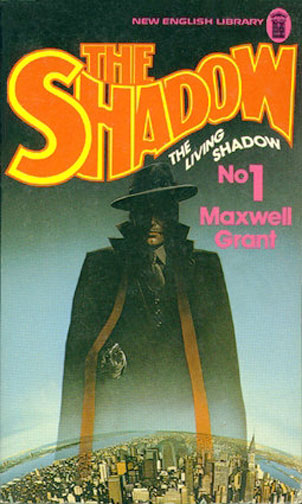
Shadow Magazine
Volume 1, issue 1 appeared on stands in April of 1931, featuring The
Living Shadow, Gibson's first
published Shadow story.
What
follows is pulp as hell.
We
meet suicidally depressed Harry Vincent on a bridge in New York. He
got a letter from his old girlfriend back in Michigan dumping him,
and so like a bitch, he jumps.
Fate
intervenes in the form of the Shadow, who yanks him back onto the
bridge and offers him a deal: Harry's financial woes are forever
taken care of, but he has to obey any and every command of the
Shadow's. Or they could go back to the bridge and Harry goes over the railing again. Harry's life belongs to the Shadow now, and decides his old life is dead anyway, so he eagerly agrees to become an Agent..
It
doesn't take long. Harry is introduced to another Shadow Agent, intermediary Claude Fellows. Harry is sent into a nearly fatal
disastrous investigation of a fence operating out of a tea shop in
Chinatown. Re-shuffled to a murder investigation in Long Island
that's got the police stumped.
Mystery!
Investigations! Misdirection! Disguises! Murder! Car Chases!
Fistfights! Deathtraps! Crossword Puzzles! About the only thing it
doesn't have is estrogen. Margo Lane wouldn't appear in radio until
1937 and in the pulps until 1941.
Anything
else would give away the plot, and it takes some very clever turns.
What's
more important is that it establishes the Shadow as a character: He
has a mysterious drive to punish evil-doers and is fabulously
wealthy. He says that he can spend the lives of his agents if he
wants to, but goes to great lengths to help and protect them in
danger. He is a master of disguise beyond normal physical
limitations. He can travel convincingly through shadows and its never
made clear if its supernatural or not. He has his trademark laugh.
These last bits move the story from a master detective with enough
prep-time hax to make Batman blush (makes sense, since Batman's the
bastard son of the Shadow) into supernatural fantasy.
What's
even more amusing is that at one point, Harry Vincent is instructed
to tune into the radio at a specific time and channel to hear his
next orders from the Shadow. It is a blatant nod to the the Shadow's
real-life radio presence and a brilliant piece of cross-media
marketing.
Imagine
being a loyal listener of the show and finally reading the Shadow's
print stories only for it imply that at any time, you, yes YOU, could
hear instructions from the Shadow to help him in his crusade on
crime. Really tickles the tympanic membrane, doesn't it?
As an
introduction, The Living Shadow
succeeds, such that Street & Smith would publish it again in
hardcover the next year and there would be numerous reprints over the years. Its not the Shadow and his mythos fully
developed, hell, the Shadow's identity as Lamont Cranston or Kent
Allard isn't even established yet. Yet there's enough there to be
unmistakably The Shadow, and its fun as hell.
The
best-selling novelist of all time (at least according to the
Wikipedia and Infogalactic entries both citing The Guinness Book of
World Records), and arguably the most popular murder mystery writer
in the history of the genre is Agatha Christie (1890-1976). An
absolutely fascinating woman. She acted as a volunteer nurse during
WWI, struggled to get published for a very long time, married twice,
had a fascination with paranormal and occult themes, and took an
active interest in archaeology, often traveling to the Middle East
with her second husband to go to digs. She also wrote a total of 73
novels over the course of her life, 66 of them being murder
mysteries. Those, along with 165 short stories and 16 plays, cement
her as a deeply prolific writer. She may not have been a pulp writer,
but damn did she write at pulp speed.
Her
most enduring creation is Hercule Poirot, an eccentric Belgian
detective with an outrageous moustache and a knack for solving odd
crimes. By the time she published Murder
on the Orient Express
in 1934, it was her 16th
novel.
I'm
laying all this backstory on you because when it comes to 20th
Century Female Authors, Agatha Christie MATTERS. She's a BIG DEAL. So
when the 1974 adaptation of Murder
on the Orient Express
by Sidney Lumet (12
Angry Men,
Serpico,
Dog
Day Afternoon)
was released, that too was a big deal, especially since she was still
alive to see it. She approved of it, but felt Poirot's moustache
needed to be bigger.
The
plot is deceptively simple. Hercule Poirot is in Istanbul returning
to England where he boards the Orient Express train to the port of
Calais. A mysterious and dangerous-looking American named Ratchett
tries to hire him as a bodyguard. Poirot declines, and the next day,
Ratchett turns up dead in his bed with twelve stab wounds and train
car full of suspects with motives. He has until the train is dug out
of a snowdrift to solve the murder, and discovers that the victim was
an important figure in the kidnapping and murder of a little girl
five years prior in a case based on the real-life Lindbergh
kidnapping.
The
cast is outstanding. Albert Finney as Poirot, followed by Lauren
Bacall, Ingrid Bergman (who won a Best Supporting Actress Oscar for
her role), Jacqueline Bisset, Sean Connery, John Gielgud, Anthony
Perkins, Vanessa Redgrave, Richard Widmark, and Michael York, among
others.
Lumet's
directing and cinematography are top notch, and aside from a prologue
sequence that provides important background on the baby kidnapping
case that feels a little long, is grand in its presentation of the
luxury of the Orient Express and the tight confines of a train car
stuck in the snow. Everything works great and is a deliberate
throwback to classic Hollywood filmmaking.
I
wish there was more I could say about it, but its a murder mystery
and it really is worth experiencing for yourself. Absolutely
recommended. Its a classic.
There's
a remake coming out later this year with another high profile cast
and with Kenneth Branagh at the helm. Might be good, even thought its
largely unnecessary thanks to the strength of the original. There's
also a 2015 miniseries from Japan that I discovered while researching
this review. It looks rather charming.
Been a while since we’ve dipped into the inky black pool of Film Noir, but 1988’s Who Framed Roger Rabbit is a good solid twisting of the genre into a curious balloon animal shape.
Uhh, that was a weird metaphor. Let’s just get right into it.
Story
Take bitter, drunken hard-boiled private eye Eddie Valiant (Bob Hoskins doing an incredible job hiding his British accent) and have him working in 1940’s Hollywood. Pretty noir-ish so far, right? Now add Toons, living, breathing cartoon characters that are a staple part of the entertainment business. Eddie, who very clearly does not like toons (for the simple fact that one murdered his brother by dropping a piano on his head) is hired by studio mogul R.K. Maroon (Alan Tilvern) to do a little snooping on the wife of Maroon Studio’s star player, Roger Rabbit (voiced by Charles Fleischer). When Valiant shows Roger pictures of his wife Jessica (voiced by Kathleen Turner) playing literal patty cake with the recently murdered Marvin Acme (Stubby Kaye) owner of Toontown, the plot starts adding up and all signs point to the sinister Judge Doom (Christopher Lloyd hamming it up BIG TIME) having something to do with the murder. And then hilarity ensues.
The live action cast is very solid and really gets it done, but since this is a hybrid live action/animation film, the real scene stealers are all the toons that populate Hollywood. And the movie does the near impossible feat of getting all the various companies to grant permission to include their characters in this one film. So you get Betty Boop, Woody the Woodpecker, Bugs Bunny, Mickey Mouse and so on. What this also means is that the movie features quite possibly the most impressive collection of voice actors ever assembled on screen. In addition to voice work god Mel Blanc (in one of his last performances), you get guys like Frank Welker, Nancy Cartwright, Jack Angel, Tony Pope, Jim Cummings, Wayne Allwine, Russi Taylor, June Foray, Joe Alaskey, Mae Questel (in one of her last performances) and more. You probably don’t recognize any of those names, but I guarantee that you’ve heard them plenty of times. Look them up and you’ll realize just how much respect is due to these incredibly talented people.
Visuals/Effects
Directed by Robert Zemeckis with cinematography by Dean Cundey (who worked with Zemeckis on the Back To The Future Trilogy). The movie has two objectives: Look like the 1930s and blend live action with animation. It works brilliantly. Yes, its in color, but they had color back then (Adventures of Robin Hood, Snow White) and it fit’s the, well, cartoonish nature of the population.
Writing
Based on the novel “Who Censored Roger Rabbit? By Gary K. Wolf (bet you didn’t know that) and screenplay by Jeffrey Price and Peter S. Seaman. The snappy dialogue is really what cements the movie together, since it effectively blends the madcap cartoon wordplay with the double-entendre of noir. The plot itself is pretty tight and includes the obligatory third act twist.
Sound
Original music by the always solid Alan Silvestri. Also, the movie gets major props for including a dueling pianos act between Daffy and Donald Duck that is entirely in character for those two hotheads.
Conclusion
A love letter to film noir, the Golden Age of Hollywood and old school animation all rolled into one. Who Framed Roger Rabbit is just about perfect.
1976's Murder By Death is a goofy, straightforward farce of some of the more notable detective characters from the 30s & 40s. Hardboiled private eye Sam Diamond (Peter Falk) and his assistant (Eileen Brennan), boozy socialites Dick & Dora Charleston (David Niven and Maggie smith), Chinese sleuth Sidney Wang (Peter Sellers), gluttonous Belgian Milo Perrier (James Coco) and his assistant Marcel (a young James Cromwell), and English governess Jessica Marbles (Elsa Lanchester from RMWC favorite The Bride Of Frankenstein) are all invited to a remote mansion for a dinner party hosted by blind butler Bensonmum (masterfully played by Alec Guinness) and hosted by the always eccentric Lionel Twain/Truman Capote (yes, THAT Truman Capote). Twain's challenge to them is to solve a dastardly murder mystery that he has come up with and he'll reward them with a hefty sum.
Beyond that, the plot just spirals further and further into absurdity and rapid fire dialogue that works well. Not all the jokes work (some end up being pretty juvenile considering the source material) but the cast is great and the jokes that DO work outnumber the duds considerably.
Directed by Robert Moore, there isn't a whole lot of fancy camera work, byt it serves the story well and allows the actors to run with their material. The script by Neil Simon is sharp, but by the end does get a little too bitter in its invective towards the characters being mocked. Additionally, you kind of have to know about (at least in broad strokes) who characters like Sam Spade, Nick & Nora Charles, Miss Marple, Hercule Poirot and Charlie Chan are for all of the jokes to work.
Still, the movie is a breezy, easygoing affair with a great cast and a lot of witty banter, which are all good things. Recommended.
Well, this is it, 1947’s Song of the Thin Man is the last one of the series. After the disappointment of the last film, its probably a good thing that this is the last one.
Plot
All right, so a sleazy jazz band leader who owes the mob a lot of money and doesn’t have any friends at a charity benefit on a luxury boat/casino and gets murdered in the night while trying to steal from the till. Nick & Nora, who were guests at the party where this guy was murdered, eventually get wrapped up in figuring out what’s going on and get swept up in a late night world of jazz music and murder.
Characters Nick Charles: William Powell looks pretty old in this one (time will do that), but he’s still as charming as ever. Not forced to be a teetotaler this time, there’s a running gag of him always getting thwarted from taking a drink. Not bad, but not quite the same. Still badass though.
Nora Charles: Myrna Loy is still awesome and lovely, and she gets quite a bit to do, even facing peril on her own in one of the movie’s darker scenes. Still badass.
Nick Charles Jr.: Dean Stock well (who should be familiar to you, considering he played Al on Quantum Leap when he grew up, among a lot of other things). He’s not a major figure in the film, and even comments to his parents that they don’t do anything with him anymore.
Tommy Drake: Phillip Reed is the jerk of a bandleader who gets offed at the beginning of the movie. He’s just an all around sleaze who’s got plenty of enemies with suitable motives for wanting him dead. Even his bandmates don’t like him.
Buddy Hollis: Don Taylor is the star clarinet player in Drake’s band and the ex-boyfriend of the lead singer (who left him for Drake). Buddy’s also got himself a problem with a vaguely explained substance that has him disappearing for days at a time. After the murder, he disappears from the scene.
Fran Ledue Page: Gloria Grahame is the girl that got between Buddy & Tommy. She definitely regrets leaving Buddy, but does she regret it enough to KILL??
Clarence “Klinker” Krause: Keenan Wynn (son of vaudeville legend & comedian Ed Wynn) is another clarinetist in the band who ends up helping Nick & Nora look for Buddy. Pretty resourceful as far as sidekicks go.
Phil Brant: Bruce Cowling is the guy who pretty much organized the event on the boat, and Drake owed him money too. When Drake is killed, he’s the prime suspect.
Janet Thayar Brant: Jayne Meadows (the wife & widow of comedian and original host of “The Tonight Show” Steve Allen) is a headstrong young woman who elopes with Phil against her father’s wishes. Naturally, her motives are in question.
David Thayer: Ralph Morgan is Janet’s father and a collector of antique pistols, one of which was used to shoot Drake. Hmmmm.
Mitchell Talbin: Leon Ames is a promoter that Drake was going to sign on with and do a tour for. Drake needed money from him badly.
Al Amboy: William Bishop plays a shady racketeer that Drake owes money to. He tries to strongarm Nick & Nora for information.
Visuals/Effects
Edward Buzzell (who directed one of the Marx Brothers' later films, At The Circus) and director of photography Charles Rosher give the film a moody, rather noir-ish look. There’s even some touches of German Expressionism in the architecture in some scenes. Its an interesting shift, and understandable since noir proper was in full swing by 1947.
Writing
So, we’ve got story by Stanley Roberts, screenplay by Steve Fisher & Nat Perrin and “additional dialogue” by James O’Hanlon & Harry Crane (it’s a safe bet that they handled the jazz lingo) and things get interesting. Nick & Nora still sparkle and Klinker’s actually not a bad addition as the sidekick. What’s interesting is that things actually take a pretty dark turn.
Sound
The score by David Snell continues to be solid but not that remarkable. There’s also, understandably, a lot of jazz music blowing around the film.
Conclusion Song of the Thin Man is definitely different, taking things in a slightly darker direction, but after the anemic The Thin Man Goes Home, its actually not a bad way for the series to go out. Still, it doesn’t really match the comedic genius of the first four Thin Man films. Still, if you’re watching the last couple films, that means you’ve got the boxed set, and since you’ve come this far, you might as well watch. I mean, the series is just damn great overall, really taking Dashiell Hammett’s characters and making them shine, and that’s a major credit to the chemistry between Powell & Loy. Nick & Nora are quite possibly my favorite screen couple of all time.
1945 brought a fifth Thin Man movie, and things were different. W.S. “One-Take Woody” Van Dyke was dead and there was that whole “World War II” event. Still, its more of Nick & Nora doing what they do best and that can’t be a bad thing. Here’s The Thin Man Goes Home.
Plot
So Nick, Nora & Asta are on their way to Nick’s hometown of Sycamore Springs to visit his family. Nick Jr. is written out as being with a nanny or whatever. The plan is to have a quiet vacation at home, but the locals, all aware of Nick’s reputation, assume he’s on a case. Then somebody gets shot on the family’s doorstep and the game’s afoot. If it sounds like a comparatively weak plot in comparison to the first four, you’d be absolutely right.
Characters Nick Charles: William Powell Nick is still as lovable as ever, and its fun seeing him on edge because his father, a teetotaler, is difficult to please. And this leads to one of the least welcome changes of the movie: Nick is stone cold sober the entire time. They try to play it up by having all sorts of slapstick moments where Nick does something clumsy and people automatically assume he’s had too much to drink, but, honestly, the shift doesn’t work. Nick’s still badass though.
Nora Charles: Myrna Loy actually does a lot regarding the main plot of the film in this one. She’s trying to impress Nick’s dad with stories of his incredible detective work and when that doesn’t really work, she’s the one who shoves Nick into investigating who’s killed who and goes off on her own investigations. Nora’s still badass.
Dr. Bertram Charles: Harry Davenport is Nick’s dad, a respected small town doctor who’s trying to get a new hospital building built for the town. An upstanding citizen who’s not all that thrilled with Nick’s colorful past.
Mrs. Charles: Lucile Watson is Nick’s mother, and a kind, likable woman.
Peter Berton: Ralph Brooks is a local painter who ends up dead on the doorstep from a gunshot wound. Who killed him and why is the driving action of the plot.
Crazy Mary: Anne Revere (curiously enough a descendent of Paul Revere) is appropriately named as the town eccentric. She lives in a shack on the outskirts of town, mutters crazy things and has more to do with the central plot than first impressions would indicate.
Sam Ronson: Minor Watson plays a local factory owner who’s the big man in town. He’s also kind of a jerk who isn’t thrilled about Nick’s investigation and tries to lean on Dr. Charles, threatening to “delay” the hospital project if things continue.
Laura Ronson: Gloria DeHaven is Ronson’s daughter, a bit of a rebel who’s been involved with Peter Berton on and off before his death.
Edgar & Helena Draque: Leon Ames & Helen Vinson are a couple of art dealers/buyers from out of town that are very interested in buying one particular painting of Berton’s.
Dr. Bruce Clayworth: Lloyd Corrigan is an old friend of Nick’s and the town coroner. The two go way back and Bruce accompanies Nick on several of his investigations.
Brogan: Edward Brophy (who had a really small role in The Thin Man as a different character) is one of the many reformed crooks that Nick sent up the river. He happens to be on the same train as the Charles’s and essentially decides to tag along from a distance. There’s actually quite a few good jokes involving him, from him essentially camping in the bushes of Dr. Charles’ lawn to him being a very obvious red herring that Nora follows around town one night.
Visuals/Effects
Directed by Richard Thorpe, the film is competently shot, but taking the series out of the big city takes a lot out of the movie. Its hard to say exactly how, but things seem to bog down a lot in various places.
Writing
The screenplay by Robert Riskin & Harry Kurnitz has quite the complicated plot by the end of the movie, and it does hit the standard plot notes (setup, murder, Nick slowly gets more involved, more murders, serious detective time and then he gathers all the suspects into one room for the finale), but in a lot of ways, the film just lacks the energy of the previous outings. Its not as hilarious, and its not as, well, edgy, really.
Sound
The score by David Snell (and uncredited Lennie Hayton & Bronislau Kaper) gets the job done nicely but its nothing to write home about.
Conclusion The Thin Man Goes Home is a definite downturn in the series. Its not a failure or anything, and some stuff works really well, but compared to the first four, its an inferior result.
And next thing you know, its time for 1941’s Shadow Of The Thin Man, the last of the Van Dyke directed films. After this one, the franchise would change quite a bit for the last two films. And no, Myrna Loy does not look like that horrible, horrible monster in the poster.
Plot
So, Nick & Nora are back in San Francisco (again) and happen to arrive at a race track just as a whole bunch of cops swarm the place investigating the murder of a jockey who squawked about fixed races. Nick tries to stay out of it, despite the urgings of an eager reporter and friend and the deputy director of the racing committee. Well, Nick gets caught up in it anyway when the reporter gets arrested for the murder of another reporter, and by now you should be familiar with the drill.
Characters Nick Charles: William Powell again, who’s ability to know when its time for a cocktail borders on the supernatural at this point. Still awesome and still likable.
Nora Charles: Myrna Loy is more proactive in this one, needling Nick into taking her to a wrestling match (where the next murder happens). She and Powell are still awesome together. How awesome? They made fourteen movies together, counting the six Thin Man films.
Nick Charles, Jr.: Richard Hall is a minor presence in the movie and doesn’t get in the way of the plot. The one scene where the Charles family sits down for a meal and Nicky orders his father to drink milk instead of a cocktail is priceless.
Paul Clarke: Barry Nelson is the reporter friend who gets framed for murder. Your standard ‘30s-‘40s supporting character male.
Molly: Donna Reed (yes, THAT one) is Paul’s fiancee and the secretary for Link Stephens, the crook who runs the gambling rackets in town.
Major Jason I. Sculley: Henry O’Neill is trying to put a dent in the local crime scene and unhappy that Nick refuses to help out at first.
“Whitey” Barrow: Alan Baxter is a crooked reporter in Stephens’ pocket, whitewashing stories involving the racketeer. Whitey’s also blackmailing Link’s girl and owes some people money, so its no major surprise that he ends up dead.
“Link” Stephens: Loring Smith is a crime lord who runs most of the shady gambling businesses in town.
Fred Macy: Joseph Anthony is Link’s lieutenant, a smug little bastard who’s alibi isn’t as air tight as it seems.
Claire Porter: Stella Adler is Link’s girl who’s been fooling around with Whitey on the side. Turns out she’s hiding more than she lets on too.
“Rainbow” Benny: Lou Lubin is a small time bookie working for Link and Whitey owes him a lot of money. He’s pretty much the guy everybody’s looking for.
Lieutenant Abrams: Same Levene is back as the cop on the scene. His comic mugging for the camera makes a welcome return.
Visuals/Effects
Maj. W.S. Van Dyke II for the last time on a Thin Man movie. Solid as always, though sadly “One-Take Woody” would commit suicide in 1943 while suffering from terminal cancer. Poor guy.
Writing
This time it was Harry Kurnitz & Irving Brecher on screenplay duties and things progress along as usual. By this point, the formula of the films was really entrenched and you’d have to try hard to screw it up. I also liked the gag about how Nick’s ability to sense alcohol nearby was essentially supernatural by this point.
Sound
David Snell’s score does the job and that’s about all I can remember.
Conclusion Shadow of the Thin Man marks the end of the W.S. Van Dyke era of Thin Man films. Myrna Loy would take a break from acting to support the Red Cross during World War II and it would be a few years before the next film. Things get shaken up a little bit.
Moving right along, here’s 1939’s Another Thin Man. By this point, everybody’s forgotten that the actual “Thin Man” was Wynant in the first movie and the name just kind of stuck to the Nick Charles character.
Plot
So Nick & Nora are back in New York, this time with a baby boy, Nicky Jr. in tow. They get called up to visit a Colonel MacFay, who was the financial manager of Nora’s assets, up at his country estate. They get there to find the Colonel’s extremely paranoid about his safety after a crook claiming prophetic dreams saw him dead three times. Well wouldn’t you know, the Colonel ends up dead and the search is on to find out whodunnit. Hilarity ensues.
Characters Nick Charles: William Powell as usual, only this time, his presence at the scene of the crime ends up making him one of the suspects too. Fatherhood hasn’t slaked his thirst any.
Nora Charles: Myrna Loy, beautiful as usual. The Charles couple continues to be quite badass despite having a baby boy at this point.
Colonel Burr MacFay: C. Aubrey Smith is the Colonel, and an old acquaintance of Nora’s late father. He was taking care of the books, but it seems he’s got a shady past of his own. One where some people might want to see him killed.
Lois MacFay: Virginia Grey is the colonel’s daughter. She doesn’t react well to his death, getting sick a few times.
Dudley Horn: Patric Knowles is Lois’ fiancee and somewhat of a douche, though he would do anything to protect her.
Freddie Coleman: Tom Neal is the Colonel’s secretary and a generally soft-spoken guy who’s got a thing for Lois.
Mrs. Isabella Bellam: Phyllis Gordon is the MacFays’ housekeeper and someone who’s also hiding something.
Phil Church: Sheldon Leonard is the villain. He’s got a past with MacFay and is trying to shake the colonel down for money. A smart guy, he seems to have an alibi for everything.
“Diamond Back” Vogel: Don Costello is a shady character who’s keeping an eye on Church, though to what end remains in question.
H. Culverton “Smitty” Smith: Muriel Hutchison is Church’s girl, though she’s not quite divorced from her husband. She carries a little gun around in a leg holster.
Dum-Dum: Abner Biberman is Church’s right hand guy, and pretty handy with a knife.
“Creeps” Binder: Harry Bellaver is one of the many, many smalltime crooks that Nick sent up the river who don’t hold it against him. Creeps is the one who decides it would be a great idea to throw a birthday party for Nicky Jr. and invites a bunch of his pals to bring their kids (or somebody else’s kids) to the party. Shemp Howard being one of those individuals.
Lieutenant John Guild: Nat Pendleton returns as the lantern-jawed New York cop who’s on Nick’s side.
Assistant District Attorney Van Slack: Otto Kruger (from Dracula’s Daughter and Murder, My Sweet) is in charge of the investigation of the Colonel’s murder, and he’s very inclined to put the squeeze on Nick since its very convenient that the detective was around at just the right time.
Visuals/Effects
W.S. Van Dyke (now with II at the end of his name) returns and the film’s got all the standard “One-Take Woody” touches from the first film; a light and breezy style that shifts into “noir-mode” when detecting is done.
Writing
The husband & wife team of Albert Hackett & Frances Goodrich are back, and the banter flows as good as always. The plot itself goes into some interesting territory, what with the “prophetic dreams,” a law officer who kind of thinks Nick committed the murder, and the denouement, but to their credit none of it feels out of place or forced, which is nice.
Sound
The score by Edward Ward is appropriate and fine, just not that memorable.
Conclusion
Three movies in and the series is still going strong at the halfway point. Another Thin Man adds a lot of interesting touches, brings back some familiar faces, AND its got Shemp! If you’ve seen the first two, definitely see this one.
You know, there’s six Thin Man movies in total, and you and I are going on a magical adventure of crime solving and booze with the Charles’s till the bitter end. Next up is 1936’s After The Thin Man.
Plot
Picking up where we left off in the first movie, we find Nick & Nora arriving in San Francisco hoping to spend a quiet New Year’s at home. Of course it doesn’t happen and the two end up spending time with family, much to Nick’s dismay. They also get dragged into family business when Nora’s cousin, Selma, is having a nervous fit because her louse of a husband’s been missing for a few days. They find him in a Chinese nightclub and send him home, and then he ends up murdered with Selma as a likely suspect. Now Nick & Nora try to figure out whodunnit. Hilarity ensues.
Characters Nick Charles: William Powell shines again, especially when he’s sarcastically interacting with his in-laws. Naturally, he is still the hard-drinking private eye that he was established as.
Nora Charles: Myrna Loy gets to do a bit more since Nora’s dealing with family issues. She even tries to do some sleuthing on her own which doesn’t end according to plan. Nick & Nora remain the collective badasses of the movie.
Asta: There’s a comic subplot with Asta coming home to find Mrs. Asta hasn’t been faithful to him while he was gone.
Selma Landis: Elissa Landi is Nora’s fragile-minded cousin. Sympathetic, but also kind of loopy (in the bad way), she plays the part convincingly.
Aunt Katherine Forrest: Jessie Ralph plays the complete bitch who runs the Forrest mansion. She keeps Selma under her thumb and Nick can’t stand her.
Robert Landis: Alan Marshall is Selma’s asshole husband. He’s a drunk and a cheat, carrying on an affair with a nightclub singer. Fortunately, this waste of air shuffles off his mortal coil before too long to trigger the mystery.
David Graham: James Stewart (yes, THAT Jimmy Stewart) is an old friend of Selma’s who’s carried a torch for her ever since she spurned him and married Robert. Seems like he’d do anything to try and protect her.
Polly: Penny Singleton (as Dorothy McNulty), who’s probably best known to this reading audience as the voice of Jane Jetson, is a singer in a shady nightclub and Robert’s other woman. Turns out she’s also part of a scheme to get a lot of money out of Robert.
Dr. Kammer: George Zucco is the shady doctor who Aunt Katherine has watching Selma. It’s a small role, and I only mention him because he popped up in a few of the Universal Horror films looked at during last year’s Octoverride.
“Dancer”: Joseph Calleia is the owner of said seedy Chinese nightclub. He knows the Charles’s, though its far from the friendliest interaction.
Lieutenant Abrams: Sam Levene is the local cop who investigates the murder and gladly accepts Nick’s help. Abrams is a fun character and a good, solid sidekick to Nick & Nora, at turns competent and flabbergasted. Visuals/Effects
W.S. Van Dyke returns as the director and that same kind of fast-paced, playful visual style returns in this movie. Things move fast, there are some interesting shots and the whole film breezes by like a refreshing, uh, breeze.
Writing
Frances Goodrich & Albert Hackett return to adapt a Dashiell Hammett story, and there’s not a whole lot to say that I didn’t for the first one. Dialogue is awesome, pacing is fast and the whole product is immensely entertaining. The plot does mirror the first movie a bit too much with the whole “murder, investigate, gather all the suspects for a finale,” but since its an excuse to have more Nick & Nora, I can’t really consider it a bad thing.
Sound
The original music by Herbert Stothart & Edward Ward gets the job done nicely, though it doesn’t really stand out.
Conclusion After the Thin Man is a good, solid sequel that delivers “more of the same, only MORE!” quite successfully. The characters and dialogue are still solid. Recommended viewing.
So, if you took a detective novel written by Dashiell Hammett and adapted it to the screen in 1941, you’d get film noir classic The Maltese Falcon. If you took a detective novel written by Dashiell Hammett and adapted it to the screen in 1934, then you’d have The Thin Man, which is not at all film noir, but this is not necessarily a bad thing.
Plot
So there’s a scientist who’s kind of a jerk to everyone except his daughter, and he vanishes right after she announces her engagement. Some time later, shady characters he was connected to start dying and the daughter drags in a family friend who happens to be a former detective to figure out what’s going on. Oh yeah, and it’s a Christmas movie. Trust me when I say hilarity ensues.
Characters Nick Charles: William Powell is our hero. Recently married and living the high life on his wife’s fortune, he is smart, laid back and easily the world’s most functional alcoholic. The guy is sauced from start to finish the entire movie and he rolls with martinis and cocktails, because he’s rich and beer isn’t alcoholic enough. Its not a hyperbole either. Drinking a cocktail whenever Nick does would be inadvisable for a drinking game, unless you like to see the floor from a closer vantage.
Nora Charles: Myrna Loy is the other half of the screen pair, and the chemistry they have is astoundingly good. She comes from money, but she’s no shrinking violet. She’s a spot on foil for Nick verbally and can almost keep up with his drinking. The dialog flies fast and the two are collectively the badass of the film.
Asta: The Charles’s dog/franchise mascot and often Nick’s partner in crime(solving).
Clyde Wynant: Edward Ellis is the titular Thin Man. When he goes missing, so does some money, and then his mistress ends up dead, making him the most wanted man in New York.
Dorothy Wynant: Maureen O’Sullivan is Wynant’s daughter, and aside from being the catalyst that gets the Charleses in on the case, is your standard issue 1930s secondary character.
Lieutenant John Guild: Nat Pendelton plays the New York cop who’s in charge of the investigation. He’s no match for Nick’s observations and makes a good comic sidekick for him. What he lacks in brain power, he makes up for in blunt force.
Julia Wolfe: Natalie Moorhead is Wynant’s secretary and mistress who was the last person to see him. She’s also the first corpse.
Mimi Jorgenson nee Wynant: Minna Gombell plays Wynant’s harpy of an ex-wife. She’s eager to find out where he is for money reasons.
Chris Jorgenson: Cesar Romero (Yes, THAT one) is Mimi’s younger husband, who happens to be a gigolo (the movie skirts around it, but the book’s pretty clear about it). A small role.
Gilbert: William Henry is Mimi’s headcase of a son who is morbidly fascinated with crime and dead bodies.
Herbert MacCaulay: Porter Hall is Wynant’s lawyer who’s also trying to figure out what’s going on.
Visuals/Effects
W.S. Van Dyke, a director nicknamed “One-take Woody” because of his fast shooting schedule (at least I hope that’s the reason) & James Wong Howe the director of photography made an incredibly smartly shot film for the low budget. Its not noir, that was still a good couple of years away, but the film does go into a “noir-ish” mode when Nick goes off to do some legitimate detective work.
Writing
Based on the novel by Dashiell Hammett and adapted by Albert Hackett & Frances Goodrich, the story is damn near perfect in terms of juggling characters and plot. The dialogue, however, is beyond top notch. Nick & Nora spar with words the way Errol Flynn & Basil Rathbone did with swords in Robin Hood. Sure, you could criticize Nick Charles for being a Mary Sue character, but Powell just plays it all up with a wink in his eyes and you totally accept that this former guy from the streets has a banter-based marriage with a beautiful woman, money out the wazoo, the adoration of law enforcement AND petty criminals everywhere, and he solves baffling murders in his spare time while plastered. Nick Charles is living the dream. The movie is a lot more lighthearted than the book, which doesn't shy away from some of the seedy themes, but it also happens to be a lot funnier while lifting most of the good bits from the novel.
Sound
William Axt provided the score, and it works really well with the movie, balancing comedy and intrigue when necessary.
Conclusion
I love this movie. I really do. Its light and airy and ballsy with a little edge all at once. Sure, there’s fun to be had in the criminal investigation and the supporting characters, but the real draw of it is in watching Powell & Loy drink and waltz through the film effortlessly together, especially since they became the archetype for pretty much every crime-solving couple to follow.
There's just something likable about old school movie trailers that completely play around with the fourth wall
Who here has ever had a burning desire to see a game made into a movie? Okay, hands down. Now, who’s had a burning desire to see a board game made into a movie? Considerably less this time. Well, for you stalwarts holding out for big screen adaptations of “Hungry, Hungry Hippos,” “Candyland” and “Battleship” there is one spot of hope for you: the 1985 mystery/comedy Clue: The Movie (or Cluedo for those silly monarchists across the pond).
Plot
So it’s the 1950s and a group of unrelated characters are invited to a mansion where it is revealed that they are all being blackmailed by the same man, a Mr. Boddy. Then the murders start with the main characters all trying to figure out who did the killing. Hilarity ensues and so do three alternate endings.
Characters Mr. Boddy: Anybody who knows the game Clue knows that it’s a bout a murder. The stiff’s name is appropriately “Mr. Boddy” and Lee Ving isn’t (alive) in the movie very long to get anything other than to make him a smug bastard who you’re just waiting to get killed. He’s apparently blackmailing all of the major characters, so they all have motives to kill him.
Mrs. Peacock: Eileen Brennan plays a senator’s wife. Haughty and easily flustered, she chain smokes when nervous. She’s really great at overreacting to everything going on.
Mrs. White: Madeline Kahn plays a rich widow who’s outlived two husbands already. Kahn’s always solid comedic timing is incredible in this film.
Miss Scarlet: Lesley Ann Warren plays the vamp-like madam of a Washington DC brothel. Miss Scarlet frequently engages in fast paced belligerent banter with just about everyone.
Professor Plum: Christopher Lloyd plays a lecherous scientist with connections to the UN. He’s fairly understated in the film (compared to Doc Brown) but always manages to stare at women’s chests with a completely straight face.
Colonel Mustard: Martin Mull plays a high placed military man who’s been a frequent visitor to Miss Scarlet’s business. Compared to the rest of the actors, he’s a bit of a weak link. Not terrible, but there’s something in his delivery that doesn’t work for me.
Mr. Green: Michael McKean plays a government employee blackmailed for being homosexual. Goes through the movie repeatedly insisting that “he didn’t do it!” in reference to the murders.
Yvette: Colleen Camp plays a maid with an outrageous French accent and a more outrageous outfit. This film probably helped contribute to the maid fetishes of millions of males. Um, not that I would know anything about that…
Wadsworth: At last we come to the film’s badass. In a movie filled to the brim with talented actors trying to out-ham one another in the scenery chewing department, but none of them, none, out-ham Tim Curry as the butler. Curry throws everything he’s got into a character who goes from collected organizer and butler to a frantic whirlwind of exposition and then back again. Curry doesn’t just steal the show, he owns it from the very start.
Visuals/Effects
This was British writer/director Jonathan Lynn’s (The Whole Nine Yards and, err, the 90s’ Sgt. Bilko movie) first feature film. The film does a great job setting up the atmosphere before knocking it down by the parody of the whole thing. Things are well lit and shot, though the film does have a “theatrical” feel to it in a lot of places that works for the movie. Still, I wouldn’t mind living in a mansion like that.
Writing
John Landis (who’s done a ton of films) and Jonathan Lynn wrote a script that was far better than anything a movie based on a board game had any right to be. They invent a fairly reasonable conceit for all of these characters and weapons to be in the same house, create characters that their actors can run with, and the banter is rapid fire awesomesauce. Campy, yes, but deliberately so. The movie even has three endings which aired separately in theaters (though the DVD has all three for your convenience).
Sound
John Morris does a very good job with the original score. There isn’t really anything theme that stands out, but its all great for the mock tense atmosphere of the film. A couple 50’s rock & roll songs round out the soundtrack quite nicely.
Conclusion
Watching Clue gives the impression that everybody on set was having an awesome time making it. The movie’s a light, airy comedy that can’t take itself seriously and neither should the audience. Its become a cult classic because of the sharp writing and even sharper comedic delivery of the actors, and its one of my favorite comedies. Definitely worth a look.
Wow, the Big Twenty. That’s pretty awesome. To celebrate, how about a movie I’ve never seen before: the 1993 Mike Myers comedy So I Married an Axe Murderer. I don’t have much of a preface for it except that it comes from a time when the world had Wayne’s World Mike Myers, and not The Love Guru Mike Myers.
Plot
A young slacker living on the West Coast (bear with me, it’s the 90s so you might have to stretch the imagination) is terrible at relationship commitment, resulting in normally being single. Things change when he meets an attractive young woman that he clicks with, but then circumstances lead him to suspect that she might be a serial killer. Hilarity ensues for 93 minutes.
Characters Charlie Mackenzie: Charlie is (apparently) a poet in San Francisco who frequents an coffee house with an open mic night kind of deal. Charlie doesn’t do commitment well, and his friends and family keep ragging on him for that. His arc kicks in when he meets Harriet and starts dating her and realizes he doesn’t want to let this one go. Complications set in when little coincidental evidence starts piling up that his new girlfriend might be a serial killer. Myers is funny and likable in the film, throwing out amusing dialog. He gets better when it comes to the scenes where he’s terrified of his girlfriend but doesn’t want her to suspect that he suspects. He also drives a VW Kharman Ghia convertible, which is a pretty sweet ride.
Harriet Michaels: Nancy Travis is the love interest. Charlie first meets her when he stops into the butcher shop she works in for some haggis for his dad. When he eventually returns, they hit it off and start going out. But there’s… something she’s keeping from her new boyfriend.
Tony: Charlie’s best friend and an undercover cop/detective. Gradually grows in importance during the film as things take a turn for the criminal. Gets a great moment where he’s complaining to his captain that being a cop isn’t what he expected: too much paperwork, not enough gunfights, commandeering civilian cars and being yelled at by the chief to reign it in or he’ll have his badge. The captain is a friendly, sympathetic fellow played by Alan Arkin, who calls back to that initial scene with a fantastic payoff scene.
Rose: Harriet’s sister. Charlie meets her quite awkwardly after spending the night at Harriet’s loft. She’s a bit creepy in her friendliness to Charlie.
May Mackenzie: Charlie’s mom, a horny old dame with the hots for Tony. Her reading of the Weekly World News is what first plants the seeds of doubt in Charlie’s head.
Stuart Mackenzie: Mike Myers again, this time as Charlie’s cantankerous, conspiracy theorizing, extraordinarily Scottish father. Stuart is the unquestionable badass of the film for constantly swearing, drinking, shouting and verbally abusing his younger son “Heed” for his very large cranium. The Scottish accent that Myers uses in this film is pretty much the same as the one for Shrek and Fat Bastard, but here its, well, it predates them, so its more original and charming.
There are also a large number of cameos from various actors like Steven Wright, Phil Hartman & Charles Grodin (the dad from Beethoven) among others.
Visuals (Direction/Effects)
Directed by Thomas Schlamme, who’s done a lot of television work, the movie makes numerous subtle and not-so-subtle references to cop and murder movies. There are some nice scenes, but ultimately, the visuals are subservient to the story and the comedy, playing up the tense scenes intentionally for laughs.
Writing
The script by Robbie Fox does a great job of showcasing Myers’ comedic chops. Granted, some of the scenes with Myers hamming it up with some deliberately bad jokes grated on me a little bit, but nothing game breaking. Also, the side characters, like Tony, get some great funny spotlighting, and the whole movie moves along at a nice clip.
Sound
I hope you like the Boo Radleys. Seriously. Get ready to hear “There She Goes” a dozen times. Aside from that, the movie also has a great soundtrack filled with other solid early nineties hits that made me wistfully nostalgic for the era of stonewashed jeans (and jeans jackets).
Conclusion
This is one of those movies that I wish I had seen earlier. Its nothing Oscar worthy, but its effectively funny, kind of heartwarming and based around a rather novel idea for a romantic comedy. Absolutely recommended.
http://www.imdb.com/video/screenplay/vi2482307865/
Real trailer can be found at IMDB, what follows below is just a clip since I can't find the trailer on Youtube.