Showing posts with label Horror. Show all posts

Sunday, October 18, 2020

Shin Super Robot Sunday: Mazinger Z vs. Devilman


Mazinger Z began airing in 1972 and finished in 1974. 92 episodes is a long time in weekly television installments. On July 18, 1973, in the middle of that successful run, a 43 minute movie was produced by Toei Animation which would cross over with another Dynamic Production series created by Go Nagai. The result was Mazinger Z vs. Devilman
 
Mazinger Z was already covered on this project, so today we get to focus on Devilman. In 1971, Go Nagai wrote and illustrated a horror manga called Demon Lord Dante about a student who is merged with the body of an ancient demon. Dante initially ended when the magazine it ran in, Bokura Magazine, was discontinued by the publisher, but Toei Animation approached Nagai for an anime adaptation which evolved into a new manga (and related anime) called Devilman


Devilman (the manga, which ran in Weekly Shōnen Magazine) is the story of Akira Fudo, a teenager who learns of the existence of demons who are trapped in hibernation beneath the Earth and will invade soon. Akira is merged with Amon, the most powerful of these demons. As Devilman, Akira fights against the demons and wages an internal war of good vs evil as he struggles to control Amon. 


In the anime (which began airing on July 8, 1972, several months before Mazinger Z), the demon invasion is still planned, and Devilman is sent to Earth, where he possesses the body of the recently deceased Akira Fudo. There he learns the meaning of love and rebels against his people, and becomes a transformation hero (who can grow to giant size) to fight the demons. Both versions were successful, and while the anime was significantly toned down from the manga to be more kid friendly, they're essentially alternate universe stories of each other. Both carry the trademark Go Nagai mix of hot-blooded protagonists, cool monsters, hot chicks, and hot chicks who are cool monsters. 
 
Devilman aired for 39 episodes, and the franchise would see multiple manga down the line, as well as OVA miniseries, a spinoff series called Devilman Lady, a live action movie in 2004, and most recently the somewhat divisive Devilman Crybaby from 2018 (which aired on Netflix).


Which brings us up to speed for Mazinger Z vs. Devilman
 
While fighting the robotic monsters of Dr. Hell, Koji Kabuto in the Mazinger Z and Sayaka Yumi in the Aphrodite A accidentally unleash the beautiful female demon Sirene from the earth. The demon flies away before anyone can do anything, but not before beeing seen by Akira Fudo, who turns into Devilman to chase after her. 

Dr. Hell, seeing a potential ally, also follows, and frees a bunch of demons in the Himalayas. The two sides cut a deal. Dr. Hell will help defeat Devilman, and Sirene will help defeat Mazinger. Akira tries to warm Koji, but makes fun of Mazinger's inability to fly, so they get into a heated motorcycle race that ends in a tie. 


Then the bad guys attack and Devilman rescues Mazinger, Mazinger rescues Devilman, and when the situation gets hopeless, Mazinger Z gets its major upgrade: the Jet Scrander. That's right, the Jet Scrander appears in this movie before its debut in the show. With the day saved, the two part as friends. 


The movie is a fun bit of light entertainment that feels like a two-part episode with a higher animation budget. It doesn't exist in either show's continuity, instead acting as a kind of “what if” team up. It would, however, open the door for more crossovers between Dynamic Production series down the line. 


Next time on Shin Super Robot Sunday: Toho goes green.

Saturday, September 01, 2018

Pre-Tolkien Fantasy: The Abominations of Yondo and The Voice in the Night


Finishing up the Pre-Tolkien FantasyChallengeI'm going to roll the last 2 reviews into because the stories are quite short.

Clark Ashton Smith (1893-1961) was considered one of the Big Three writers of Weird Tales (the others being his friends Robert E. Howard and H. P. Lovecraft). Despite outliving either of them, he's fallen into relative obscurity, despite his contributions to both Lovecraftian Horror and Sword & Sorcery.

The Abominations of Yondo was published in April, 1926 in Overland Monthly and Out West Magazine, a California-based magazine with publication going back to 1868. It had published such authors as Mark Twain, Bret Harte (who was its Editor in Chief during its early years), Willa Cather, Jack London and John Muir. In short, it was respectable.

The nameless narrator of Abominations finds himself released into the desolate wasteland of Yondo by the cruel Inquisitors of Ong. Having been tortured for an unknown blasphemy, he narrates his journeys through a strange desert and his encounters with weird creatures, broken ruins, and horrifying monsters until his resolve breaks and he flees back the way he came.

This is mood piece, and a strong one at that. We have no idea who the narrator is, nor what his crime was. Ong is described as a lion-headed god, but that's all we learn about him or his Inquisition. The occupants of Yondo are even weirder in this wasteland at the literal edge of the world. Who they are, what they are, and why they are is all left to the reader's imagination as the narrator flees through this nightmare world.

There is absolutely nothing comparable to “standard” Tolkien-derivative fantasy within it, but the monsters are maddeningly Lovecraftian, while the cult of Ong would fit right in with Howard's Hyborean Age.


Finding a good cover of this specific issue of Blue Book was not feasible, so here's the Toho movie poster instead. 


The Voice in the Night was published in the November 1907 issue of Blue Book Magazine (essentially Redbook's cooler sibling that ceased publication in 1975, and a competitor of Argosy). Its author, William Hope Hodgson (1877-1918) was an adventurous figure in his own right. Sailor, bodybuilder, and photographer, he returned to England and enlisted during World War I and was killed in action at the Fourth Battle of Ypres at the age of 40.

Like many of his short stories, The Voice in the Night is set at sea, where land-based humans are especially vulnerable. In it, the crew of a schooner in the North Pacific are hailed by a rowboat begging for food. When the narrator tries to shine his light out, the rowboat paddles out of view. Promising to put away the light, the captain of the schooner sends out a box of foodstuffs. The mysterious rower returns, and relates his sad story.

He and his fiancee were abandoned by the crew of their ship and forced to make a raft. Coming upon an island covered in strange gray fungi, they also find a derelict ship moored there. The fungus grew on the ship in tall piles, but they were able to survive on the ships' stores for a while. Until the fungus started growing on them. Whenever they clean it off, it grows back. Fleeing to a patch of beach untouched by the fungus, but overcome by hunger, both eat some of it, and find it difficult to resist eating it.

Realizing that they cannot ever return to civilization because of how contagious this stuff is, they resolve to quietly meet their fate on the island, and the rower commends the crew of the schooner to God for their generosity toward him and his fiancee. In the morning light, the narrator on the schooner catches a glimpse of the rower as a covered in gray fungal growths and barely recognizable as human.

Addictive gray fungus with unstoppable growth that ultimately consumes whatever it grows on is horrifying enough, but there's a deep layer of Christianity that gives the doomed couple dignity. When approached by the ship, the man actively avoids coming into contact with them, to avoid contamination. When the fiancee is infected, she knows they can't leave the island for the good of humanity. Rescue is impossible, but the two face their impending deaths with a signature British stiff upper lip and belief in the ultimate mercy of God.

Just imagine anything like that getting released through a major traditional publisher these days.

Curiously enough, The Voice in the Night would serve as the basis for the 1963 Ishiro “I Created Godzilla” Honda movie Matango.

Liberties... were taken.


What's been most interesting to me about this exercise has been in how the lines of what is "Fantasy" get blurred the further back in time you go. Weird fiction, horror, ghost stories; those are all integral parts of what Fantasy is. Tolkien certainly knew this when creating Middle-Earth, but he wrote The Lord of the Rings in a conscious effort to create a quintessentially English Epic (in the Beowulf sense). Magic was weird and rare in his works, but the dwarves and elves and hobbits and orcs are, basically, people. They have histories and cultures, songs and art. They're funny-looking humans, in a lot of ways. 

That's fine, because Tolkien was a smart guy and knew that what he was doing was the exception, and not the rule. Fantasy itself is a no-limits kind of genre. Everything is possible within it, if its presented convincingly enough. 

The problem arises from those who wanted to be the next Tolkien. Ponderous doorstoppers with twenty book series that lie unfinished at their creators' deaths, Dry and dusty histories of the world and long names with gratuitous hyphens and apostrophes chained within them. The elves, and the dwarves, and the orcs, and the hobbitshalflings are all pretty much the same as how Tolkien wrote them but without the weightiness. And with Tolkien undergoing the slow process of erasure by the Modernists that poison the genre, the way forward isn't through the evolutionary cul-de-sac of Epic Fantasy that would like to forget its own founding father for the sin of being Catholic. 

It needs to reclaim horror from the ghetto of jump scares and generic serial killers. Fantasy needs to start telling more ghost stories and unexplained just-so stories. If Fantasy is to grow, it needs to get WEIRD again. 

Monday, October 16, 2017

Octoverride '17: Blacula (1972)


Blacula. This little 1972 Blaxploitation horror movie has quite a reputation for its name alone. Black Dracula, essentially. Directed by William Crain, a black director with a few other Blaxploitation movies to his credit, along with several tv shows, including some episodes of The Dukes of Hazzard, and with a screenplay written by Joan Torres and Raymond Koenig, the movie starts out strong.

Campy, but strong.

In 1780, Prince Mamuwalde (William Marshall, the Future King of Cartoons on Pee-Wee's Playhouse) and his wife Luva (Vonetta McGee) are on a diplomatic tour of Europe and end up in Transylvania. Count Dracula (Charles Macaulay) patronizes them and constantly needles the prince about race until Mamuwalde tries to leave, and Dracula captures him, turns him into a vampire, and buries him in a coffin in his castle because Dracula is an asshole. Oh yeah, and Dracula dubs Mamuwalde “Blacula.”

Because Dracula's an asshole.

Fast forward to the 70s and an interracial gay couple of interior decorators buy up a bunch of stuff in Dracula's castle, including Mamuwalde's coffin. They're goofy, and definitely campy, but they're also innocent of what's about to happen, so there's definitely sympathy for them when they inadvertently ship Blacula to Los Angeles and awaken him and get killed.

After that, it slows down pretty hard. A doctor, Gordon Thomas (Thalmus Rasulala) begins investigating the deaths and turns into this movie's Abraham Van Helsing. Meanwhile, Mamuwalde runs into Tina (Vonetta McGee again) who's a dead ringer for his long-lost love and he chases her, getting run over by a taxi, and exsanguinating the sassy black cabbie lady as consolation.

Then it turns into a slow build of Dr. Thomas figuring out Mamuwalde is Blacula, and his allies trying to save Tina and stop a vampire outbreak across the city. There's a fun scene of a photographer developing a photo of Mamuwalde that he doesn't show up in (before she gets eaten by Blacula, of course), the vampire Cabbie waking up in the hospital and charging down character actor Elisha Cook Jr (from The Maltese Falcon) that's actually kind of spooky, some vampires in cheap capes get thrown into cardboard boxes, and a bunch of extras dressed like motorcycle cops get killed.

There's really not a whole lot to the movie, actually. It borrows heavily from the classic Bela Lugosi Dracula plot while throwing in the love story angle from Boris Karloff's The Mummy. That's fine, its just very pedestrian. The cast is fine, the effects are low budget, and it would be rather forgettable if not for one thing: William Marshall.

Marshall anchors and elevates the movie above its shortcomings by bringing a sense of tragic gravitas to the character. His rumbling bass voice helps too, along with his Shakespearean background. He's more sympathetic than Dracula traditionally is, and despite running rampant across LA for several nights, his death at the end of the movie is handled with a lot of dignity. After he is denied love one last time, he chooses to walk out into the morning sunlight. Marshall makes a scene where he walks up a flight of stairs and falls over dead into something not goofy. That's some real talent there.


Blacula occupies a kind of middle ground of averageness in the Blaxploitation genre. Its inoffensive, competent enough and mostly forgettable. I do, however, recommend it for William Marshall's performance as Mamuwalde. That's worth seeing.


Monday, October 09, 2017

Octoverride '17: The Thirsty Dead (1974)


The Thirsty Dead AKA Blood Hunt AKA The Blood Cult of Shangri-La is a 1974 American-Filipino co-production shot on location in the Philippines. It was directed by Terry Becker, an actor with a few TV episode directing credits. This was the only movie he directed. The story was written by Becker and Lou Whitehill (another actor) with the screenplay by Charles Dennis (another actor, who's done a lot of voice-over work in recent years).

It begins with a long establishing shot of a harbor, then a dancer entertains a bunch of sailors in a sleazy dive bar before her set ends and she goes back to her dressing room to listen to exposition radio discuss a rash of women being kidnapped and because this is 70s schlock, she fantasizes about being taken as a white slave to Hong Kong. This is Claire (Judith McConnell) and sure enough, she herself is soon captured by mysterious people in dark robes. After the credits, another woman, Laura (Jennifer Billingsley) turns down a marriage proposal and goes home alone so she can be kidnapped by the same monk-lookin guys. She wakes up half-drugged in a sewer and tries to get away, doesn't, and is taken by boat into the jungle with another girl, Ann (Fredricka Myers). They get dropped off with Claire and a local girl, Bonnie (Chiqui da Rosa) and are then escorted through the jungle by some bored-looking men in loincloths to a hidden cult.

The cult is led by Ranu (Tani Guthrie) with religious services by Baru (John Considine) and his giant silly collar. They worship a head in a red plastic box called Raul. At least, I think its Raul. The audio of the version I watched was terribly muddy and difficult to understand. Doesn't matter. Raul's only in one scene anyway.

The four women arrive and Laura is singled out by Baru because Raul mentioned her name as part of a something-something prophecy and Baru painted a portrait of her thanks to a prophetic dream he had of her because he's a lonely weirdo and so they can throw in a weak romance plot.

An IMMORTAL lonely weirdo, as it turns out. This cult is kidnapping attractive young women so that they can harvest their blood and mix it with leaves from a local jungle plant with remarkable healing properties and the resulting cocktail extends their life and youth. Interestingly enough, the cult uses the leaves to heal up their wounds so they don't die. Those “rejected” by Raul eventually turn into withered and crazy old people who get locked away in a cave.

Anyway, Baru tries to woo Laura over to his side and while she has some attraction to him, she's horrified by the cult's practices. The conversation goes “What right do you have?” “We are the chosen ones.” Rinse. Repeat.

Claire, on the other hand, likes the idea of being young and immortal and not being the one who's blood is being drunk. This leads to some half-assed tension and the four girls escape into the jungle, wander aimlessly for a while, then get caught and brought back.

Laura wins Ranu over to her side, and with his help escapes again and frees the rejected ones, who predictably turn on their masters. Claire decides she wants to stay, Laura tries to force her into escaping with the group, Claire tries to run away, takes a wrong turn and falls down into a spike pit and dies. Good job missing the point of why forcing people into doing things they don't want to is bad, Laura.

Anyway, the three girls escape with Ranu, and he leads them toward the exit, only they pass the “Ring of Age” which borders the cult's territory and he rapidly starts aging because we needed fake drama introduced at the last minute. The slave revolt is put down and the three women barely escape their pursuers by reaching a road and flagging down a passing jeep.

The movie ends with police searching the jungle with helicopters while a police lieutenant who was investigating the disappearances (Vic Diaz, who I only mention because he was a prolific actor in the Philippine horror movie industry of the 70s) tells Laura that they can't find any trace of settlement on the mountain, not even with helicopters. Meanwhile, Ranu looks at the futile search through a telescope and has a good laugh.

The biggest problem is complete lack of tension in the movie. After getting captured in the beginning, most scenes revolve around “how will the girls be able to escape?” and until the finale, the answer is “they can't.” Everything reverts back to them being captured without much trouble and more scenes of them talking about escaping. Bonnie has a deadly snake crawling at her feet! Never mind, it leaves without any fuss. Ann's bloodletting wound opens up! Never mind, somebody used one of the magic healing leaves to fix it. Its dreadfully boring.

The moral conflict of “We are the chosen ones!” versus “You don't have the right to do this!” feels like a bad episode of Star Trek. The cult's silly robes, propensity for interpretive dance, and soundtrack all add to that feel.

Is there anything good? Well, its got a talking head in a box. That counts for something. The character of Claire, while being a two-dimensional turboslut, is at least entertaining to watch and McConnell has scene-chewing fun with the role, which can't be said about the rest of the cast. That's really about it.

Ultimately, its a boring movie with a paralyzing reluctance to move its own plot forward.


Absolutely not recommended.


Wednesday, October 04, 2017

Octoverride '17: Varan the Unbelievable (1962)


This is going to be shorter because there's not a whole lot to 1962's Varan the Unbelievable, which is a heavy re-edit of a 1958 Japanese kaiju movie, Daikaijû Baran, directed by the father of Godzilla himself, Ishirō Honda.

This version, directed by Jerry A. Baerwitz, features scenes of an American Naval officer, James Bradley (played by character actor Myron Healey) and his wife Anna (Tsuruko Kobayashi) and some support staff. Its a joint US-Japan project looking into a water desalination experiment, and the saltwater lake they've chosen happens to have a giant monster lying dormant at the bottom.

The monster wakes up and if you've seen the original Godzilla or even Gamera, you know what happens. Monster wanders around destroying things, military tries and fails to stop it, some model buildings get destroyed, and then the scientists come up with a solution eventually that kills the creature.

Its all quite dull, and the editing job does it no favors, though the American cast isn't awful by any means. It just lacks all sense of weight and purpose. Its going through the motions.

I will say that the monster costume for Varan/Baran/Bara-dagi. Varan is essentially a giant Iguana who stomps around smashing nicely detailed sets.


The chop-job does it no favors though, and I would like to see Honda's original version at some point, but this version?


No. Its dull and forgettable.


Monday, October 02, 2017

Octoverride '17: Fangs of the Living Dead (1969)


After a long absence, the Octoverride is back, though I can't promise it won't be nothing but wall-to-wall schlock this year.

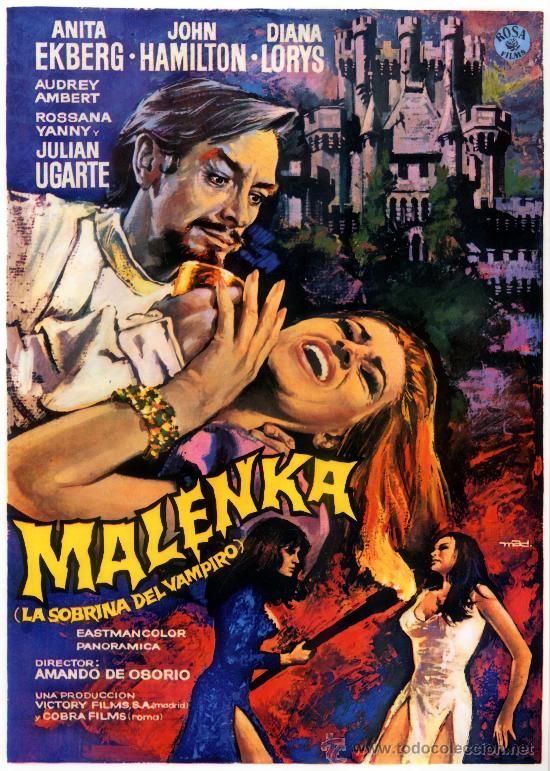
1969 brought us today's piece of European Horror Schlock. Fangs of the Living Dead AKA Malenka AKA Malenka, the Vampire's Niece AKA Malenka: La Nipote del Vampiro AKA Malenka: la Sobrina del Vampiro AKA The Vampire Girl. Yeah.

This one's going to have SPOILERS because there's not much else to discuss.

It was an Italian-Spanish co-production that tapped into the then-popular horror plot of “Young(ish) person inherits an old, spooky castle in a town of weirdos and travels there, encountering HORRORS” much like in Horror Rises From the Tomb.

Here, we are introduced to Sylvia Morel, played by Swedish model and actress Anita Ekberg. Sylvia has no job or background to really speak of, but she receives a letter from an uncle that she's inherited the family estate in Walbrooke (which is in some vaguely Carpathain region). She decides to go there and fill out the necessary paperwork two weeks before her wedding to Dr. Piero Luciani (played by Gianni Medici as “John Hamilton”). He's not thrilled about the idea, but their mutual friend and incredibly Italian comic relief sidekick Max (César Benet as “Guy Roberts”) sees no harm in it.

Sylvia arrives in Walbrooke, stops for a drink in a local tavern run by sisters Bertha (Diana Lorys) and Freya (the strong-jawed Rosanna Yanni, who was also a producer of the film). We get hints that Bertha is ill with anemia before the Count's coachman and goon, Vladis (Fernando Bilbao) arrives to drive her to the castle.

At the Castle, Sylvia learns that her uncle, the Count Walbrooke (Julián Ugarte), is a weird recluse with perfect hair and an obsession with Sylvia's grandmother Malenka, who looked just like Sylvia and was played by Ekberg in an overly long flashback sequence. Sylvia also meets Blinka (Adriana Ambesi as “Audrey Ambert”), who lives in the castle, dresses in lingerie, and gives off a rapey vibe when she tries to sweet talk Sylvia into leaving her room. The Count drags Blinka out of Sylvia's room and starts whipping her in the dungeon, where its revealed to Sylvia that Blinka is a vampire. And so is the Count.

The Count wants Sylvia to call off the wedding because “Something Something Family Curse,” and he starts manipulating her to try and turn her into a vampire.

Piero & Max arrive to find out what's going on and they speak with the innkeepers. Bertha is in some kind of relationship with the Count and dies the next day from bite wounds. She rises from the grave, and it all comes down to a climactic showdown in the castle's dungeon where the Count chains a shirtless Piero to a cross and explains that he's trying to drive Sylvia into thinking she's a vampire so she can be declared insane and the Count can then claim the inheritance. Then Blinka and Bertha get into a catfight, which buys Sylvia (who had been pretending to be under the Count's power) enough time to free Piero, who then does the unheroic thing of stabbing the Count with a flaming torch, which then prompts the Count to age rapidly into a papier-mâché skeleton, which then burns up in a pretty decent scene.

Its my understanding that there are two endings to the film. The first, follows the “hoax” plot to its conclusion, and the shorter one for American audiences, which features the burning vampire skeleton. Not having seen the first ending, I still prefer the idea of vampires trying to run an inheritance fraud scheme, mainly because its more original. “Supernatural Goings-On Were All A Hoax To Drive Someone Insane For Money” is a much more cliché plot twist than people realize. 

So what's good about it? Honestly, not a whole lot. There are some fantastic and atmospheric shots, usually in the castle crypt, and the twist of “inheritance fraud vampires” is wonderfully goofy. Other than that, the movie is ill-paced with frequently bad acting, especially during reactions to scares. The biggest star of the film, Anita Ekberg, was a major beauty icon in the 50s and early 60s, even having a major role in Fellini's La Dolce Vita, but there's little allure in a middle-aged sex symbol playing a character that feels written like they're in their early twenties.

Not recommended. 


Wednesday, August 16, 2017

Pulp Review: Black God's Kiss


Its such a common narrative among modernist Sci-Fi/Fantasy pundits to say that the genre was always a boys' club and that women are only now assuming their rightful place at the top of the field. (There's probably an io9 article about the subject right now.)

This is bullshit because it erases women who were writing at the top of their game to great commercial and critical success almost a hundred years ago. Catherine Lucille “C. L.” Moore being among the best and brightest of that group.

An Indiana native, Moore made her first professional sale to Weird Tales in 1933. In 1934, she made the cover story of Weird Tales' October issue with Black God's Kiss. It's weird.

Jirel is the tall, fiery, red-headed, yellow-eyed warrior commander of Joiry, a castle somewhere in France that has just been captured by the arrogant and dashing Guillaume. He takes something of a fancy to her spirited defense of the castle and cavalierly kisses her.

Imprisoned and seething with wounded pride and rage, she escapes her cell and with the help of Father Gervase, she sneaks into a dark, forbidden part of Joiry Castle where a dark tunnel will lead her to a dark place where she might find the means of her revenge.

Gervase's pleas fall on deaf ears. Jirel will have her revenge, even at the cost of her soul, and she descends into a bizarre Hell that isn't like the kind described in Dante.


It would be a crime to spoil what follows, but it entails physical peril, moral peril, spiritual peril, and some very difficult decisions and repercussions.

Jirel is an incredible female heroine: strong and flawed, skilled in battle but with so much growing up left to do. Her battle prowess isn't what can help her, though, and she must use her judgment to reach the end of the story, which arguably moves it away from Sword & Sorcery (where cutting a bloody swath through one's enemies is de rigueur) to the kind of weirdness that marked the beginning of Merritt's The Moon Pool. There's no mistaking that Moore is a female author, though, and her perspective adds another layer to the experiences of young Jirel that wouldn't be found in Robert E. Howard's work.

Less action-packed and more weirdness & wonder, Black God's Kiss is an incredible introduction to an incredible character written by a Grandmaster of the genre who is leagues better than the modern SF/F writers (male or female) who've forgotten her legacy. She stands shoulder to shoulder with Burroughs, Merritt and Howard and deserves to be a household name.

Respect due.

Essential Reading.

Friday, August 11, 2017

Pulp Review: The Horror Stories of Robert E. Howard (pt 1)


The poetically unimaginative but accurately titled The Horror Stories of Robert E. Howard is a book of short fiction from 2008 that collects a massive number of short stories from arguably the best writer of the Pulp Era. 

I've been reading the collection on and off for several months now, and while there's a very good reason why Conan is Howard's most enduring creation, this book provides an excellent survey that hammers home just how damn good he was as a writer.

Some of the stories are better than others, with some I would call essential fantasy reading, but there isn't a single one I would say is “bad.” The theme being horror, that's what you end up with: spooky tales, the genesis of the Weird West genre, monster hunters, and eldritch abomination slayers. Action and imagination are the cornerstones of Howard, and every single genre he puts his hand to spins something enjoyable.

Rather than dwelling on a single story, I'll review them in smaller chunks because while they've all been enjoyable, some have more meat on their bones than others.

In the Forest of Villefère (Weird Tales, August 1925)
A traveler named de Montour is passing through a forest on the way to the village of Villefère. He meets a fellow traveler, Carolus le Loup. With a name like that, he's obviously a werewolf and attacks de Montour when the moon rises. A slight tale, but atmospheric with explosive action at the end.

Wolfshead (Weird Tales, April 1926)
The sequel to the above story, this time a new narrator travels to Africa and the fortress of one Dom Vincente da Lusto, a trader and slaver who has carved himself a small empire there. Among the guests there is de Montour, who is himself a werewolf now and tries to lock himself away from others when the moon rises, but of course that doesn't work 100% and a couple people in the castle start dying. Then one of Vincente's courtiers starts a slave revolt as a power play against him and it ends in some literal explosive action. The slavery issue (which makes sense given that its set during the Age of Sail, also Dom Vincente isn't a very good man in the first place) will be a turnoff for some but the action is top notch and an early example of a “heroic werewolf” in fiction. De Montour's desire to lock himself away during the full moon notably prefigures Larry Talbot from the Wolfman movies.

The Dream Snake (Weird Tales, February 1928)
On a warm summer night down South, an old man named Faming explains his horrific dreams of being hunted by a gigantic snake. Every night its the same dream, only the snake gets closer. A short and simple creepy tale.

Sea Curse (Weird Tales, May 1928)
Now we're getting somewhere. The first of the “Faring Town” stories about a small coastal town that suffers from weird incidents. This is about two drunken scoundrels and pirates named John Kulrek and Lie-lip Canool. Kulrek did wrong by one of the girls of the village, and when she died at sea, her old mother, Moll Farrell, places a curse on the two. I'll say no more, since the payoff is fantastic.


Tuesday, June 06, 2017

My music is for Phoenix. Only she can sing it. Anyone else who tries, dies!


Phantom of the Paradise is a 1974 camp horror/fantasy/comedy/penny dreadful rock opera by a young Brian De Palma who was just getting off the ground. His big breakout film, Carrie, would come two years later in 1976 and the rest is history, as they say.

The movie's nuts. Winslow Leach (William Finley) is a sensitive singer/songwriter type common in the 70s, and is working on a concept cantata adaptation of Faust. He tries to approach Swan (Paul Williams), the mysterious producer who runs Death Records and the biggest name in the music biz. Swan wants to open up a concert hall called The Paradise and Winslow wants to get signed.

Well, Swan likes the song but not Winslow, so he has his assistant Arnold Philbin (George Memmoli) feed him a line about signing him and steals the song, which Winslow believes for a while, but after hearing dead silence for a month, returns to see what's happening and finds a bunch of women auditioning to sing the song he wrote. One of them, Phoneix (Jessica Harper), catches his eye and they have a moment, but Winslow is thrown out (multiple times) and Swan has him put away for life on trumped up charges.

After a rough time, Winslow escapes, smashes up Death Records a bit and disappears after an accident involving a record press, presumed dead. Then musicians start ending up dead, killed by a grotesque, deformed Phantom who haunts the Paradise. Swan, though, is more than he seems, and has sinister plans for the Phantom and Phoenix.

Oh yeah, and there's a crazy Glam rocker named Beef (Gerrit Graham) who's in the movie for a short while but steals every scene he's in.


Visually, the movie is a technicolor-soaked acid trip with plenty of surrealistic camera tricks that often work to unsettle you. If you haven't noticed from the character names above, we're in Allegory Town, and not reality, so the more stylized the world becomes the better.

More than that, the look of the Phantom himself is fantastic. Tight black leather, cape, black lipstick, metal teeth, electric voice box on his chest, obvious scarring on half of his face and bizarre mask that's either creepy or goofy depending on the angle. He's like Darth Vader's Gothic rock opera cousin, only three years before Star Wars.

The acting goes full ham, or, Beef, as the case may be. Beef is a prancing, pill-popping glam prima donna who still manages to be one of the most sympathetic characters. He's a head case who's in over his head at the Paradise, but largely innocent.

Phoenix is probably the most grounded character, which makes sense as the plot pivots around her (whether she knows it or not). She just wants to sing and be famous, and her willingness to do anything for that goal helps escalate things.

Winslow/The Phantom starts off as a nice guy goofball who wants to be famous but isn't sure how to break into the industry. He gets taken for a ride and his work is stolen (not uncommon, if you know anything about the early music industry) and he flips out. As Winslow, Finley plays him a bit close to being too over the top to be sympathetic, while as the Phantom he dials it up even further, which makes him more sympathetic. Weird, maybe, but it works really well.

Swan's the most fascinating character, and largely because of Paul Williams. Williams was/is a very successful songwriter who penned a large number of 60s-70s hits, songs for films, and frequent acting roles. You might recognize him as Little Enos in Smokey and the Bandit or the voice of the Penguin from Batman: The Animated Series.

Swan's riveting because his voice is smooth, his demeanor is calm, and he's got an unassuming baby face that gives him a youthful innocence. Which juxtaposes perfectly with how much of a manipulative asshole he is. Swan's evil. Unquestionably, unrepentantly evil. And he revels in it, which is itself a joy to watch.

Williams ends up being the cornerstone of the movie, writing the songs for the soundtrack as well. They're unified by themes of dying for art and selling one's soul for fame, from the doo-wop style teen tragedy song that opens the film right on through to the haunting “The Hell of It” that rolls over the end credits.


Those same themes carry through the script, written by Brian De Palma and an uncredited Louisa Rose, and it also draws heavily from classic horror. Faust being the most obvious, of course, but also The Phantom of the Opera, Frankenstein, PsychoThe Cabinet of Dr. Caligari and The Picture of Dorian Gray. If you're going to steal ideas, might as well go whole hog. It works well here and the movie never bogs down like, say The Rocky Horror Picture Show (which was released a year later in 1975).

It is, I would say, a much, much better movie than Rocky Horror, but that's subjective taste speaking. I think the songs are better, the characters better defined, the conflict more interesting, and the underlying themes tapping into a more mythic vein. Its been years since I've seen Rocky Horror, but once I got past the “wow, Tim Curry in fishnets is shocking and outrageous” it was a vast stretch of “wow, this is really boring.”

Is there Action? A modest amount, but its all practical effects and explosions, which is nice.

Adventure? Not really. The Paradise is a bubble of Swan's ego, but its in America.

Romance? Quite a bit, but twisted. Winslow's love is what keeps him going once mere revenge is out of the question.

Ideals? This is more of a cautionary penny dreadful tale, but yes. Despite being an unhinged murderer, Winslow ends up fighting for something other than himself.

Mystery? Not a whole lot. The plot is fairly straightforward.

Wonder? Not immediately apparent, but the supernatural abounds and the Faust connections are more than just symbolic.

Phantom of the Paradise is too classy for grindhouse, too weird for mainstream and too good for “cult” movie status. Totally recommended. 


Monday, March 27, 2017

“Even the children threw rocks at me.”


Horror Rises From the Tomb, also known in its original Spanish as El espanto surge de la tumba, is a 1973 eurotrash horror movie. I knew nothing about this going in, which should be fun, I guess?

An Hour and Twenty Minutes Later

Fun” may have been an overstatement. “Curious” might be a better word. “Heavily edited for television to get the juicy bits out” would be several better words.

For a bit of context, the name Paul Naschy looms large in Spanish horror history. Born Jacinto Molina Alvarez, Naschy (a screen name he came up with to better market his films internationally) was a big fan of classic horror films and eventually turned to screenwriting and acting and eventually directing. Incredibly prolific, especially in the 70s, he performed in over a hundred projects, including 12 werewolf movies where he played a tortured soul named Waldemar Daninsky, before his death in 2009 at the age of 75.

Here, Naschy plays three roles in a script he wrote under his real name. The first is Armand de Marnac, a 15th century nobleman who executes his wicked warlock brother Alaric de Marnac (also Naschy). In Ye Olde Times, Alaric was accused and convicted of a litany of horrible and supernatural crimes that made him a Satanist, warlock, werewolf and vampire all at the same time. He had a lover, Mabille de Lancre (played by Helga Line) who was more of a vampire herself, but no less evil. Before their deaths, the two cursed Armand that they will come back and take revenge on his descendants.

Fast forward to modern times (well...1973 Modern, at least). Hugo de Marnac (also Naschy) is a professional bored aristocrat with a bunch of boring and kind of dumb friends. The first is Maurice Roland, descendant of Armand's friend Andre Roland (both played by Victor Alcazar). Maurice is an artist haunted by dreams of a pair of sinister eyes. Maurice is also dating Paula (played by Cristina Suriani), a journalist stationed in Germany home on vacation. Hugo himself is in a one-sided relationship with Sylvia (played by Betsabe Ruiz). Sylvia wants Hugo to settle down and marry her, but Hugo's ambivalent about that.

At a party they all decide to take part in a séance, where the ghost of Alaric messes with the medium, table, and a candlestick to get across the point that he can't rest until his head is reunited with his body. Intrigued by the thought of treasure buried on the property, they all go to the de Marnac estate to look for it out of idle curiosity.

Along the way they get attacked by thieves who are in turn killed by some shifty village vigilantes, reach the estate, find a conveniently head-sized chest, and the spirit of Alaric de Marnac starts possessing people and killing them and its a whole thing as he works towards getting his head reattached to its body and resurrecting his bloodthirsty consort Mabille.

Oh, and we also meet Elvira (played by Emma Cohen). She's the daughter of the caretaker Gastone and sister of Chantal, and the childhood friend/lover of Hugo. And his affection for her is why he hasn't committed to Sylvia.

Anyway, people get killed by sickles, people get possessed one by one and disappear, and there's an interlude where a bunch of people killed over the course of the movie who were dumped into a lake get revived as zombies that unsuccessfully try to capture/kill Hugo and Elvira. Then it reaches a bloody but somewhat standard climactic fight.

The movie was directed by Carlos Aured, and despite being a quickly-produced, low-budget horror, has some nice visual touches. The medieval opening is cold and moody, and the claustrophobic atmosphere of the rest of the movie is well executed despite taking place in a reasonably large estate. The makeup effects are serviceable for the zombies and tricks like teleportation and Mabille's resurrection are achieved with simple editing tricks in a low-budget but somewhat respectable way. Its cheap, but at least an effort was made to overcome budget limitations.

This is, however, a heavily edited version of the film that removed all of the nudity and most of the goriest elements, presumably so it could be suitable for broadcast on American television. The downside is that it makes an already slow burn downright boring for long stretches, since all that's left is people trying to figure out what's going on and making stupid decisions that get them killed in poorly edited ways. A better cut exists, without the editing hack job and with better visual and sound quality, but I can only review what I've seen.

And what I've seen is a ponderous, frequently dull movie with characters that have to act stupid in order for the already thin plot to happen. The script isn't great and steals heavily from vampire, witchcraft and werewolf movies and combines them all into a duo of villains who are quite overpowered except for some very specific weaknesses. Except instead of a holy crucifix driving back the vampire, its an amulet with “Thor's Hammers” on it that can undo the evil warlock's magic.

There are flashes of entertainment, such as Naschy's scenery chewing stare as Alaric de Marnac (a character he would revisit in a later movie) and the atmosphere is often successfully creepy with a few noteworthy setpieces near the end, but man is it a boring journey most of the way. The complete version is probably better, but I'm in no hurry to see it.


Not recommended. 

Saturday, February 18, 2017

Pulp Revolution Review: Nethereal


Nethereal is the 2015 debut novel by Brian Niemeier, and it is one hell of a page turner.

First, some ethical disclosure: the author and I follow each other on Twitter, I am a frequent listener to a podcast that he co-hosts, and we are both part of the current Superversive and Pulp Revolution movements taking place within Sci-Fi/Fantasy. So there is absolutely a level of personal bias to this review that I want you to be aware of.

Now to business. Nethereal is the first book of the Soul Cycle, which is a Weird Space Opera/Horror setting. Now, by Weird, I mean WEIRD. Traditional physics have no place here and a combination of super science and magic are what propel space travel, which is under the monopolistic control of the Guild. Thrown into this is the pirate frigate Shibboleth, captained by Jaren Peregrine, the halfbreed last survivor of the Gen race (effectively Space Elves) hell-bent on revenge for the Guild's genocide of his people. He has two steersmen (magician/pilots): Nakvin, a beautiful, half-human woman with mysterious origins and Deim, a devoutly religious young man who's family has been helping Peregrine's for several generations. And there is Teg Cross, mercenary sociopath and Jeren's combat enforcer.

Misfortune leads them to a revolutionary group building a massive and unnerving exploration ship called the Exodus, which further misfortune causes it to travel to Hell during its maiden voyage.

Yes, actual Hell (at least Hell as described by Gen theology).

Then it gets weirder.

That's all I want to say about the plot, because a) I want to avoid spoilers and b) I could be here all day trying to explain what happens, there's so much of it.

I simply trying to explain what the book is is less effective than explaining what it is like. It is like Dune meets Firefly meets Outlaw Star meets Lovecraft meets Spelljammer meets Moby Dick meets the Inferno. It draws from a tremendous variety of influences and in doing so defies genre classification, though “Space Opera Horror” might be the closest you can get.

Despite the disparate influences (or maybe because of them), the setting is one of the strongest selling points for the book, and its is incredibly thought-out. The action escalates to grandiosity, and the villains rise to match the scale.

Its not a perfect book, though a lot of my criticisms are nitpicks and entirely subjective. Scene transitions sometimes feel rushed or lacking in cohesion. The prose is straightforward but feels like it lacks a little something to make it quotable. The same is true for the dialogue. They get the job done, but its not on the level of a master like Bradbury's narration or Herbert's quotability.


That doesn't mean that Neimeier can't get there. Nethereal is a very strong, imaginative debut propelled by a confident enthusiasm for its subject matter. Absolutely recommended, though the intentional weirdness won't be for everybody. Amazon's your best place to find it. 

Monday, October 03, 2016

"I am Torgo. I take care of the place while the Master is away."


So yes, Manos: The Hands of Fate is an infamous little movie from 1966 that is often mentioned in conversations about the "Worst Movie Ever Made." While I don't think its the actual worst movie ever made (that's a matter of personal taste), it is a colossal turkey that earns its reputation.

Written, produced, directed and starring Harold P. Warren, an insurance and fertilizer salesman from El Paso, Texas, the movie was famously made on a bet with a Hollywood location scout named Stirling Silliphant, who would himself go on to great acclaim as the screenwriter of such classics as In the Heat of the Night, The Towering Inferno, The Poseidon Adventure, and, uh, Over the Top. The bet was that Warren could complete a low budget horror film on his own.

After a tumultuous production and failing miserably in the Southwest, the film languished in obscurity until the famous MST3K episode aired in 1993. After that, it turned into a Z-movie icon, eventually spawning a mobile game, a blu ray digital remaster, and a successful crowdfunded project for Manos Returns, which is due some time this year if IMDB is correct. Much like Troll 2, its not exactly obscure anymore, but that doesn't change the fact that its still awful.

What's it about? 

After eight minutes of driving around the El Paso countryside, a family on vacation get lost looking for Valley Lodge. The father, Mike, is played by Hal P. Warren himself. The mom is Margaret, played by Diane Mahree, who would later find success in fashion modeling, and their daughter, Debbie, played by Jackey Neyman, but dubbed into incomprehensibility. They stop at a house that “wasn't there before” first to ask for directions, then for lodging as night approaches. The caretaker is a twitchy and awkward man with strange knees (whether he was supposed to be a satyr or “like a hunchback, only hunchknees” seems a bit ambiguous, since I've seen both reported. Doesn't really matter, anyway.) He's named Torgo, and played by John Reynolds, a troubled young man who was apparently on LSD during filming and committed suicide at the age of 25 a month before the movie was released to theaters. 

So that's depressing.

Torgo's weird as hell, speaking in halting sentences and stumbling around with his own theme song. He takes care of the place while the Master is away, and while reluctant to allow the family to stay, he lusts for Margaret.

The Master is played by Tom Neyman, and is the leader of a mysterious and vague cult of possibly immortal, possibly undead people. He worships an abyssal being of primordial darkness named Manos that has a hand motif, and his cult centers their worship around a macabre bonfire where they sit, talk, argue, and eventually get into a catfight around. Essentially the Dark Souls of movies.

I'm only half joking. The similarities might be purely coincidental, but they are striking.

Tom Neyman is essentially the unsung hero of this movie. In addition to being the villain, his daughter played Debbie, his dog played the devil dog, he helped make Torgo's knees, built some of the props and his wife designed most of the costumes. He also gives the best performance of the movie, for what its worth.

I've noticed that in the best worst movies made, there's always some person with talent that is applying genuine effort to elevate the movie above its massive failings. Here, its clearly Neyman who gave it his best effort.


So what doesn't work? Saying “Everything” is a cop out, and also untrue. The editing is bad, with long and short cuts jumping around the place and long stretches of boredom that help drag its run time over 60 minutes. The cinematography is bad, with mostly dull scene composition, flat interior lighting and absolutely horrible exterior night lighting. There's the occasional flash of an interesting shot, but it passes just as quickly as it arrived. The acting is bad, with flat deliveries of dull dialogue. The female characters have it worse, with weird delays in their reactions and awkward expressions and just generally weird timing issues with their delivery. The audio itself was bad, and every sound, including dialogue, was added in post production, with voice recording occasionally being drowned out by sound effects. The smooth jazz soundtrack also doesn't fit the tone of a legitimate horror movie at all, with its flutes and saxophones and pianos.

So what's good about it? Or at least “good” with air quotes?

Torgo has become such an iconic character because he's so damn weird. He's a filthy creepy pervert that peeps through windows, yet he's the most sympathetic character because its obvious he's an unwilling servant of the Master who's fed up with being treated like dirt for a very long time.

The Master himself chews the scenery and glowers like a madman. There's even a kernel of a moody, mysterious horror film buried at the core (brigadoon house, strange cult, creepy caretaker, supernatural goings-on, etc), but the execution is so un-salvageable that it adds to the boredom and, oddly, its bizarro charm.

Like so many of its Z-level kin, Manos: The Hands of Fate ends up being a trainwreck that is simultaneously boring and utterly surreal.


Do I recommend it? As a movie that fulfills the basic requirements of entertainment, no, HELL NO. For the certain masochistic subset that has conditioned itself to find joy in weird cinematic failures this is absolutely essential, like a rite of passage. 


Monday, July 18, 2016

“Do not compare me to the Jaws mayor!”


Full disclosure: I was deeply skeptical of the new Ghostbusters movie. The controversy, the trailers, the leaked plot rumors (that turned out to be true), the previous failed attempts to get Ghostbusters 3 off the ground where Bill Murray allegedly shredded up a script and mailed it back to Dan Aykroyd. So for at least ten years, the story behind making a new Ghostbusters has been a shitshow, and before that, a pipe dream. The last time I actually wanted to see a new real, live Ghostbusters movie was in high school computer class back in 2001. I went into this skeptical but hopeful that it would surprise me.

So why am I writing a review of a movie I didn't really want to see for 15 years?

I had to know.

Not for the controversy, not because somebody else recommended it. I had to know for myself.

Now I know.

Its a giant piece of dogshit that has nothing to do with who has what kind of chromosomes.

First the setup. Have you ever seen Ghostbusters? It follows the major story beats without taking much time to set things up because this isn't a reboot of Ghostbusters. It's a remake. For the uninitiated: some academics have crazy ideas about researching the paranormal. They get kicked out by the faculty for being crackpots. They go into business for themselves, hire a secretary, investigate paranormal occurrences, have some rocky starts, build technology to catch ghosts, hire a new employee, successfully capture a ghost, attract the attention of a cranky mayor, then find themselves the only thing that can stop a giant supernatural threat that could destroy the city of New York.

All that's missing is the humor, the scares, the buildup of a credible supernatural threat, chemistry between the leads, character development that sticks, humor, any kind of made-up rules for how you could use technology to capture ghosts, any kind of a love interest plot that goes anywhere, quotable lines, and humor.

But it does have poop jokes. And fart jokes. And it steals a gag from Young Frankenstein. Oh, and there's a queef joke. And a pointless cameo from Ozzy Osbourne. And its got Bill Murray in a cameo where he looks dead inside.

And it devolves into a 20 minute action sequence at the end with fight choreography and goofy weapons and shooting the physical manifestation of their logo in the dick.

Our four leads are Erin Gilbert played by Kristen Wiig, who was once big into paranormal investigation but left it behind to become a real scientist and then loses her tenure track when she reunites with her old collaborator/friend and flips out after almost catching a ghost and her supervisor fires her. You would think that would lead to conflict between the two, and in a good script it would. Anyway, aside from playing the straight face of the group, she just fades into the background in most scenes. Except when she accidentally kills a man by releasing the only ghost they've managed to catch and it throws him out a window to prove to him that ghosts exist. See, its funny because its Bill Murray's cameo.

Yeah, that was a spoiler. I'm not sorry.

Next is Abbey Yates, played by Melissa McCarthy, who babbles incessantly. That's it. No realizing she accidentally ruined her friend's academic career, no self-awareness, no character development at all.

Abby has partnered up with Jillian Holtzmann, played by Kate McKinnon. Her only purpose in the plot is to be a mad scientist type who creates anti-ghost weaponry and rattles off techno-jargon. So to fill time, she mugs for the camera because there's nothing else to work with. She's one “Freunlaven” away from turning into Mr. Director from Animaniacs.

And last is Patty Tolan, played by Leslie Jones. She's an MTA employee with an encyclopedic knowledge of the weird side of New York and the connections to get a vehicle for the team. She's useful, resourceful, tough, and, remarkably enough, the most believable, fleshed out and likable character in the entire movie and actually has a character arc where she grows from when she's introduced. The movie might even have been better if it was just Patty and Holtz getting into crazy shenanigans. 

They hire Kevin Beckman, played by Chris Hemsworth. Kevin's a narcissistic, airheaded idiot who is miraculously still alive, but he's pretty and Erin has an immediate crush on him, so he's hired. He gets close to some genuine comedy because the character's such an oddball.

There's Rowan North played by Neil Casey, who's the villain. He's creepy and wants to usher in the Fourth Cataclysm (whatever that is) because he's...been bullied all his life? Its stupid and then he kills himself and turns into a ghost that can possess people and then he turns into a terrible CGI version of the Ghostbusters Logo and gets shot in the ghost crotch before being sucked into a portal.

Oh, and there's Andy Garcia as the mayor of New York who knows about ghosts and the supernatural, but helps the Feds clamp down on it to prevent panic. I only mention him because its Andy Garcia and he gets the only line that got a chuckle out of me (which is the quote I used above).

So to sum up what's good about this remake? Leslie Jones and some of the ghost effects. Annie Potts and Ernie Hudson both had good cameos. I had hoped that the controversy surrounding this movie would have at least been a lot of noise about an average movie with a few yuks. The script is terrible, the chemistry between the leads is absent, and there's absolutely zero weight to anything going on in this movie.

Instead, it commits the two biggest sins of comedy: Its boring, and its not funny.


The Star Wars Holiday Special of Ghostbusters.  

Avoid it if you can.