Blacula. This little 1972
Blaxploitation horror movie has quite a reputation for its name
alone. Black Dracula, essentially. Directed by William Crain, a black
director with a few other Blaxploitation movies to his credit, along
with several tv shows, including some episodes of The Dukes of
Hazzard, and with a screenplay
written by Joan Torres and Raymond Koenig, the movie starts out
strong.
Campy,
but strong.
In
1780, Prince Mamuwalde (William Marshall, the Future King of Cartoons
on Pee-Wee's Playhouse)
and his wife Luva (Vonetta McGee) are on a diplomatic tour of Europe
and end up in Transylvania. Count Dracula (Charles Macaulay)
patronizes them and constantly needles the prince about race until
Mamuwalde tries to leave, and Dracula captures him, turns him into a
vampire, and buries him in a coffin in his castle because Dracula is
an asshole. Oh yeah, and Dracula dubs Mamuwalde “Blacula.”
Because
Dracula's an asshole.
Fast
forward to the 70s and an interracial gay couple of interior
decorators buy up a bunch of stuff in Dracula's castle, including
Mamuwalde's coffin. They're goofy, and definitely campy, but they're
also innocent of what's about to happen, so there's definitely
sympathy for them when they inadvertently ship Blacula to Los Angeles
and awaken him and get killed.
After
that, it slows down pretty hard. A doctor, Gordon Thomas (Thalmus
Rasulala) begins investigating the deaths and turns into this movie's
Abraham Van Helsing. Meanwhile, Mamuwalde runs into Tina (Vonetta
McGee again) who's a dead ringer for his long-lost love and he chases
her, getting run over by a taxi, and exsanguinating the sassy black
cabbie lady as consolation.
Then
it turns into a slow build of Dr. Thomas figuring out Mamuwalde is
Blacula, and his allies trying to save Tina and stop a vampire
outbreak across the city. There's a fun scene of a photographer
developing a photo of Mamuwalde that he doesn't show up in (before
she gets eaten by Blacula, of course), the vampire Cabbie waking up
in the hospital and charging down character actor Elisha Cook Jr
(from The Maltese Falcon)
that's actually kind of spooky, some vampires in cheap capes get
thrown into cardboard boxes, and a bunch of extras dressed like
motorcycle cops get killed.
There's
really not a whole lot to the movie, actually. It borrows heavily
from the classic Bela Lugosi Dracula
plot while throwing in the love story angle from Boris Karloff's The
Mummy. That's fine, its just
very pedestrian. The cast is fine, the effects are low budget, and it
would be rather forgettable if not for one thing: William Marshall.
Marshall
anchors and elevates the movie above its shortcomings by bringing a
sense of tragic gravitas to the character. His rumbling bass voice
helps too, along with his Shakespearean background. He's more
sympathetic than Dracula traditionally is, and despite running
rampant across LA for several nights, his death at the end of the
movie is handled with a lot of dignity. After he is denied love one
last time, he chooses to walk out into the morning sunlight. Marshall
makes a scene where he walks up a flight of stairs and falls over
dead into something not goofy. That's some real talent there.
Blacula
occupies a kind of middle ground of averageness in the Blaxploitation
genre. Its inoffensive, competent enough and mostly forgettable. I
do, however, recommend it for William Marshall's performance as
Mamuwalde. That's worth seeing.
After
a long absence, the Octoverride is back, though I can't promise it
won't be nothing but wall-to-wall schlock this year.
1969
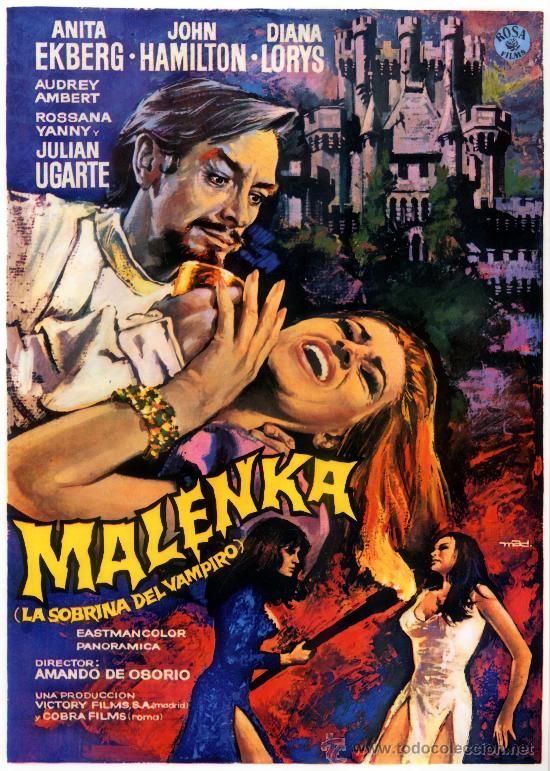
brought us today's piece of European Horror Schlock. Fangs
of the Living DeadAKA MalenkaAKA Malenka,
the Vampire's NieceAKA Malenka:
La Nipote del Vampiro AKAMalenka:
la Sobrina del Vampiro AKAThe
Vampire Girl.
Yeah.
This
one's going to have SPOILERS because there's not much else to
discuss.
It
was an Italian-Spanish co-production that tapped into the
then-popular horror plot of “Young(ish) person inherits an old,
spooky castle in a town of weirdos and travels there, encountering
HORRORS” much like in Horror Rises From the Tomb.
Here,
we are introduced to Sylvia Morel, played by Swedish model and
actress Anita Ekberg. Sylvia has no job or background to really speak
of, but she receives a letter from an uncle that she's inherited the
family estate in Walbrooke (which is in some vaguely Carpathain
region). She decides to go there and fill out the necessary paperwork
two weeks before her wedding to Dr. Piero Luciani (played by Gianni
Medici as “John Hamilton”). He's not thrilled about the idea, but
their mutual friend and incredibly Italian comic relief sidekick Max
(César Benetas
“Guy Roberts”) sees no harm in it.
Sylvia
arrives in Walbrooke, stops for a drink in a local tavern run by
sisters Bertha (Diana Lorys) and Freya (the strong-jawed Rosanna
Yanni, who was also a producer of the film). We get hints that Bertha
is ill with anemia before the Count's coachman and goon, Vladis
(Fernando Bilbao) arrives to drive her to the castle.
At
the Castle, Sylvia learns that her uncle, the Count Walbrooke (Julián
Ugarte), is a weird recluse with perfect hair and an obsession with
Sylvia's grandmother Malenka, who looked just like Sylvia and was
played by Ekberg in an overly long flashback sequence. Sylvia also
meets Blinka (Adriana Ambesi as “Audrey Ambert”), who lives in
the castle, dresses in lingerie, and gives off a rapey vibe when she
tries to sweet talk Sylvia into leaving her room. The Count drags
Blinka out of Sylvia's room and starts whipping her in the dungeon,
where its revealed to Sylvia that Blinka is a vampire. And so is the
Count.
The
Count wants Sylvia to call off the wedding because “Something
Something Family Curse,” and he starts manipulating her to try and
turn her into a vampire.
Piero
& Max arrive to find out what's going on and they speak with
the innkeepers. Bertha is in some kind of relationship with the Count
and dies the next day from bite wounds. She rises from the grave, and
it all comes down to a climactic showdown in the castle's dungeon
where the Count chains a shirtless Piero to a cross and explains that
he's trying to drive Sylvia into thinking she's a vampire so she can
be declared insane and the Count can then claim the inheritance. Then
Blinka and Bertha get into a catfight, which buys Sylvia (who had
been pretending to be under the Count's power) enough time to free
Piero, who then does the unheroic thing of stabbing the Count with a
flaming torch, which then prompts the Count to age rapidly into a
papier-mâché skeleton, which then burns up in a pretty decent
scene.
Its
my understanding that there are two endings to the film. The first,
follows the “hoax” plot to its conclusion, and the shorter one
for American audiences, which features the burning vampire skeleton.
Not having seen the first ending, I still prefer the idea of vampires
trying to run an inheritance fraud scheme, mainly because its more
original. “Supernatural Goings-On Were All A Hoax To Drive Someone
Insane For Money” is a much more cliché plot twist than people realize.
So
what's good about it? Honestly, not a whole lot. There are some
fantastic and atmospheric shots, usually in the castle crypt, and the
twist of “inheritance fraud vampires” is wonderfully goofy. Other
than that, the movie is ill-paced with frequently bad acting,
especially during reactions to scares. The biggest star of the film,
Anita Ekberg, was a major beauty icon in the 50s and early 60s, even
having a major role in Fellini's La
Dolce Vita,
but there's little allure in a middle-aged sex symbol playing a
character that feels written like they're in their early twenties.
And so I'm back from outer space, and
you can tell by that sad look upon my face that you should've changed
that stupid lock and thrown away the—No. Wait. That's not right.
Where was I?
Oh yes. Jesus Christ Vampire Hunter.
It's like a 1980s Troma movie, but shot on 1970s film stock, except
shot in the late 1990s in Ottawa, Ontario, and starring a few women
who look like Suicide Girls.
This
movie is WEIRD and
DUMB. But is it the
good kind of Weird and Dumb?
Story
Stop
me if you've heard this before, but a bunch of vampires, led by
Maxine Schreck (Murielle Varhelyi), Johnny Golgotha (Ian Driscoll)
and Dr. Praetorious (Josh Grace), are killing and harvesting Canadian
lesbians, so that they can wear their skin to gain immunity to
sunlight. The only thing standing in their way? Savior of mankind and
martial arts master Jesus of Nazareth (Phil Caracas) joined by his
allies Mary Magnum (Maria Moulton) and silver-masked Mexican wrestler
Santos Enmascardo de Plata (Jeff Moffet, and a nod to the actual El
Santo luchador/movie star/vampire fighter)
Visuals
This
was director Lee Demarbre's first feature length film, and it is
extremely aware of its own amateurishness. I don't just mean the film
quality. That's actually in its favor, since it really does remind me
of 70s and 80s B-movies where the night scenes are poorly lit and the
editing isn't quite as tight as it should be. The self-awareness
expresses itself in the fight scenes, which are obviously not done by
professional stunt people, but make up for it in goofiness. Jesus
fights some vampires on the beach. Jesus fights a clown car's worth
of Atheists in a public park who just showed up to pick a fight with
him for no reason. Jesus & Santos kill a bar full of vampires
with drumsticks, crutches, toothpicks and other improvised stakes.
Dr. Praetorious (another nod to old cinema) fights Jesus by
improvising organs as weapons.
Negatively,
the pacing of the movie is rather awful. It's only 85 minutes long
but so many scenes drag on much longer than necessary, particularly
the “Jesus shops at a thrift store for hip new clothes” scene
that wears out the gag really, really fast. The fight in the park
with the atheists I mentioned? Completely irrelevant to the plot. The
“Jesus Signal” scene transition? That gets old too.
Writing
Like
the directing, there's a lot of hit and miss in Ian Driscoll's
script. Some of the elements are great, and really show a deep love
for genre films of the past. The whole presence of Santos is really
funny, and not just because “haha, here's a luchador.” Johnny
Golgotha is an AMAZING name for a douchebag vampire and I am insanely
jealous. The crazy narrator-preacher that pops up randomly to rant at
the viewer through his awe inspiring beard? That's pretty great too
(and the best acting in the movie, at least... I hope it was acting).
Unfortunately, there's lots more jokes that fall flat, like the
running gag of someone grabbing the butt of Santos' appropriately
named Gloria Oddbottom.
Sound
Everything
is dubbed. Everything. A lot doesn't quite synch up with the lip
movements, which can be funny. The occasional *bonk* sound effect in
combat isn't very funny. The songs? Also not great.
Conclusion
Jesus
Christ Vampire Hunter
tries to walk a fine line between telling its own absurd
grindhouse-esque tale with a straight face but then constantly winks
at the camera that it knows its awful. It's shameless enthusiasm is
commendable, and speaking from experience, it is damn challenging to
make an intentionally cheesy film, so tremendous props for achieving
that. Yet as a comedy, it ultimately falls flat for its dearth of
good jokes. The concept is good fodder for absurdist humor, but it
doesn't quite deliver in a way that, say, Tongan
Ninja
does, a contemporary movie that it shares a LOT of similarities with.
Jesus Christ
Vampire Hunter
feels like it makes a much funnier trailer than feature.
Sometimes you see a movie that has all the ingredients of a quality time and it just leaves you scratching your head at to why you didn’t like it. Which is exactly how I feel about 1967’s The Fearless Vampire Killers Or: Pardon Me, But Your Teeth Are In My Neck AKA Dance of the Vampires.
Story
Well, we have a disgraced academician, Professor Abronsius (Jack MacGowran) and his meek assistant Alfred (Roman Polanski) arriving in Transylvania in December in their quest to find genuine vampires. The village they stop in has a castle nearby and its pretty clear that there are vampires in the area. The innkeeper, Shagal (Alfie Bass), even hangs garlic all over his place to try to fend them off. Alfred falls for Shagal’s beautiful daughter Sarah (Sharon Tate) who is naturally taken away by the count one fateful night. With a vampire confirmed and Sarah’s life in danger, the two would-be heroes set out to the castle to rescue her from Count von Krolock (Ferdy Mayne).
Visuals/Effects
Directed by Roman Polanski with cinematography by Douglas Slocombe (who had a long and storied career), the movie certainly looks impressive. The exterior locations are nicely done and the set design of the castle is fantastic. The movie looks great and there are some really great shots and great visual atmosphere.
Writing
Story and Screenplay by Gérard Brach and Roman Polanski. On paper, the plot sounds fine. In practice, things are tremendously uneven. The main characters are simply unlikable and worse for a comedy, not very funny. I understand that this is a farce and characters rarely develop past the second dimension, but honestly, Abronsius and Alfred are simply too incredibly stupid to be sympathetic. Alfred in particular is an egregious example of obliviousness and an inability to perform even simple tasks. Easily the best things in the movie are Shagal (who is actually very funny as a lecherous Jewish peasant who becomes a vampire) and Count von Krolock (who is actually very charming and threatening in that classic movie vampire way). Sarah Shagal is quite radiant, but a distant character who just kind of floats through the movie. Its not a good sign when the side characters would make much more interesting story fodder than the main ones.
Sound
The original music by Krzysztof Komeda is adequate, but not particularly memorable. There are some choral flourishes that add to the general creepiness, which is a nice touch. Overall though, its neither here nor there.
Conclusion
I, uh, didn’t like The Fearless Vampire Killers OR: Pardon Me, But Your Teeth Are In My Neck. Yes there are touches of great atmosphere and visual impressiveness. Yes there are some funny performances, but as a whole…its just not funny and just not scary. On the DVD, there’s a special short from 1967 promoting the movie that I got more laughs out of than the entirety of the movie itself. Maybe I wasn’t in the right mood at the time of viewing, but there is no way I am going to recommend this movie.
And if you're wondering, the cheesy sound effects from the trailer are not in the final film. Thankfully.
Young vampires in love. What could be more…heartwarming than that? Contrary to a certain bestselling series of disposable novels written in purple prose that shall remain unnamed, its like opening a really, really, really, really, really, really big can of bad things, and people die. 2008’s Låt den rätte komma in (Let The Right One In for us non Swedes) is just such a tender love story of twelve year old boy meets more or less twelve year old vampire girl. Then it gets…messy.
Plot
Oskar is a shy, retiring little twelve year old living in a suburb of Stockholm. His parents are separated and he’s the frequent target of bullies. One winter night, he meets a new neighbor, Eli, a young girl about his age with a few eccentric traits who’s moved in next door. They bond over a Rubic’s Cube and he hangs out with her a couple of nights. Meanwhile, her “legal guardian” (well, henchman) is murdering people in the park and draining them of blood for Eli, but he messes up when he almost gets caught one night and leaves the blood behind as he makes a break for it. Starving, Eli personally assaults someone one night, killing them, and some people start getting worried about the deaths. Things keep building up as Oskar & Eli start developing something a little deeper than a friendship.
Characters Oskar: Kåre Hedebrant is our young protagonist. Shy and bullied, its easy to feel sympathy for him, but as the movie goes on, you also realize that there’s just something not right about that boy. He’s got a knife that he likes to stab trees with in a way of working out his frustrations, and he’s also an obsessive collector of news stories about murders and serial killers. And he’s twelve. After he meets Eli, the relationship that develops is quite tender, or rather, it would be if she wasn’t a vampire. He even starts up a Morse Code way of talking with her through the walls of their apartments. At Eli’s urging, Oskar eventually does stand up to the bullies one day, cracking one of them upside the head with a really long fiberglass-looking stick when they try to throw him in a frozen pond. It’s a cool moment of development for him as he makes the bully cry like a little baby, but its also rather disturbing watching the ecstatic look of glee that comes over him after he’s finally had a taste of causing actual pain to someone else. That boy just ain’t right, I tell ya.
Eli: Lina Leandersson is our vampire, a little girl who’s been twelve for a very long time. She’s not exactly happy about murdering people to survive, but she persists. Considering the actress is about twelve in this, she does an outstanding job of being both sympathetic, rather innocent and CREEPY AS ALL HELL. Seriously, Eli the vampire is just so damn creepy, especially if you start thinking about how a twelve year old girl was turned into a vampire long ago in the first place…well, there’s a lot of potential for squick here and the movie doesn’t discourage you. Hell, there are some scenes that fall into the “too much information” camp. Easily the badass of the film.
Håkan: Per Ragnar is Eli’s guardian and henchman, masquerading as her father. A rather creepy older guy, he’s been her Renfield for a long time apparently, but he’s starting to slip up, forgetting the blood from a victim one night, then getting caught before he can get started on another one. He gets points for commitment when he pours hydrochloric acid onto his face before getting caught to disfigure his identity to protect Eli. It messes up one side of his face royally and also makes him mute too. Then he goes the final mile by offering his own throat to Eli when she visits him in the hospital. The guy’s seriously messed up.
Jocke: Mikael Rahm plays one of the townsfolk who happens to be Eli’s midnight snack one night. However, a neighbor sees the attack (but not the details of the attacker) and that sets up a pretty fatal subplot for a few people.
Gösta: Karl-Robert Lindgren is one of Jocke’s friends and the guy who sees the attack from his window. He’s also the owner of rather a lot of cats, and cats, it turns out, really, really don’t like vampires.
Lacke: Peter Carlberg plays the, for lack of a better word, “hero” of the Jocke subplot. Jocke was his best friend and drinking buddy, so when he turns up murdered, he takes it personally, and as things go on, it really sucks to be Lacke as he tries to put a stop to the murders.
Virginia: Ika Nord is Lacke’s girlfriend who, after having an argument with Lacke, storms off to be jumped by a starving Eli. Lacke rushes to her aid and drives off the vampire (who’s identity he still doesn’t know), but surviving the attack only means that yes Virginia, there is a Dracula. Its actually pretty tragic how Virginia discovers that she’s become a vampire. Visuals/Effects
The direction by Tomas Alfredson really showcases a stark and desolate portrait of Sweden in winter. Colors are generally muted (except for blood of course) and shots are usually wide and feature only a few characters. The overall effect is one of unsettling loneliness and a bit of dread. Being a vampire movie, most of the action takes place at night, but its very well lit. Special effects are generally restrained. CGI is used when necessary, but sparingly. The scene where the cats attack Virginia when she enters Gösta’s apartment just comes out of nowhere to floor you with how violent it is. Hilarious, yes, but there’s no warning whatsoever of what’s coming. Most of the violence in the movie is like that. Sudden, brutal and brief, leaving you blinking in surprise after the fact and going “did that just fucking happen?” I mean, that climactic scene in the pool. That’s whole shot at the end is just…God damn.
Writing
John Ajvide Lindqvist adapted his own bestselling novel (well, in Sweden, at least, I don’t know about how well it sold here in the States) into the screenplay. Apparently, the novel is even more disturbing in its details than this movie. As it is, the movie balances the love story between Oskar and Eli on that incredibly narrow wire between “tender” and “thoroughly disturbing.” The way the movie ends, it really makes you question whether it was a good thing for Oskar & Eli to fall in love.
Of added note is how the movie handles the vampire tropes that we’ve all grown to know this month. A strictly supernatural state doesn’t seem to be the case here. Eli’s not undead. She breathes, and her condition is handled more like a sickness or condition instead of a mystical curse. However, most every other limitation on vampires is played brutally straight and we see just why they’re limitations. Sunlight? Yeah, first it starts to burn a vampire’s skin, then they go “FWOOM!” in a moment of sudden combustion. The Thirst? We see vampires go into severe hunger pangs, start to feel weak and basically begin to shrivel up. The old idea of a vampire being unable to enter a place without being invited is even shown in a truly sick scene as Oskar teasingly refuses to give Eli permission to enter his apartment asking what could happen. She does and after a few moments of her being silent, she starts bleeding. From EVERYWHERE. Then there’s the whole “animals can sense the unnatural nature of the, er, (not)undead.” Cats don’t like vampires. They VIOLENTLY don’t like vampires.
Sound
The original score by Johan Söderqvist is generally as sparse as the movie’s visual style, but at times a very lonely and haunting piano tune plays that is, again, both tender and creepy at the same time.
Conclusion Let The Right One In is really, really good at what it does, and what it does is creep you out with a tender love story of two seriously messed up pre-adolescents. Hauntingly tender and completely messed up at the same time, it delivers a “less is more” element to the horror, leaving your imagination with the task of fleshing out various missing pieces. I can say right now that this is really not a movie for everyone, but for those who bring enough Vaseline for a thorough mindfuck by the end will find one really ballsy and experimental vampire movie. Naturally, there’s an American version on the way, but I just don’t know how it could compare to the bleak Swedish winter setting that is so unique to this film.
1944 saw the return of Boris Karloff to the Frankenstein franchise but not as the Monster. WHHAAATT? Well, yes. This movie, a monster mash by the name of House of Dracula, put Karloff in the Mad Scientist role and threw a whole bunch of misanthropes and malevolents at the screen.
Plot
A mad scientist, who was imprisoned 15 years for trying to put a human brain into a dog’s head, is freed from his prison during a freak storm that breaks the walls down. He and his hunchbacked cellmate escape and murder the proprietors of a traveling carnival/circus thing (what is it with carnivals being repositories of weirdness this month?), travel to the town of Reigelberg, unleash Dracula from his coffin to have some revenge on one of the doctor’s enemies and then move onto the next town (without Drac) Frankenstein, where they find the Wolf Man and Monster frozen in ice, revive them, find Dr. Frankenstein’s notes somewhere in the House of Frankenstein (Dun, Dun, Dun!!) and then travel to Visaria ((which, I’m assuming relates to Vasaria from some of the other late period Universal Horror films) to continue the doc’s multipronged scheme of revenge and Mad Science.
Characters Dr. Gustav Niemann: Boris Karloff is thoroughly badass as the frightfully amoral Mad Scientist. He’s introduced at the beginning by reaching his hand through the narrow window of his cell to strangle his jailer for the purpose of getting chalk out of the guy so he can draw formulas on the walls of his cell. That’s pretty hardcore SCIENCE right there. Then when he gets free, he’s just so methodical and cold in his plans, adapting quickly and ruthlessly to new situations. His delivery is great, and he’s actually a pretty cool villain. I mean, he screwed over Dracula and got away with it.
Daniel: J. Carrol Naish is the unfortunate hunchback who falls in with Dr. Niemann. He’s obviously not right in the head, has some freakish strength, but really, he just wants a normal body and to be loved by the gypsy woman that he rescues along the way. He’s quite sympathetic and does an all right job of it. Poor henchman just can’t get a break.
Lawrence Talbot/The Wolf Man: Lon Chaney Jr. is quite fine in his signature character. Apparently there’s a Wolf Man Meets Frankenstein movie where just that happened and both creatures somehow ended up frozen, Captain America style in the basement of the House of Frankenstein (Dun, Dun, Dun!!). He gets thawed out by Niemann, who wants Frankenstein’s journals. Talbot helps him on the condition that Niemann find a way to cure the curse of lycanthropy, since it sucks to be Larry Talbot every full moon. Talbot’s sympathetic, sure, but he’s also incredibly impatient about finding a cure.
Dracula/Baron Latos: John Carradine (yep, he’s been in at least a few Universal Horror films) is all right as Count Dracula, but he doesn’t do a whole lot. Niemann pulls the stake out of his skeleton’s chest, Drac’s back and agrees to wack someone for the doc in return for protection of his coffin, but when Drac meets his target’s granddaughter in law, he goes back into standard Dracula procedure (hypnotizing and seducing a beautiful woman with the intent of violating her later) which, as things turn out, ends in a near-dawn chase scene where Niemann tosses Drac’s coffin out onto the road and Drac sees the sun. So, Dracula’s actually kind of a chump in this film.
Ilonka: Elena Verdugo is the gypsy woman that Daniel falls in love with. She actually shares a moment with Daniel when she sees his hump for the first time but still wants to be friends, but its obvious from the get-go that she’s not interested in Daniel the same way that he’s interested in her. She’s also rather flighty, immediately taking to Larry Talbot when he joins up with the doctor’s crew, and this of course just eats away at poor Daniel.
The Frankenstein Monster: Glenn Strange is the monster but as in the later House of Dracula, doesn’t really do a whole lot. He was also frozen Captain America Style, but for some reason the event left severe tissue damage to him and he’s sick and immobile for most of his screen time.
Burgomeister Hussman: Sig Ruman (who was also, get this, the leader of the Nazi villains in the Marx Brothers’ A Night In Casablanca: Heinrich Stubel) is the kindly burgomeister who long ago helped sentence Niemann to prison. Dracula kills him as a favor to Niemann for setting him free.
Karl & Rita Hussman: Peter Coe & Anne Gwynne are Hussman’s grandson and granddaughter-in-law. A standard couple for a monster movie victim thing, they’re not very interesting, but they’re also not in the movie long before the action moves to a different town.
Inspector Arnz: Lionel Atwill plays a police inspector with a striking similarity to Inspector Krogh from Son of Frankenstein, except without the fake arm. He’s a friend of the Hussmans and it was a nice character nod to Atwill’s earlier portrayal of Krogh, but the movie just kind of tosses him in as a glorified cameo and then moves on.
Professor Bruno Lampini: George Zucco is the friendly carnival guy who picks up Niemann & Daniel. Then he makes the mistake of not wanting to go where they want to go.
Strauss & Ullman: Michael Mark & Frank Reicher are two of Niemann’s old enemies from Visaria. Niemann kidnaps them and plans to put their brains into the bodies of the Wolf Man and Monster. Now, a special note about Michael Mark. He’s been in a bunch of these Frankenstein films. He was a burgher in Son of and Ghost of, and more importantly, he played Maria’s father in Frankenstein. Like I said in that review, the scene where he’s walking through the village with his waterlogged daughter in his arms with a stunned and broken look on his face is just so amazing and painful at the same time.
Visuals/Effects
Erle C. Kenton, Universal’s go-to guy for 1940’s monster mashes. Visually, there’s nothing really wrong with the movie, but there’s not a whole lot that its got going for it either. The visual effects of Dracula transforming from bat to human aren’t as great as in some other films, but the way Karloff is generally lit is usually very good, so I guess it evens out. The ending with the quicksand is also a pretty cool scene.
Writing
Curt Siodmak (story) and Edward T. Lowe Jr. (writer) throw a bunch of monster movie tropes at the screen and some are interesting. Dracula’s just kind of wasted in his appearance, and Larry Talbot is doing his thing trying to find a cure for his condition, but the stuff with Dr. Niemann (and his slightly silly, rather disturbing backstory of trying to put a human brain into a dog’s body) is pretty solid and the stuff with Daniel at least tries to be a little different. I’m of two minds about the Dracula section, because while on one hand it shows just how ruthless and dangerous Niemann is in that he can screw over Dracula, it also introduces us to a bunch of characters that don’t have any bearing on the rest of the story. The whole part feels like a digression rather than a major part of the film. Still, I don’t fault the film for trying, and the overall pace of the film moves at a steady clip that doesn’t waste a lot of time.
Sound
Hans J. Salter & Paul Dessau deliver a standard, sweeping score that works well. Not much more I can say.
Conclusion House of Frankenstein is an odd film (like a lot of these 40’s era Universal films are, I’m noticing). Not quite up to par with the original films in the respective franchises being mined, but still offering some good performances, interesting situations and the fun novelty of being a monster mash film (and monster mashes never get old). If you have the Legacy Collection box set (and I do recommend these sets because you get a lot of classic movies in each), yeah, check it out. As far as the must-see Frankenstein films, I’d say see Frankenstein, Bride of Frankenstein and Son of Frankenstein, the other two are optional.
By now you should realize that it is impossible to escape the grasp of Dracula. Face the truth, the Count is here to stay. He’s foreclosed on a house on the coast and he’s invited his…friends over to party like its 1945. Can you survive 67 minutes in the House of Dracula?
Plot
In the…country I suppose of Visaria, a certain Dr. Edelman lives in a castle by the sea and has a reputation for treating strange medical cases. One night, Dracula approaches him seeking a cure for his vampiric condition, and the doctor, intrigued by the challenge, begins trying to come up with a cure. Meanwhile, another man comes to the doctor seeking help to cure his lycanthropy, who eventually accepts this challenge as well. Over the course of the movie, things get…weird.
Characters Dr. Franz Edelman: Onslow Stevens plays the kindly doctor, a man of both science and faith. He lives in a castle, but he’s got a reputation as a good man with a staff of attractive women working for him. One of his major developments is growing a plant/fungus/whatever that releases spores that can soften bone enough that it can be shaped like putty. At first, he seems like a stock skeptic character, but he’s also pretty quick on the uptake to recognize a vampire and werewolf when he sees one jump out at him. He’s more or less the Hero, selflessly trying to help people, until Dracula messes with the blood transfusion thing they’ve got going on and the doc goes into a Jekyll & Hyde kind of thing.
Count Dracula/“Baron Latos”: John Carradine (father of David Carradine & siblings) plays the count as a thin, intense man haunted by his cravings. He’s also upgraded the costume to include a dapper top hat at most times. His Dracula isn’t a bad one, actually, though you never really buy the idea that he wants to get cured since he backslides faster than a directionally challenged junkie on a ski slope. Still, he’s got one really sinister scene where he’s trying to seduce one of Edelman’s aides as she plays the piano and he goes on about the darkness of the music she’s playing. Admittedly, it was also done in Dracula’s Daughter, but here its got that whole creepy sexual predator thing that Drac’s got going on.
Miliza Morrelle: Martha O’Driscoll is the Doctor’s blonde nurse/assistant, and someone who had met “Baron Latos” previously. She’s basically there to be the Count’s mark and a damsel in distress.
Nina: Jane Addams plays Dr. Edelman’s much more interesting nurse/assistant. She’s a hunchback, which I suppose makes her a Shegor (like an Igor but- well, you know). She’s also a charming, sweet, fairly attractive lass who’s also got a fair amount of initiative. She’s really sympathetic and a stark contrast to standard Igor type hunchbacks. Probably my pick for badass of the film for being an interesting variation on a theme.
Lawrence Talbot/The Wolf Man: Lon Chaney Jr. playing the horror character he’s most famous for, just not in the horror movie he’s most famous for. Talbot approaches the good doctor seeking a cure for his werewolf status since his life sucks. At first, the Doc’s not sure, but he sees the transformation right before his eyes, so he agrees to help. However, Talbot’s a bit…impatient about the situation and not sure if he’s got the time to wait for enough spores to be harvested for the surgery.
Frankenstein’s Monster: Glenn Strange plays ol’ bolt neck, but really, he’s barely in the movie and just seems to be in there…just to have the Frankenstein Monster in the movie for a big finish. I mean, they just find the monster’s body in the basement of the castle by chance and drag him upstairs and tease out his reanimation until the end of the movie where he brings the building down on top of himself.
Visuals/Effects
Directed by Erle C. Kenton, the movie’s fairly well shot. Makeup effects, particularly on Dr. Edelman when he goes full crazy are great, as are the Wolfman and Frankenstein’s Monster costumes (for however briefly they’re seen). The movie also uses the animated trick for Dracula going from bat to human forms from Son of Dracula. I’m also pleased to note that rubber bat on a string technology has consistently moved forward in these movies.
Writing
Edward T. Lowe Jr., Dwight V. Babcock and George Bricker threw everything at the wall on this one. Dracula, Wolfman, Frankenstein’s Monster, a hunchback (though not a villain) and a mad scientist (though only for the last half of the movie). Hell, there’s even a torch-bearing mob at the end of the movie. The mid-movie twist is an interesting one, since it basically eliminates Dracula, making you think the heroes have won, then the Doc starts freaking out and becomes the new villain.
Sound
The score by William Lava is quite fine and melodramatic for the action.
Conclusion House of Dracula is a really weird movie. On the one hand, it’s a monster mash that just throws horror characters together, sometimes without rhyme or reason. On the other, the mid-movie twist is pretty fun and spirals the movie into a pretty dark ending with a burning building.
And again the trailer goes and spoils the end of the movie.
And for funsies, here's the piano scene that I mentioned above
Vampires. Do you think your Lestats and your Cullens are VAMPIRES?? No…these are not vampires. Not the creatures stepping out of the swirling shadows of a night far more ancient than any living human has a right to know about. Not the inhuman eyes that look back across the campfire that wait for you to blink and then vanish into your nightmares. Those vampire imitators are merely the unsuccessful children of the night. True vampires are the undisputed lords of the nocturnal. Lords like Nosferatu, eine Symphonie des Grauens (Nosferatu, A Symphony of Horror). Released in 1922, this version of the Dracula story didn’t have the permission of the estate of Bram Stoker to adapt his novel. Most ironically, it is a…miracle that any copies of this example of German Expressionism still exist since they were all supposed to have been destroyed.
Plot
A hapless solicitor is sent by his boss to Transylvania to help a reclusive nobleman purchase a house in his city. The solicitor’s wife doesn’t want him to go, but he does. Oh he does, and the experience nearly kills him. The papers finalized, the nobleman, who is clearly not among the living, travels aboard ship, getting dinner along with his cruise, and when he finally arrives, plague breaks out.
Characters Hutter: Gustav von Wangenheim plays the facepalmingly stupid solicitor sent to Transylvania. That isn’t the problem, there he’s just a guy who asks “how bad could it be?” No, his greater mistakes happen when he arrives, hears the warnings and dismisses them as petty, provincial superstitions. Worse still, he fails to see the obvious when things get really weird on his trip to the castle.
Ellen Hutter: The beautiful Greta Schroeder is fantastic in this film. She plays Hutter’s wife, a woman of great compassion but also frailty. When he leaves town, its almost too much for her and she pines for him every day that he’s gone. She can sense that something is wrong, though of course no one believes her. She’s much too good (in the “saving the city” sort of way) to be saddled with him.
Knock: Alexander Granach plays Hutter’s boss, a man secretly a loyal devotee of the nosferatu. After Hutter leaves, Knock takes leave of his senses and is confined to a mental institute, where he rants and raves to his heart’s content.
Graf Orlock: Max Shreck, a veteran of German stage and screen is the reason why you’re here. His tall, gaunt, bald, ratlike vampire is possibly the most successfully creepy vampire put on the screen. He’s horrific, not just in appearance, but in body language and in behavior. He lives alone in a creepy decrepit castle and the local villagers won’t go anywhere near that place. The way he turns his head to look at someone. The way he walks. The way he rises out of his coffin. All of these things are absolutely disturbing. He contains all of the rapaciousness of vampires and none of the alluring sexuality. Wherever Orlok goes, plague and blight follow him. One of the most badass vampires in all of film history.
Visuals/Effects
Friedrich Wilhelm Murnau creates an excellent atmosphere of dread and foreboding. Interior scenes combined with location shooting in Eastern Europe give the visuals weight and realism. The lighting is appropriately oppressive. The real interesting parts are the camera tricks/special effects. To convey the inhuman speed and unreality of several things, like a carriage driven by a grim cloaked man, a stop-motion effect is used, and its fantastic. More iconic are the use of Orlok in silhouette. His ascent up a flight of stairs at the end of the movie in shadow form and then watching his shadowy fingers stretch and stretch and stretch into a doorway are fantastic. Tremendous stuff. The only complaint I can muster is that the pacing of the film lags quite a bit in the middle as Orlok is in transit. His voyage is interesting, but Hutter’s convalescence is considerably less so.
Writing
Henrik Galeen did a fair job of adapting Bram Stoker’s work, taking care to change the names to protect the filmmakers. It didn’t really work, because the plot is clearly that of the novel Dracula, but I give credit to Galeen for mixing things up a bit by making the vampire’s arrival in town the beginning of a virulent plague that just keeps killing and killing.
Sound
Surely you must be joking. Again, since this is a public domain silent film, different versions exist with different soundtracks added. Beware of versions that have heavy midi level scores. You will be clawing at your ears after five minutes, experiencing a pain seldom found at the audible range of human hearing.
Conclusion Nosferatu is an astoundingly great silent film. It is also probably the best realized early and very disturbing horror movie, and easily one of the greatest vampire films ever made.
Being from 1922, there's no actual trailer, but here's a clip of probably the best scene. Its public domain anyway, so you can find it on the internets and watch for free.
At last we reach the end of our current vampire slaying romp with Wesley Snipes. In 2004, series writer David S. Goyer stepped up to take the helm of the franchise for Blade Trinity. The film looked at is the “extended, unrated” cut on the DVD (if you care about that) which runs about 122 minutes. Let’s see how it stacks up to the first two.
Plot
A group of vampires seek out the great granddaddy of their race to try and put a stop to that pesky dhampir that keeps killing them. Before that can happen though, the vampires try and neutralize the Daywalker by setting him up to kill a mortal familiar of the vampires in a very public way to get the law breathing down his neck. Captured, our hero is rescued by a band of young vampire hunters called the Nightstalkers. Things escalate as both sides try and find some kind of “final solution” to the war between them.
Characters Blade: Wesley Snipes plays the sociopathic half-vampire once more. While he still has the look and the movies for killing vampires and all that, some of that fire he had in the first two movies is missing. Maybe its because Blade is once again forced to work with a large team of characters that vie for the spotlight. Maybe its because he now plays the mentor figure to a young vampire slayer. He does get some cool lines (he gives a gravely “koochie-koo” to a baby he just rescued) as well as his only real emotional outburst in the entire trilogy after his safe house goes up in smoke along with his mentor. Its surprisingly effective as a character moment.
Whistler: Kris Kristofferson once more, but he doesn’t last very long in the film before he goes kablooey and dies again (for real this time. At least until they make another movie) when the feds storm Blade’s safe house. That’s a shame, since he doesn’t get much of a chance to be the surly badass we’ve come to know and love.
Danica Talos: Parker Posey is the more or less mastermind to put down Blade this time. A pretty, spoiled “rich bitch” its her idea to find the very first vampire so that he can take down Blade once and for all. She doesn’t do a bad job of things, but after the first two movies, she just doesn’t seem quite as interesting as the main villains of those films.
Asher Talos: Danica’s brother, played by Callum Keith Rennie. He’s…her brother, defers to her leadership…and that’s about it.
Jarko Grimwood: Paul Levesque, better known as Triple H, as Danica’s metal-fanged hulking enforcer with a pet Pomeranian. A vampire Pomeranian. Yes, he’s a wrestler, but he’s not bad as the bad guys’ big guy, gets some fun lines, and has a pretty cool brawl at the end of the film. Out of the villains, he seems to get the most mileage out of his characterization.
Abigail Whistler: Jessica Biel plays Whistler’s heretofore unknown illegitimate daughter, which works about as well as it sounds like it should. After Whistler’s death, Blade takes her under his wing, since she’s the last legacy of his dead mentor. She’s pretty good in a fight and really good with a compound bow (which, having taken archery as a kid, I find Jessica Biel drawing back a bow extraordinarily hot). Sadly, she doesn’t get a whole lot of good dialog and the whole “Whistler’s unknown daughter that he trained in vampire slaying but never once thought to mention to his star pupil” thing just doesn’t work out. Also, the movie loves the idea that she loads up her iPod (product placement!) with music for when she hunts. Its not a very good slot for a character trait, but the film keeps trying to hammer home how badass it is when she puts the earbuds in, like shit’s about to get real. Its…very difficult to take that seriously.
Hannibal King: Ryan Reynolds pretty much steals the show here as the smartassed former familiar and ex-boyfriend of Danica Talos. The character was drawn from the comics, but I don’t think that that version of King was as cavalier with the quips. Regardless, he gets the best dialog, does the best delivery, and chews every scene he’s in. Easily the best character in the movie, he gets major badass points for intentionally pissing off Blade at every chance, wearing a bull’s-eye on the back of his bullet proof vest (and a tasteful “Hello, my name is Fuck You” on the front), and for endlessly taunting the vampires when he gets injured, and later captured. Rather than break or stay silent, he just keeps jawing off to his ex, no matter how many times he gets smacked around.
Drake: Dominic Purcell (the guy from Prison Break) is the first vampire, the one people called Dracula and so on. An ancient evil, dug up in the Fertile Crescent to solve the problem of Blade, he’s a rather disappointing character, largely on account of being a jumble of things. He’s an ancient shape shifter, has a mouth that can open up like the reapers in the second film, and can walk around in daylight without ill effects (which, okay, Bram Stoker’s Dracula could do that). He’s also presented as a kind of uber-predator and a proud warrior guy at the same time, and for some reason the first vampire’s natural form is a demonic, chitinous cousin to that dude from Legend. I have a problem with this, since the second movie clearly established that vampirism in this series was some kind of virus. What virus mutates a human into a chitin-armored demon shape shifter??? It doesn’t make sense. We’ve had one writer for the entire trilogy, so I mean, what was he thinking when it came to that? Was it supposed to look cool and imposing? Was it studio meddling? Anyway, Drake gets one pretty cool scene where he’s wandering around town and enters something like an independent Hot Topic that stocks nothing but Dracula merchandise (Dracola, Drac plushies, Drac vibrators). Watching him stare in absolute confusion at all the bizarre merch they made out of his name was pretty funny.
Hedges: Comedian Patton Oswalt, the guy who voiced the main character in Ratatouille, is the replacement tech guy and, well, he’s a pale shadow of Whistler. Hell, he’s even a pale shadow of the chain smoking Scud.
Sommerfield: So, the nerdy brains of the Nightstalkers, the one who comes up with some kind of genetic bomb to kill vampires is a blind woman with a little kid named Zoe. This wouldn’t be a bad thing necessarily, except the Nightstalkers also never bothered to think that perhaps putting the blind woman on monitor duty might not be the best idea. Also, I think she wears high heels at some point near the end, which, I don’t want to sound insensitive, doesn’t sound like a safe footwear choice for a blind person trying to find out if there’s an intruder in the place… Well, you get the point. Basically her death is there to give Abigail’s character a traumatic rude awakening and fuel her desire for vengeance.
Dr. Edgar Vance: A psychologist who examines Blade after the cops catch him. Its actually a pretty funny scene since it goes about as well you’d think, and the guy voiced Mentok, the Mind Taker on Harvey Birdman. Just thought I’d share.
Visuals/Effects
Let’s see, the special effects are largely good. Dying vampires are more incendiary than in the last film, the reaper-faced dogs are well done, and that cool but impractical UV arc thing is suitably cool and useful in exactly two combat situations. Drake’s true form isn’t very good. The full body costume is okay for what it is, but just that. This is supposed to be the Big Bad Vampire, the cloth from which all other bloodsuckers are supposedly cut, and its not impressive and difficult to take seriously.
For a directorial debut, David Goyer has some good things going and some bad things. The good includes being pretty good at framing a shot, letting the action scenes speak for themselves without an over reliance on quick cuts and close ups. The lighting isn’t anything terrible, but nor is it nearly as atmospheric as the first two films.
The worst thing the film does visually is the preposterous number of slow motion slowdowns. While the fight scenes largely avoid that nonsense, you could easily make a drinking game out of this movie whenever a character jumps, is running or whatever other scene the filmmakers feel needs extra DRAMA. You could probably shave off a few minutes of film if the slow-mo stuff was removed. Occasional slow-mo is okay, using it this much knocks you out of the suspension of disbelief.
Writing
It wouldn’t be a Blade movie without David Goyer writing the script. Credit is again given to Marv Wolfman and Gene Colan for creating the Daywalker. It still feels like a Blade movie, but, well, something’s wrong. The second movie bordered on the line of “too many characters to juggle,” but that was mostly the Bloodpack, and most of them died in action anyway. This one pretty much replaces the Bloodpack with the Nightstalkers, but the support team gets, depending on your mood, either not enough time to endear you to them, or too much time on screen which sucks away development of more important characters. Interestingly, the “Nightstalkers” themselves were an actual team in comics in the early 90s featuring a trio of Blade, Hannibal King and some guy named Frank Drake. The movie version works better as a power trio. Whistler getting killed off for real this time doesn’t really have any bearing on the plot, its just an excuse for Blade to “need” the new kids, and to give Abigail some gravitas.
This isn’t to say that there aren’t some interesting ideas presented. The vampire “final solution” is just creepy when you think about it (and see it). Watching Blade interact unsuccessfully with human society is a nicely done way to show you just how outside the normal he is. The network of vampire slayers laying low across the world in little cells fighting a guerilla war in the shadows is also kind of cool. There’s definitely some fun stuff in there, but the whole doesn’t equal the sum of its parts.
Sound
Music’s appropriate and good for what its supposed to do here. Original music by Ramin Djawadi and the RZA, along with yet more hip-hop and techno that helps drive action scenes forward.
Conclusion Blade Trinity is, in the final estimation, nowhere near as good as the first two. Its still fun, but filmmaking and storytelling choices show that the franchise is losing steam. It doesn’t run out of gas, but by the end, I realized that, while we’ve had our fun with these movies, and much fun was indeed had, its time is passed, Blade’s story is told, let’s move on, before the franchise loses all footing and slips down the slippery slope of franchise decay.
Well fina-damn-ly. Its time to take a look at 2002’s Blade II, a sequel to Blade (obviously) but this time, Guillermo del Toro was behind the helm, steering the vampire slaying ship toward Eastern Europe and giving audiences a closer look at the political machinations of the vampire world. Contextually, this movie comes after the debuts of some high profile comic book movies like X-Men and Spider-Man, and Marvel was much less shy about having their logo planted on the film. It didn’t hurt that del Toro is himself an unabashed comics fan either.
Plot
After tracking down the not-quite-dead body of his mentor in Prague, a vampire slayer gets a curious offer of temporary alliance when the vampires that oppose him face a new strain of bloodsucker that feeds on human and vampire alike. Sounds like a simple vehicle for our hero to kill Euro-trash vampires, right? Well…the third act throws a lot of twists at the audience that throw things into a more…dynastic light.
Characters Blade: Wesley Snipes is once more the sunglasses wearing, heroically sociopathic dhampir. Blade finds himself in an awkward position when the Vampire Nation offers a truce. Of course he doesn’t trust the bastards and at various points displays an incredible level of magnificent bastardness that reminds everyone why he’s a bogeyman for vampires across the world. Blade is also a lot quicker with the quips in this film, throwing out one-liners with a disturbing smile (considering the character). He even gets some tender moments when he finds his mentor, Whistler and with Nyssa at the end. Easily this film’s Badass for his level of contingency planning (and for attaching a bomb to the back of a guy’s head).
Whistler: Kris Kristofferson returns as Blade’s crotchety- Wait. Didn’t he die in the last movie? He did. Or DID he???? Apparently the Vampire Nation got a hold of him and kept him in a weird state of life/undeath so they could torture him and use him as bait to lure Blade to Prague so he could take care of their reaper problem. He’s still a badass in this film, and actually manages to be even surlier than before (coming back from the dead will do that to you), but doesn’t get as much time to shine what with all the other characters populating the screen. The movie also dangles the idea that he might be a traitor to the cause because of his mysterious disappearances, but you never really get the feel that he actually would betray Blade.
Scud: Norman Reedus (one of the McManus brothers from The Boondock Saints) is Blade’s replacement Whistler. He’s a tech-head with an eye for making vampire-killing gear and vies with Whistler for surly one-liners.
Damaskinos: One of (if not the) Grand Poobahs of the Vampire Nation, he’s a frail, positively ancient bloodsucker geezer that recruits Blade to eliminate the reaper-strain of vampires, since, well, after the new guys finish off the vamps, who else will they turn to for food? He’s just…creepy, but you realize that a vampire like that doesn’t get ancient without good reason, and there’s more to Damaskinos than he lets on.
Nyssa: Chilean actress Leonor Varela is Damaskinos’ daughter, she’s sent to recruit Blade for the job, and the two kind of, sort of bond despite being on opposite sides of the war. He’s a Daywalker bent on slaying them, she’s the leader of a black-ops vampire team called the Bloodpack trained to take him down. You bet there’s a bit of sexual tension. Speaking of the Bloodpack…
Reinhardt: Ron Perlman is easily the most competent of the Pack, a shades wearing, almost totally bald shotgun toting badass who doesn’t hide the fact that he really doesn’t like Blade. He’s definitely a villain, but the question is, who’s he working for, really?
Asad: The other vampire sent with Nyssa to recruit Blade (and something like a lieutenant for her), he’s played by Danny John-Jules, who voiced one of the Fierys in Labyrinth and apparently played Cat (an evolved human-shaped cat) on TV’s Red Dwarf.
Priest: Tony Curran (who was the redheaded, non-tattooed Viking in The 13th Warrior who made it all the way through the film) isn’t in the film much. He’s a pro-pureblood vampire, ready and willing to slaughter turned vampires. He’s the first of the Bloodpack to fall to the reapers, but not without a fight.
Chupa: Matthew Schulze is one of the bigger vampires (and wearing a chain mail shirt for a while). He shares Reinhardt’s sentiments about working with the Daywalker. He gets really pissed about Priest’s death. Actually, he gets pissed about a lot of stuff easily. He’s the easily pissed off one.
Snowman: Big name martial artist/actor Donnie Yen is the silent, katana wielding member of the Bloodpack. Sadly, aside from one pretty cool fight scene, he doesn’t get a whole lot to do in the film.
Lighthammer: Daz Crawford plays the big, largely silent, Maori-face tattooed big guy of the Bloodpack. He’s got a big honkin’ hammer that looks anything but light. Sadly, he’s a case of wasted potential as he’s not nearly as badass as you would hope.
Verlane: Marit Velle Kile is the redheaded vampire who’s the lover of Lighthammer. Aside from one complication near the end of the second act, that’s about as far as her character goes.
Jared Nomak: Oh yeah, the bad guy (well, the bad guy who’s the most urgent threat). Luke Goss’ Nomak looks like a homeless bald guy, which isn’t very scary, until his face opens up like the Predator and he starts killing vampires that turn into other reapers. He’s apparently a carrier for the reaper strain, a mutation of vampirism (which is now referred to as a virus, so in the Blade universe, vampirism is a biological, not mystical condition). The hunger is particularly nasty for reapers. They need blood like junkies need a hit, and he can feed off of vampires as well as humans, the side effect being that vampires killed this way turn into reapers themselves. Unlike Nomak himself, the regular reapers are more zombie-like (fast zombie that is) in their behavior (and lack of coherent speech) and they’re pretty damn creepy when you see them swarming through a suspiciously large, old world sewer at the heroes. However, as the movie progresses, there’s more to Nomak than what’s initially presented, and allows for some tragic elements into his characterization.
Visuals/Effects
Guillermo del Toro is a damn good director, no doubt about that. His shots are well lit, staged and framed, but its also clear that Blade II looks different from the first one. For one thing, the Prague underworld is much more colorful than New York in the movie, and the overarching visual sense of the characters’ isolation isn’t present (probably due in part to the sheer number of characters on screen). Its certainly not a bad thing, and I like what del Toro has done with shooting this movie, but, I really liked that stark, isolated look from the first movie because, in a way, it provided most of the character subtext for Blade.
That said, the visual effects are a huge step forward from the first movie. The reapers are just creepy in their design (and well realized), the movie is particularly gory and squicky in places, and as vampires die, they ignite before turning to ash this time around. The CGI has improved quite a bit, though some of the fight scenes use computer graphics to substitute for actual actors. Those scenes aren’t bad or badly done, but you can tell that the figures are slightly off in those parts.
Action scenes are well done, generally well shot and provide nice visuals. Blade fighting two vampire ninjas against a wall of UV lights is a groovy idea but unfortunately, the CGI “stuntmen” are a little too obvious. The final battle with Nomak is brutal, and the shootout in the sewer is full of that “how the hell are they gonna get out of this?” that caps off the second act nicely. Oddly enough, the only times the movie really goes for more closeups and quick cuts are when Blade fights Nomak.
Writing
David S. Goyer once again behind the keyboard, though the movie also credits Blade’s creators Marv Wolfman and Gene Colan (two well known names in comics) for, um, creating Blade. Anyway, the writing is pretty good. The first movie stayed on its rails until the plot reached the station, but here Goyer adds in intrigue and at least three twists by the end of the film. One of the twists is just kind of tossed in for the hell of it with no foreshadowing, but the other two parts are handled better. Dialog is good, no complaints there. Unfortunately, most of the Bloodpack only have a scene or two to stand out from the background. They don’t really feel like the credible, well-trained unit we’re told they are. Instead, most of them feel like throwaway fodder with an occasional gimmick (poor, poor Lighthammer).
Sound
The original score by Marco Beltrami and Danny Saber peeks its head up from the ambient background for a couple very good moments. In that, its superior to the previous movie’s. The commercial soundtrack of techno and hip-hop continues to be appropriate for action scenes and ass whoopin.’
Conclusion Blade II is, once more, a solid action movie. It introduces more characters and a few plot twists that mostly work without overflowing the basic idea of “Blade kills Vampires a lot” with a bloated, ponderous movie. Its not quite as streamlined as the first movie, but its by no means bad, and I found myself sitting there watching going “you know what? I like this franchise. These are fun to watch movies.” When you boil it down away from my verbose penchant for pretentious superlatives and thirty dollar words, that’s the whole point of a movie, right?
It was 1998 and the comic book movie genre was effectively dead after things like Batman and Robin. A Wesley Snipes movie was released about a half-vampire that hunted down vampires with extreme prejudice. It turned out to be a pretty successful action flick, but most audiences at the time didn’t know that the characters involved were (rather loosely) based on an obscure vampire huntin’ superhero created by Marvel back in the 70s. The movie made enough to support a franchise, and the modern superhero film was ushered in.
Plot
So there’s a guy who hunts vampires in the back alleys and discothèques of New York. He’s supported by a crotchety mentor figure, and rescues a woman who’s been bitten by one of his targets. That target vampire works for an up and coming vampire who wants to shake the status quo up a bit by unleashing a vampire god upon the world. In 120 minutes, things go from bat to worse. (Oh yes, I went there)
Characters Blade: Wesley Snipes is the stone-faced, thoroughly antisocial Blade. He’s a half vampire, known as the Daywalker among his prey since he has all of the strengths of a vampire (strength, healing, being able to sense them) and none of the weaknesses (garlic, turning into a wicker man at dawn’s early light), though he does have a mean thirst. Now, granted, Blade only has about one expression throughout the film: pissed, but at least they give him a good reason for it, ie. His mother was bitten during labor. Blade survived, she didn’t.
Whistler: Kris Kristofferson as Blade’s crotchety old mentor with a limp and a foul mouth. His family was destroyed by a vampire attack, so that’s why he’s pissed at them. He’s like Blade’s surly, foul-mouthed version of Q, coming up with gadgets and devices to kill vampires. It was a hard choice, but I think I’m going to go with him as this film’s badass, but only because they didn’t give him any scenes to angst about near the end. No special powers, just piss & vinegar and a hatred of vampires keep Whistler truckin.’
Dr. Karen Jenson: N’Bushe Wright as the unfortunate doctor who gets attacked by a vampire while examining him in the morgue. Blade rescues her, and she becomes our point-of-view character in this war. She also brings some comic book science into play, having discussions with Blade & Whistler about vampires, and what can make their blood explode. Ostensibly a love interest, but aside from one or two scenes, there’s not much of a love story.
Deacon Frost: Stephen Dorff plays Frost, an upstart vampire kid who isn’t a pureblood (he was “turned” while a mortal) His band of bloodsuckers is a motley one, but he’s got ambition and the desire to bring about some kind of vampiric apocalypse by unleashing a blood god. He’s smarmy, sarcastic and highly animated, an interesting foil to the “all business” Blade.
Quinn: Donal Logue is Frost’s right hand man, a colorful, violent vampire who has a habit of surviving fights with Blade with only a missing limb here and there. Logue plays him over-the-top, sociopath (even for a vampire) and its fun to watch.
Mercury: Arly Jover is Frost’s lover, a white-wearing vampiress with a foreign accent and peroxide-blonde hair. She doesn’t say much compared to Quinn, but seems the more business oriented of Frost’s associates.
Elder Dragonetti: Udo Kier is the most vocal of the Vampire Council, and he makes it perfectly clear that he doesn’t like Frost and his punks trying to stir things up. This is a bad move on his part.
Visuals (Direction/Effects)
Considering that this was 1998, I’m largely willing to give a pass to some of the CGI effects. Most are pretty good, like how vampires turn to skeletons and then ash when killed (usually). However, the blood stuff near the end, well, it hasn’t aged as well. Certain physical effects are really nice though, like the big, fatass vampire in the archive that Blade encounters when he’s looking for information.
Stephen Norrington handles the visuals rather well here. I understand that he was also the director of the…not well received League of Extraordinary Gentlemen, but we’re not getting into that. The pacing of the film is rather good, there are only a few slow spots here and there. The action scenes, being the whole point of the movie, are all well done. Blade has some interesting toys with which he puts the undead in their place, and Snipes is very good at killing vampire stuntmen in an interesting manner.
There are two non action oriented things I would like to commend the movie on. The first is the time lapse photography of New York daytime turning into night. There is just the slightest hint of otherworldliness involved that adds menace to the transition location shots. The other part is that Norrington shoots the heroic characters as being alone, outside of the locations around them. Blade stands alone in every scene he’s in, which is fitting for someone who doesn’t belong in either world. It’s a very subtle thing, and it carries over to Whistler and Karen, but its very effective at communicating mood.
WritingThe script is by David S. Goyer, whom you’ll likely hear more about as we delve deeper into the Modern Superhero Film Genre. Goyer introduces some new(ish) things among vampires, like the two classes bickering, the temporary sunscreen thing, the “EDTA makes vampire blood explode since its an anticoagulant” and the fat vampire living in a basement. Sure, the concepts might not stand up to scrutiny, like, if sunblock can keep vampires from getting all roasty, what about their eyes? Still, they’re trying new things with vampires, and its kinda nifty.
One problem I did have was that it really wasn’t clear about the nature of the vampires. Are they mystical in origin, since they have a “vampire bible” and a blood god they want to summon? Or are they simply a genetic mutation, something that can be cured by SCIENCE, like how the doctor lady posits? The end result is rather vague.
Sound
The techno/hip-hop soundtrack during action sequences works quite nicely. Unfortunately, I can’t remember a single thing from the score by Mark Isham.
Conclusion
Blade is a very fun, surprisingly competent superhero movie (remember, for 1998). There isn’t a lot of meat to this film, the bulk of it being “what if a dhampir was a superhero and killed vampires in New York?” Sure, it’s a bare bones concept, but the movie succeeds in delivering just that without too much annoying baggage. Certainly recommended.