Friday, June 29, 2012

“My boy we are pilgrims in an unholy land.”


1989 brought the closing act in the Indiana Jones trilogy with The Last Crusade. It brought back Nazi-punching, and artifacts buried in the desert and expanded the cast. And proved to be a difficult one to write about because while I love it dearly, there are some things that really bug me about it.

The Story
It begins with…Utah in 1912 with a group of boy scouts, including a young Indiana Jones (River Phoenix) exploring the wilderness. Indy wanders off and spots some goons digging up the Cross of Coronado. Noting that it belongs in a museum, Indy takes it upon himself to steal it from the people stealing it, and a merry chase ensues that involves horseback riding and a circus train full of wild animals. Indy escapes the bandits, tries to show the cross to his preoccupied and distant academic father, and the guy who hired the goons shows up to reclaim his item because he’s bought off the cops. The head thief though, admires Indy’s moxie and gives him his hat. What does this have to do with the plot of the rest of the movie? Absolutely nothing, because even when it fast forwards to the present day of 1938, where Indy finally gets the cross back from the guy in a Panama hat, the boat sinks and the villain dies. Raiders at least had the villain outwitting Indy in the beginning be Belloq, who remained a villain throughout the film. But I digress.

Anyway, the real movie begins in 1938 with Indiana Jones (Harrison Ford) approached by a wealthy art patron named Walter Donovan (Julian Glover, hey its General Veers from Empire Strikes Back!) Donovan’s obsessed with finding the Holy Grail and shows an incomplete tablet with clues to its whereabouts. He says that he had an expert in the field who’s gone missing and wants Indy to find it. Said missing expert? Professor Henry Jones, Sr. (Sean Connery). After a little chatting with Dr. Marcus Brody (Denholm Elliott) and finding his Dad’s house sacked, the two agree to help find Professor Jones. Along the way, Indy goes to Venice where he hooks up (in more ways than one) with Austrian archeologist Dr. Elsa Schneider (Alison Doody), runs into some guardians sworn to keep the Grail hidden, led by Kazim (Kevork Malikyan), takes a blimp ride, gets shot at by Nazis, fights over possession of his dad’s Grail journal with the Nazis, finds his father, gets betrayed by Donovan and Schneider, ends up in the fictional Middle Eastern country of Hatay, reunites with Sallah (John Rhys-Davies), fights a German General Vogel (Michael Byrne) on a giant tank, and has to survive several death traps to prove his worthiness and find the grail.

The Sights
Once more, Directed by Steven Spielberg with Douglas Slocombe as Director of Photography. And once more the movie looks fantastic. The grittiness is dialed back a lot compared to Temple of Doom and the tone is largely more lighthearted. The requisite creepy-crawlies in this movie are the rats in the Venice sewer/catacomb, and aren’t really focused on like the bugs or snakes of the previous movie. The effects, both practical and composite continue to be top notch, and the action scenes continue their ambitious stunts. There are quite a lot of great set pieces in this movie. The Venice boat chase, the one-sided dogfight, the motorcycle chase, and of course the Tank Fight are all fantastic scenes that just scream ADVENTURE. Even the train scene with Young Indy, as much as I rag on it not being essential to the film, is well done and exciting. Just gratuitous. And we also get a suitably gruesome and supernatural villain death, as all good Indiana Jones films should have.

The Cast
Dr. Henry “Indiana” Jones Jr.: Harrison Ford continues to nail his role, bringing more of that humor, charm and indestructibility that made him an awesome movie hero. This time around, he’s also got awkwardness to play with, since he’s often overshadowed in events by his almost equally active estranged father. The relationship between them starts off essentially nonexistent, but over the course of the movie, both learn about each other, gain respect for each other, and finally show some heartwarming familial love. Indy continues to get beat up quite a lot by goons before triumphing, but he’s also outwitted a couple times too, which is a nice flaw (and way to keep the tension flowing). Also, and it’s a completely minor but appreciated detail, we see more of Indy teaching class, and his extensive time in the field causes his academic career to get out of hand. Since he’s hardly on campus and such a popular professor, whenever he IS around, he is completely swamped by students with questions about their coursework and is stifled by a tiny office and is WAY behind on class and paperwork. And so he does something only a professor with tenure can get away with: sneaking out of his own office hours to play hooky. Which, while horribly irresponsible of a professor, is also kind of awesome.

Professor Henry Jones Sr.: Sean Connery brings a tremendous amount of charm to the role of Indy’s father. When we finally meet him, he’s been captured by the Nazis, having fallen for the same honey pot that Indy just fell for. Brilliant but aloof and condescending to Indy, the two have an incredibly rocky reunion and their antagonistic banter is a highlight of the film’s dialogue.

Marcus Brody (Denholm Elliott) and Sallah (John Rhys-Davies): Its good to see both of the characters back in action. Sallah remains the boisterous and jolly digger that he was in the first movie, but Brody has transitioned into a full comic relief character. Which makes sense, after all, it wouldn’t make much sense to keep him as a father-figure when Indy’s father shows up.

Walter Donovan (Julian Glover), General Vogel (Michael Byrne), and Dr. Elsa Schneider (Alison Doody): Our 3 villains hit some interesting points. First, the General is our requisite military man since somebody needs to command the Nazi goons in the movie. Vogel is professional but has a sadistic streak, and there’s not much to the character. Donovan is obsessed with finding the Holy Grail because he wants immortality. He’s already a wealthy man and is quite respected as an art collector. He’s even contributed a lot of pieces to the museum Indy & Brody work for. But Donovan is completely driven to find the Grail and is willing to make all kinds of shady deal and arrange bad things to get it. Dr. Schneider is, like Belloq, a dark mirror of Indy. Like the Joneses, she’s driven by the search for antiquities for the improvement of mankind, and like Belloq, she is completely willing to compromise her ideals to find said artifacts. At one point she professes that the Grail is all she cares about, not the Swastika, and at a Nazi book burning/rally she seems to be full of regret at witnessing the destruction of history (ie books). But the fact remains that she’s working with the Nazis. This obsessive drive causes all kinds of other problems for her and others as well.


The Script
Characters created by George Lucas & Philip Kaufman, Story by George Lucas & Menno Meyjes, Screenplay by Jeffrey Boam. Like I said above, the entire beginning sequence is unnecessary to the actual plot and could be excised. Cut that bit off and you’ve got a much more tightly-contained, roller coaster-fast movie with a lot of heart. I think what really sinks the Young Indy sequence is that they load Indy up with all of his accoutrements in the course of ten minutes. Indy gets his whip, his chin scar from said whip, his fear of snakes, and his hat all in that sequence. Its pretty farfetched, especially since all of these traits aren’t really anything close to character development, they’re just accessories that make the character recognizable. At the end of those ten minutes, Indiana Jones’ personality is exactly the same as it is in the movies. From 1912 to the 1930s, there is no change in Indy except for the actor wearing his stuff and the fact that he‘s punched more Nazis in the intervening years. I’m not knocking that, per se, since Indy is a heroic archetype more than a fleshed out character, but if Young and Adult Indy are identical in character, I’d much rather have more of Adult Indy. That’s the reason why I never felt the need to watch the Young Indiana Jones Chronicles, because I had no interest in watching an Indiana Jones that wasn’t Harrison Ford. Watching something about Indiana Jones before he became a two-fisted professor would be like watching a Philip Marlowe movie not about his Private Detective activities but instead about his frustrating life at the District Attorney’s office. Backstory belongs in the past.

That complaint aside, and I guess it is a pretty major complaint, the script does other things brilliantly. When the movie gets going the pacing and dialogue are both whip-smart, and the way it builds a relationship between Jones Senior and Junior out of thin air is great, as is how the healing power of the Grail heals their broken relationship. There’s even a great Ark of the Covenant throwback joke. The script works so well that by the final shots of the movie, you feel a satisfying completeness to the story and the characters. The heroes triumph (as they always do in these) and their brush with the unknown has left them better people. The excellence of the ending is good enough that it makes up for 10 minutes of gratuitous introduction to a character that needs no backstory.

The Sounds
Original Music by John Williams and its another hat trick of fantastic music. This movie’s particular contribution is the Grail Theme, which is grand, sweeping and a bit melancholy.

The Verdict
If it weren’t for the 1912 stuff, Indiana Jones and the Last Crusade would be my uncontested favorite of the trilogy. It polishes off some of the rough edges that Temple of Doom has but just can’t quite hit the efficient perfection of Raiders of the Lost Ark. That said, its full of heart and ends the trilogy with the perfect note of finality. The filmmakers leave with Indy and a crew of beloved characters riding into the sunset, not because Indiana Jones is done having adventures, but because they were done filming them. The further adventures of Indiana Jones are effectively handed off to the audience to imagine for themselves, where he can search for mystical artifacts, bed beautiful women, and punch Nazis in the face in the hearts and minds of you and me forever. That’s what’s perfect about the ending of Last Crusade.

And then 19 years later they made another one.

Wednesday, June 13, 2012

“Biggest trouble with her is the noise.”


The second Indiana Jones movie came out in 1984 and wound up getting some mixed responses. Up until 2008, Indiana Jones and the Temple of Doom was widely regarded as “the bad one” of the trilogy, which I honestly think is an unfair epithet.

The Story
We start in Shanghai in 1935, making this a prequel to Raiders. After a musical number (of all things) to open the credits with, Indy is in a nightclub to meet a gangster to make a transaction, a diamond for the remains of his ancestor. The gangster, being a gangster, double crosses Indy and poisons him. A fight breaks out over the antidote, Indy escapes and flies off in a plane owned by the gangster. While Indy and his companions sleep, the pilots bail out and our hero crash lands in India, where the real plot begins.

The real plot is that a modest village they come across is plagued by horrible things. The land is blighted, and a cult has taken away all of their children in the night, and all this because the cult stole their sacred stone. Indy is dragged into the quest to recover the stone because A) it might be one of the fabled Sankara stones and worth a LOT of money, and B) the god Siva himself seems to be nudging him to do this. So its off to Pankot Palace where the stone is, because there lies fortune and glory. And a reborn Thuggee Cult that worships the dread goddess Kali.

The Sights
The visuals by director Steven Spielberg and director of photography Douglas Slocombe continue the trend of “beautiful grittiness.” Temple is actually more gritty than Raiders even, and was considerably darker thematically, so much so that it helped lead to the creation of the PG-13 rating. Darker how? Well, there’s lots and lots of bugs in this, a gross-out dinner scene that ends with “chilled monkey brains” served in monkey skulls, child slavery, and, oh yeah, a guy gets sacrificed to Kali by being locked in a cage, having his heart removed from his chest and not killing him, then being lowered into a pit of lava that kills him and causes the heart to burst into flames. I guess you could call that dark. Its pretty awesome too as a villain-establishing moment.

That said, its not all blood sacrifices and deathtraps, and Temple features a hell of a lot of lighthearted scenes as well. The intro musical is a glitzy, glamorous and upbeat rendition of Cole Porter’s “Anything Goes” that sets the mood for the rest of the movie. From the Shanghai sets to the jungles of India (well, Sri Lanka), there’s a great sense of anything can happen. Indy has not one but TWO comic relief characters following him along, and the action scenes ooze just as much ADVENTURE! as the rest of the series. For set-pieces, this one’s got a raft used as a parachute (not advisable to try in real life), a moving ceiling deathtrap, a bareknuckle brawl with a big Thuggee on a conveyor belt, and the famous mine car chase. The Mine Car chase is a literal roller-coaster made even more impressive when you realize most of it was done with miniatures instead of real people. I’m sure the heavy shadows and lighting helped cover that up effectively, but for years I had no idea there was so much miniature work done in that scene. Now that’s awesome effects work.

The Cast
Dr. Henry “Indiana” Jones: Harrison Ford is pretty much our only returning cast member (not counting the stuntmen). Since this is set before Raiders, this is a slightly different Indy. Yes he’s still the daring, charming, highly intelligent adventuring archeologist, but he’s considerably more mercenary in this. After another fantastic character introduction (walking in wearing a tuxedo and speaking Chinese to Lao Che and making sure he gets his payment while oozing cool), we find out he’s bargaining a rare antiquity (the ashes) for another (the big diamond). Then when he gets to India, he really has no interest in helping the village. He just wants to get to Dehli and go home. It takes an escaped slave child with a scrap of ancient scroll identifying the lost rock as a Sankara Stone to get him in gear. And even then he’s not doing it for the village, but for the money. It takes even more events to actually propel him into actual altruism.

Wilhelmina “Willie” Scott: Kate Capshaw plays the love interest this time and, well, Willie is Willie. She’s a very “girly-girl” who is completely unsuited to any kind of ADVENTURE! She complains constantly, hinders Indy’s progress more than helps, and is basically an attractive comic relief sidekick that Indy makes out with occasionally. She’s not completely useless (I counted two times where she does something that legitimately helps Indy. See if you can find them!), and the scene at Pankot Palace where Indy and Willie are flirting then arguing then pouting in their rooms waiting for the other to cave in and come to bed is actually good comedy (and feels like it was lifted out of some older 60s comedies).

Short Round: Ke Huy Quan plays Indy’s OTHER comic relief sidekick. He’s considerably more resourceful and helpful than Willie. He’s also been with Indy for a little while. I know some people hate Short Round, but I never found him annoying. Hell, he’s got some of the best, most memorable lines in the movie.

Chattar Lal: Rushan Seth plays the Prime Minister of Pankot. A Western-educated, bespectacled man, at first glance he seems like a reasonable regent for a child Maharaja. But of course he’s not. He’s a high-ranking member of the Thuggee cult, but aside from a few later scenes, he fades to the background when the real villain arrives.

Mola Ram: Amrish Puri plays the real leader of the Thuggee. Mola Ram is one hell of a crazy villain. He wants to conquer the world in the name of Kali, and is trying to collect all of the Sankara stones to do so. He’s got an impressive hat, is physically imposing, has an army of fanatics backing him up, and manages to elevate himself from a two-dimensional villain through sheer force of hamminess. He is, essentially, a James Bond villain (complete with molten lava pit headquarters).

The Script
Story by George Lucas, Screenplay by Willard Huyck & Gloria Katz. Darker mood notwithstanding, Temple of Doom continues the breakneck pacing and excellent dialogue that Raiders started. The intro sequence even plays into the direct sequence of events this time, unlike in Raiders where it serves as an independent episode that only introduces the hero and villain. Character development is also well done. Indy’s an archetype, drawn in broad strokes to allow a wide audience to imagine themselves in his shoes having crazy adventures, but here (and a little less so in Raiders) he DOES have character development. He starts out as a slightly amoral treasure hunter, and after going through a metaphorical Hell (seriously, it would suck to go through everything that happens at Pankot), he emerges as a much better person. And the way its done is fairly subtle. By the end of the conveyor belt fight, Indy is actually trying to help his opponent (a particularly brutal cultist) from not dying a horrible death. Of course it happens anyway, the guy’s a miniboss after all, but that Indy even tries to help the guy stands out as being more benevolent than he was at the beginning. The darkness of the mood is brightened by two comic-relief characters, and the villain is just as memorable as any other in the series.

But the voodoo doll thing? I can’t think of any way to defend a Haitian/West African thing being worked into the Indian subcontinent. That’s just kind of dumb. At least its barely in the movie.

The Sounds
Original Music by John Williams again, and again it is top notch. In addition to bringing back The Raiders March, new themes are added, the most noticeable ones being Short Round’s theme, which is suitably Asian-influenced, and the harsh, percussive theme of the mines. The soundtrack is a fine addition to the series. Also, the musical number with “Anything Goes” sung in Chinese is catchy as hell.

The Verdict
Temple of Doom is a very good movie though. Its got great action, memorable characters, and is a worthy continuation/backstory for Indiana Jones himself. More than that, the dialogue is some of the most quotable of the series, and the movie as a whole is a lot of fun. And that’s what this series is about. Fun. Okay, fine. Indiana Jones and the Temple of Doom is not as perfect of a movie as Raiders of the Lost Ark, but then again, few movies are, even the other Indiana Jones films. It may be the runt of the Indiana Jones Trilogy, but that’s like saying it’s the smallest of three grown wolverines: it can still maul larger game with frightening power.

Yeah, it’s a weird analogy, but I stand by it.


Monday, May 21, 2012

“Indiana, we are simply passing through history. This? This IS history.”


I’ll admit, taking a critical eye to the Indiana Jones movies is an intimidating thought, because so much has already been written in praise of the trilogy that what could I possibly add except more praise? Well, hopefully it’ll be reasonable, thoughtful, and insightful praise in what turned out to be a super-long update. And it provides an excuse to watch 1981’s Raiders of the Lost Ark again.

The Story
Its really rather simple. Dr. Henry “Indiana” Jones is an archeologist in 1936 who does extensive field work and gets recruited by the US Government to track down the Old Testament Ark of the Covenant before the Nazis do because the Germans might find a way to weaponize it. What follows is a globe-trotting, two-fisted race against time ADVENTURE!

No, really, that’s it. That’s the plot right there. Two sentences and we’re good to go. Beautiful, isn’t it?

The Sights
Raiders is beautifully gritty. What do I mean by that? It means director Steven Spielberg and director of photography Douglas Slocombe take us from dank South America to frozen Nepal to Egypt (well, locations meant to be those places at least) and give us all kinds of incredibly well-shot and lit harrowing situations. There’s death traps, golden idols, a giant boulder, tarantulas, a creepy Gestapo agent, and a bar brawl that ends with a tavern burning to the ground. And that’s just the first half hour. Then there’s chase scenes, Nazis getting punched in the face, ancient tombs and riddles, more chase scenes, a Nazi monkey, the finding of the Ark, Indy having a semi-belligerent relationship with an ex-girlfriend, an aristocratic French archeologist working with the Nazis, a fistfight against the backdrop of a flying wing on an airstrip, Nazis getting punched in the face, a U-Boat, and the constant struggle between Indy and the Nazis over who will claim the Ark. The movie is loaded to the gills with awesome stuff that happens. It clocks in at about two hours, and the pacing and content is just so damn good that there’s really not a single bit of fat that could’ve been trimmed from the finished product. It is, in essence, a perfect example of an ADVENTURE! movie with perfect pacing. And Nazis getting punched in the face.

Some highlights: The South American intro to Indiana going through incredible effort and avoiding all kinds of death traps (and the iconic giant boulder) only to have the idol taken from him at spear point is a fantastic character introduction. The digging in the desert that leads to the discovery of the Well of Souls and the discovery of the Ark of the Covenant is suitably majestic and epic. Even the expository scene at the University between Indy and the Feds who recruit him is incredibly well done. Its straight up exposition, but all of the things mentioned come back around and happen by the end. Its fantastic.

Then there’s the action sequences, and what action sequences they are! The fight with the German mechanic and the flying wing stands out as a great miniboss fight filled with great escalation, tension, and choreography. What makes it awesome is that they essentially made it up as they went. The truck chase through the desert that follows it is also incredible. And these action scenes are done in the traditional “stunt men & pyrotechnics” method. All of its as real as it can be.

The special effects are also damn good. The Ark is mystical/magical, and in addition to the famous melting/exploding Nazis, there’s all kinds of mystical stuff throughout the film. The Ark burns the Nazi logo on its crate. Even more subtly, as the movie progresses, whenever characters even so much as mention the Ark, it causes strange localized atmospheric changes, like a gust of wind or a thunderstorm during a dig. The subtle touches are just as important as the blatant ones, and this does both well. Okay, sure, some of the blue screen effects are certainly showing their age, but honestly, it detracts nothing from the viewing experience because the rest of the movie is so visually amazing. Besides, there’s stuff that was made in the last ten years which has aged much worse in the effects department.

I think part of the reason why it works is because it’s a movie set in 1936 made in 1981 using filmmaking techniques that were not impossible for the 1930s (as in computers and stuff). Lots of locations, soundstages, props, stuntmen, pyro, models, camera tricks, stop-motion. All of it was really done in front of cameras and recorded on celluloid. It adds a…plausibility to it. It’s a direct line to that old Hollywood craft tradition and wears that heritage proudly.


The Cast
Dr. Henry “Indiana” Jones: Harrison Ford completely nails the two-fisted pulpy charm of the character. And Indy’s not even a character so much as an archetype to hang the ADVENTURE! on. What’s Indy’s character? He’s a brilliant, handsome, tough-as-nails archeologist who’s students all love him, hates villains, loves beautiful women, and is terrified of snakes. He wears a fedora and is great with a bullwhip. And that’s Indy in a nutshell. He gets introduced as a take-no-shit guy who doesn’t hesitate to bullwhip a guy who tries to shoot him in the back, so he’s clearly a man of action. But despite this, Indy’s not a Mary Sue character because he has incredibly spotty luck. He always manages to get the ever-loving crap kicked out of him, he gets captured all the time, and the bad guys are frequently able to trick or outwit him. About the only thing that consistently goes right for him is that he’s doggedly persistent and really good at surviving things that should kill him. In short, he is an everyman hero. The only actual character development he gets in the movie is: “Learns to respect the power of the supernatural as it pertains to legendary artifacts.” Aside from that, he’s just an awesome professor who punches Nazis and hates snakes.

Dr. Marcus Brody: Denholm Elliott plays Indy’s boss at the museum. He’s highly intelligent, well-connected, and rather paternal, but he’s past his adventuring prime and has to deal with negotiations and red tape at home. A staunch and charming ally, but not someone who can back Indy up in the field. He, like most everybody else in the archeology business in this movie, has respect for the Ark, and warns Indy to be cautious and respectful of it should he find it, because who knows what kind of forces are at work within it?

Satipo: Alfred Molina in his first movie role! He’s a cowardly and ultimately treacherous sidekick in South America and really only noteworthy for having a long and successful career after appearing in Raiders.

Sallah: John Rhys-Davies is great as Indy’s Cairo contact. He’s a jolly man with a big family and prone to singing merrily who runs a digging crew that gets hired by the Nazis to dig for the Ark (along with every other digger in Cairo). Another staunch ally, he gets a lot of choice dialogue bits. He too gets very respectful when discussing the Ark.

Marion Ravenwood: Karen Allen from Animal House is Indy’s love interest in this movie. She’s the daughter of Abner Ravenwood, an old mentor of Indy’s that was tracking the Ark. He died before the movie, but Marion has a medallion that’s the key to finding the Ark. She runs a bar in Nepal and wants to get back to the states. They have a rocky history together, and she slugs Indy one on their first reunion. Marion’s a great female character. Smart, tough, independent, feisty, handy in a fight, brunette, and capable of drinking most men under the table. God, she’s like my ideal woman. She does tend to get captured a lot, but so does Indy and that’s one more thing they have in common.

Major Arnold Toht: Ronald Lacey plays the creepy Gestapo agent with oily perfection. Sinister, weasely, and sadistic, he conveys enough menace that he doesn’t even really have to do anything physically evil on screen to get across the threat of it. It culminates in a great gag where he enters a tent with a captured Marion and brings out a chain with sticks attached that looks like a torture device but turns out to be a coat hanger. It’s a great gag.

Colonel Dietrich: Wolf Kahler plays the German officer in charge of the expedition. He’s more of the “I’m doing my job but I’m still a jerk” brand of secondary villain. And provides someone who can logistically provide all the Nazi goons that get killed during the movie.

Dr. Rene Belloq: Paul Freeman plays an incredibly sophisticated villain. He is an incredibly intelligent, cultured, and resourceful French archeologist who is a rival of Dr. Jones. He’s the one in the beginning who snatches the idol out of Jones’ hands. I think he’s possibly the best villain of the series and likely a standout one for movies in general. He’s a smug, traitorous bastard, but he’s never uncivilized about it, he’s perfectly willing to be reasonable and possibly even compromise at times. He certainly compromises by helping the Nazis (whom he doesn’t personally like, but they have the logistics and manpower to find the Ark and is ready to disagree with them on various issues). He, like Jones, is superhumanly motivated in his quest for antiquities. Similarly, he’s also got a thing for the ladies, but he’s a bit more lecherous about it (he pervs on Marion when she changes into a nice dress by looking in a mirror at her). And like Jones he also wants to find artifacts for the betterment of mankind. The difference is his hubris. He not only wants to find the relic of the century, but also to attach his name to the finding of it. Glory is his goal, and perhaps he’s also intrigued by that mysterious association with “Power” that the Ark has. He certainly wants to know what it is. He’s an absolutely fascinating character and frequently likable.

The Script
Story by George Lucas & Phillip Kaufman, Screenplay by Lawrence Kasdan. Being a plot-driven ADVENTURE! I’ve already discussed a lot about what makes the movie work, but there’s still room to discuss things. Dialogue is outstanding in this movie, with some excellent one-liners and exchanges (Sallah gets a lot of them). Pacing again should be praised, because everything in the movie furthers the plot and characters and nothing is extraneous. There’s nothing that doesn’t relate to either the next scene or a bit of information that was or will be revealed. It all fits together into a watertight package. Sure some of the characters might be drawn in broad strokes, but they’re all memorable and incredibly well executed.


The Sounds
Original Music by John Williams and it is, naturally, exceptional. Of course there’s The Raiders March main theme (or as closed captioning liked to call it “Rousing Adventure Music plays”), but the other major themes are excellent as well. The Love Theme is sweeping and tender and the Ark Theme is magical, mysterious and carries a hint of danger. Like everything else in this movie, the sounds (including the sound editing by Ben Burtt) are exceptional. Oh, and throughout the trilogy, keep an ear out for the Wilhelm scream.

The Verdict
Raiders of the Lost Ark is an amazing movie. This is common knowledge. It stands up to thorough analysis. That’s like proving its good with Science! Hopefully my pretentious little insights give you an excuse to revisit the movie again and look for stuff you might’ve missed. Hell, this viewing made me look at Belloq with newfound appreciation.

And if you haven’t seen Raiders yet, what is wrong with you?? Go and correct this right now! Its only two hours long, and those are hours well-spent on every viewing.

Saturday, May 12, 2012

“It's too bad Mothra has no alarm clock.”


1966. Godzilla vs. the Sea Monster AKA Gojira, Ebirâ, Mosura: Nankai no daiketto. Godzilla fights a giant prawn on an island owned by spy movie villains.

Story
So, we open with a ship getting sunk by…something. Next, the brother of one of the missing sailors wants to go search for him. He and his generic, interchangeable buddies sneak onboard a fancy yacht and run into a shady fellow who doesn’t admit to being, but pretty clearly is, a famous jewel thief. They wake up the next morning out at sea since the brother decided to take the boat looking for his missing brother and they reach an island ruled by the terrorist group Red Bamboo. The island also has a giant prawn named Ebirah that sinks ships when they come close. Our heroes get stuck on the island but hook up with a slave resistance movement. And for some reason Godzilla is asleep on the island. The big guy wakes up eventually and fights the sea monster, the island, which is volcanic, becomes unstable and the giant moth Mothra shows up because the good guys need some kind of way to leave the island.

Visuals/Effects
Directed by Jun Fukuda. There’s not really much to recommend this movie. Godzilla vs. Megalon has better production values. Ebirah isn’t exactly A-Class when it comes to Godzilla foes because, let’s face it, there’s little intimidation to be had from a giant, delicious-looking prawn. And then we get Mothra, one of the other Major kaiju, but she just kind of feels tacked on as a deus ex machina to get the humans to safety. The monster fights are also fairly dull, with Godzilla and Ebirah tossing a rock back and forth at one point.  I’ve read that originally this was supposed to be a King Kong movie, so a shift in the production of the film probably didn’t help either.

Writing
Written by Shinichi Sekizawa and there’s quite a few dashes of James Bond in this movie. Secret island stronghold run by a terrorist organization? I’d say it qualifies. Easily the most interesting character is the jewel thief, because he’s a competent crook who gets thrust into a position of leadership and ends up rising to the challenge. It’s rather neat and he is essentially the only character to get some actual characterization. The rest of the movie though…rather forgettable and rather random. Mothra’s presence? Random. Godzilla’s presence on the island? Also random. Godzilla fighting a giant condor? Very random. Godzilla kind of taking a fondness to one of the main females? Random and creepy.

Sound
Original music by Masaru Satô (who worked with Akira Kurosawa on, lets be honest, much better films than this). The music channels the James Bond vibe, which is actually kind of cool hearing a groovy spy-sound in a Godzilla movie.

Conclusion
The few interesting moments in Gojira, Ebirâ, Mosura: Nankai no daiketto don’t really overcome the general blandness of the film. I had to watch it twice to really figure out the plot, and even then a lot of stuff doesn’t make sense (Mothra is on the island Because, for instance). Certainly a lesser Godzilla film.


*Note* Classical music not actually in the picture.

Thursday, May 03, 2012

“How many preachers you know carry a six-gun?”


Find A Place To Die AKA Joe…cercati un posto per moriere! is a rather somber Spaghetti Western from 1968. It opens with a man and woman defending a mine from bandits, but the man gets caught in an explosion and trapped under some rubble. He gives his wife a bag of gold and tells her to get help and/or start a new life without him. Her name’s Lisa Martin (Pascale Petit) and she at least has the decency to leave her dying husband a Winchester and some whiskey.

After a travel montage (the movie has several) she arrives at a town that translates to “Eagle’s Nest.” It’s a crummy town full of scum and villainy, and a lady of negotiable affection named Juanita is singing the grim theme song. Lisa enters and finds a drunk American wearing gray named Joe Collins (Jeffrey Hunter, who played Captain Pike on the original Star Trek pilot), a disgraced cavalry officer. She eventually convinces him to help her rescue her husband from the gang of Chato (Mario Dardanelli). After a bar brawl, Joe agrees, but needs help fighting Chato’s men. They assemble a motley gang of shady types that include: Gomez (Gianni Pallavicino as Gordon York) a crook who buys guns from Joe and sells them to Chato; Paco (Reza Fazeli), Juanita’s pistol favoring lover/pimp; Fernando (Nello Pazzafini), a big dumb lug of a goon with a sidekick (that he leaves behind) and along the way they pick up the shady Reverend Riley (Adolfo Lastretti) who’s obviously some kind of lecherous con man. Actually, they’re all pretty lecherous and greedy men interested in Lisa’s body and the 2 thousand in gold she’s promised. The band rides out to the mine and toward a violent showdown over the gold with Chato and lots of betrayals along the way.


Visuals/Effects
Giuliano Carnimeo (as A. Ascot) also directed the (arguably better) Sartana films. Still, he’s got a good eye for scenery and mood here. The mood here being “Bleak.” Visually this is a rather stark film right from the beginning, where the camera focuses in on an iguana, which…I don’t think is actually native to the American Southwest. Ah whatever, these movies were all made in Spain anyway. The brawls and shootouts are all solidly done as well. If there’s anything the movie does wrong, is pad out a lot of the plot and action with long montages of people riding places without particular impetus.

Writing
Story by Lamberto Benvenuti and Hugo Fregonese. Screenplay by Lamberto Benvenuti, Giuliano Carnimeo and Hugo Fregonese. I will hand it to this movie, it certainly commits to grimdarkness. The only character who isn’t sullied or bad in some way is Lisa. Chato is a murderous bandit who displays corpses of people he’s killed. Fernando is a brute who doesn’t seem to care about the meaning of the phrase “bad touch.” Gomez is a sneaky, backstabbing bastard. Riley’s skilled in medicine, clearly a false preacher, and apparently very, very good at torturing information out of people. Paco’s loyal to his woman, but he’s still a murderous pimp. Even Joe is tainted because he was court-martialed, is wanted in Texas for killing a man, and in Mexico selling a cache of stolen military guns. From his clothes, he also looks like he was on the losing side of the Civil War too. Like I said, grimdark.

Sound
Original music by Gianni Ferrio, the music’s actually quite good. Lots of haunting acoustic guitar and the “theme song” sung in the bar continues the dark mood since its all about finding a place for a gunfighter to die. Thematically consistent.

Conclusion
There’s not a whole lot to Find A Place To Die. It’s a competent movie that is coherently told and committed to telling a dark tale of frontier greed and betrayal with a few rays of hope scattered throughout. It is grim and violent, and rather mirthless, and slightly dragged down by frequent sequences of people riding. Ultimately a decent movie with a few interesting characters (Joe, Paco, and Riley come to mind). Certainly not essential viewing, but if you’ve got a boxed set like I do, it’s a pleasant little surprise.

Thursday, March 22, 2012

The Journey and the Destination

Whoo-ee, its been a while. Sorry about that for anybody who’s enjoyed my rambling, opinionated analysis of movies, but quite honestly, the real world got in the way again with job searching and the like.

This isn’t to say I haven’t been writing. Actually, that was the other reason why I haven’t squeezed out  new review in months. I’ve been revising and editing a novel and trying to get the ball rolling toward publication. (Long story short, writing novels is hard, writing 1-page query letters is even harder.)

What's cooler than walking away from an explosion without looking back? Walking away from an exploding PLANET without looking back

And then I beat Mass Effect 3 a week ago. I loves me some Mass Effect. I even raved about the first game here (didn’t have a chance yet for the second game, but it was also very enjoyable). So yes, a massive space opera about defending the universe from gargantuan threats where I can make decisions and have consequences unique to my choices was totally the bees knees, as they say.

And for the most part, Mass Effect 3 delivered on that front satisfyingly. So satisfyingly that I was able to overlook the stupid dream sequences and the blatantly cheap attempt at emotional connection with Vent Boy and his Infuriating Dream Sequences. (And yes, having the ONLY human child you ever see in the entire trilogy die as his shuttle gets shot down to the sounds of sad piano music is an exceedingly cheap attempt to build emotional resonance to the devastation occurring in the galaxy). But even that was easy to overlook when you can settle the genophage issue, rescue the Turians, and resolve the centuries-old war between the Geth and Quarians in different ways. That stuff was awesome.

And after all that goodness, all that excellent build-up, BioWare didn’t stick the landing. Actually, the ending not only fails to land on both feet, but it also rolls down a flight of stairs, through broken glass, and into a completely different story and then bursts into flames. Whole reams of digital paper have been filled with internet people dissatisfied with the ending. There’s even a fan-grown conspiracy theory about how the ending has to, HAS TO be secretly about Shepard being indoctrinated by the very things he’s been trying to destroy.

I won’t bother to go into the plot holes and logical head scratchers the ending features because there’s plenty of that out there. But I will go into something else that the ending jarringly does, and that is its massive tonal shift.

From the beginning, Mass Effect was a space opera, which as a genre is cut from a cloth that deals with discovery and wonder. That was one of the things the Mako exploration missions did extremely well: it let you put your boots on dozens of alien surfaces with differing skylines. Then you learned about the Reaper threat and it turned into a race to preserve not only humanity, but a wonderful, vibrant galactic federation of interesting species as well, and a battle against impossible odds.

Mass Effect 2 found humanity under attack by the mysterious Collectors, bug-aliens that raided human settlements and kidnapped whole colonies of people. They also try to kill you, but like the Six-Million Dollar Man (or Woman) you get rebuilt. The game then turns into a quest to assemble a team to stop the Collectors and figure out what the hell they’re doing. It culminates in what is described as a suicide mission against impossible odds.

Commander Shepard triumphs over that too and returns to Earth in Mass Effect 3, once more trying to warn everyone of the Reaper threat. Then the Reapers arrive and start attacking everyone and everything with faster-than-light capability. All of the shits have hit all of the fans and its up to Shepard to rally all of the alien races he can to find some kind of way to stop the Reapers and end their cycle of galactic harvest. Which is exactly what you do. You fly around, gather resources, rescue people, forge alliances, and make some tough decisions before coming back with a super-weapon that should help you retake Earth and stop the Reapers once and for all. Sounds like rollicking Space Opera, doesn’t it? It is, and that part works amazingly. It also goes some way to recapturing that sense of scale and wonder the first game had, so bravo!

And then you get to the actual ending.

HUGE SPOILERS FROM HERE ON DOWN!!!

NO, REALLY! HUUUUGE SPOILERS!


The ending features a badly wounded Shepard staggering into a conversation with a glowing version of that damn kid you were supposed to feel forced emotion for where he gives some vague explanation that this “Catalyst” thing controls the Reapers to kill organics before they can create synthetics that will kill all organics. Bad logic aside, he then offers you the final choice of the game: Destroy the Reapers, Control the Reapers, or Synthesize organics and synthetics with Space Magic. Either way, the ending is pretty much the same. The station you’re on fires a blast of energy into every mass relay in the galaxy that performs your chosen action (indicated by color) and in doing so destroys the relays, which are the crux of galactic transportation and connection. Also, DLC for Mass Effect 2 made it very clear that destroying a Mass Relay is a Very Bad Thing for the system its in. So regardless of everything you’ve done in the course of three games, Galactic Civilization is just as boned as though the Reapers had succeeded.

Let me reiterate: The same galactic civilization that Commander Shepard has spent three games fighting to preserve (successfully, I might add) is unequivocally destroyed at the ending of the game. Regardless of your previous choices. The relays are destroyed, civilization is in ruins (at best). That’s. Not. Space. Opera. That is Tragedy. That would be like Return of the Jedi ending with Luke’s death and the Emperor and Darth Vader high-fiving as they blow up Endor and the entire rebel fleet as the heroes fail.

A grim, bitter ending would be perfectly fine if the game had been tonally billed as such. For instance, that wouldn’t be too out of place in the Fallout games and even those have room for the possibility of a more cheerful ending than this. But Mass Effect was hailed for its less linear approach to the story. You save the galaxy how you want to. Commander Shepard has a minimal personality presented because the player is given control of how to proceed. Shepard doesn’t get drunk unless the player makes that decision. For instance, my “canon Shepard” in the first game was played pretty much as “Captain America in Space” and going full-paragon because the game let me. Through effort and diplomacy, I was able to save as many people as I could for a brighter future because I was playing a Space Opera. And I felt like I was making a difference in this fictional universe.

That is why the ending fails. Because it is not consistent with anything that has happened leading up to it. Commander Shepard can convince the villain of the first game to shoot himself, he himself comes back from the dead, can lead a suicide mission with zero sustained casualties, and can resolve several centuries-old diplomatic disputes by convincing people to get along. The series is full of precedents of Shepard being able to find favorable solutions to impossible situations (while still allowing bad resolutions to those same situations) that it is not unreasonable for the fan base to be unhappy with how it all ends. Because it feels like a rug has been pulled out from under you for the sake of a cheap twist ending (or TWEEST! if you prefer). A left-field twist can work for other narrative fiction, but in a game of Mass Effect’s ambitious scope, the player has an incredible amount of agency beyond “I will watch this movie or I will not watch this movie.”

So yes, Mass Effect 3 ends on a note of colossal disappointment not because it betrays “the Fans” (which is such a nebulous thing that includes dudes that want to simply renegade interrupt people through every available window to those who wonder what Tali’s sweat tastes like, and I wish I was making that up), but because it betrays itself. The choices presented to Shepard at the end are all superficial and all lead to the same basic ending: Shepard sacrifices himself/herself to make the galaxy a better place and does not succeed. The “choice” to sacrifice Shepard is not what people have a problem with, it’s the feeling of utter nihilistic futility that accompanies that action.

The ending of Mass Effect 3 is not a Space Opera, while the rest of the series is. Its no wonder that that kind of tonal shift fails to resonate with the audience. Its not even a “but it’s the journey, not the destination that’s important!” situation. In this case its like an exhausting but awesome hike through a national park and at the beginning someone says “Hey, enjoy the trip, there will be a bottle of water for you at the end!” And you DO enjoy the trip, smelling the fresh air and taking pictures and having a great time. Then you reach your destination and somebody hands you a bottle of water filled with sand, and that awesome park you just hiked through and enjoyed was paved over after you left and then someone asks you to enjoy any future parks they may add on that you have to pay extra to visit.

I’m still curious to see what may come down the pike regarding Mass Effect. I still love the fictional universe BioWare created for it as one of the most imaginative game series of this generation. But I’m guarded about any future downloadable content. And I will play the game again at some point, but when it comes down to facing the three unsatisfying choices at the end, I realized my player agency allows me a fourth choice.

I will turn off the console. Because the only winning move at that point is to not play the game.


Whew, I feel better. I wonder which stage of grief this is?

Saturday, January 07, 2012

“They say the devil blows in their sails.”

So yes, that was a “break” that lasted about two months longer than I planned on. I won’t bore you with the details, but the real world took top priority on everything for a while there.

Where were we?

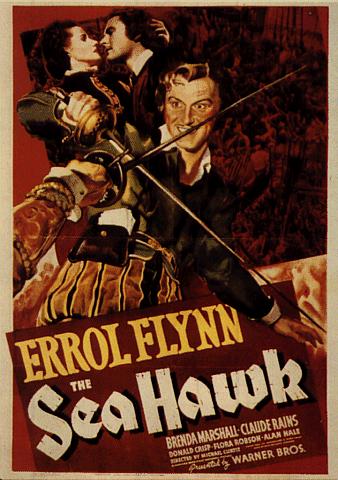
An Errol Flynn pirate movie? Sure, that sounds fantastic. But I’ve already seen Captain Blood! Not to fear, because 1940 heralded yet another Michael Curtiz’ helmed Flynn swashbuckling ADVENTURE! The Sea Hawk.

The Story
Wait, wait, wait. Play this while you're reading. Trust me.


It is 1585 and Geoffrey Thorpe (Errol Flynn) is the dashing captain of the Albatross, an English privateer and his life is pretty awesome. He’s got a ferociously loyal crew, headed up Mr. Pitt (played by his old sidekick Alan Hale Sr.), a fast ship with which he can raid Spanish vessels with bravado, and an almost-first-name relationship with Queen Elizabeth. He’s unfailingly polite, charming, merciful, yet a stern disciplinarian to those who disobey his direct orders.

We open with a Spanish galley delivering a diplomat to England. The Spanish are quite furious with English piracy against their ships and for the Brits funding their enemies. The two nations are not at war, but things are starting to move in that direction, and the surprisingly British-accented Spanish already have a secret plan for invading/conquering England. So really, considering the time this was made, you should really cross out “Spanish” wherever you encounter it in this movie and replace it with “German” since this is fundamentally a WWII propaganda film. C’est la guerre.

Anyway, the diplomat is Don Alvarez (Claude Raines), and he’s bringing along his neice, Doña Maria Alvarez de Cordoba (Brenda Marshall), and she’s got her own servant in tow, Martha (Una O’Connor, and not nearly as annoying as in Bride of Frankenstein). Suddenly, a ship attacks. It’s the Albatross, and the galley being Spanish is all the pretext Thorpe needs to attack. After a rousing battle where ships shoot each other and men swing across riggings, fall in the water, and insult-swordfight, Thorpe’s sea hawks (DUN DUN DUN!) are victorious and capture the crew and diplomats who…were already…headed to…England. Well, uh, Thorpe also frees the English galley slaves the Spanish were using as labor. The Albatross doesn’t HAVE galley slaves, so there. Either that or its not a galley. Thorpe also takes a liking to Doña Maria (who had an English mother, apparently), and is about the only character he ever feels nervous around. Awww, somebody’s twitterpated.

In England, the Spanish raise a big stink about Thorpe’s actions, and they’re aided by Lord Wolfingham, who’s basically Elizabethan Neville Chamberlain with a dose of actual seditious treason thrown in. Elizabeth (Flora Robson) chides Thorpe about his antics, but shares a lot of sentiment about being wary of the Spanish. Thorpe wants to raise a fleet to counter Phillip II’s armada and he proposes to lead a daring raid on Spanish New World territory to “divert” funds to England. She gives him the go-ahead but with the understanding that “if you get caught, its not my problem.”

Well, Thorpe DOES get caught. The raid is a disaster and most of his men are killed. He’s is caught and sentenced to the galley by the Inquisition. This causes all kinds of headaches back in England, as Elizabeth cracks down on her privateers to appease the Spanish, Wolfingham schemes behind her back, and Doña Maria pines for Captain Thorpe.

The Sights
Like Captain Blood, The Sea Hawk is black & white. However, the movie (at least the DVD I watched) did something different. When the action shifts to the New World, it takes on a sepia tone. Then when they get back to Europe, B&W again. Its an interesting little touch. Apparently the film reused most of the sets of another Elizabethan movie that was shot before it (Essex and Elizabeth, also starring Errol Flynn). The sets are quite lavish, particularly the queen’s palace, as are the costumes.

Interestingly, the movie leads off with its big set piece. The naval battle between two ships is taken care of in the first twenty minutes and then there’s a lot of politics and dialogue for most of the movie. Still, that opening fight is really impressive, compounded by the fact that they really shot it in a giant tank on the Warner back lot with two life-sized ships operated by hydraulics. That is friggin’ awesome! Its also great because you can have guys splashing into the water and continuing to swim as they fight. There’s even a sailor who gets “killed” by a grappling hook tossed at him. That doesn’t really add anything thematically or symbolically. I just thought it looked cool and different enough from other pirate movies to make a note of it.

Now there are more action sequences in the film, of course. Thorpe’s escape and capture of the Spanish galley he’s on is the penultimate one that shows him being a clever leader. Then he high-tails it back to England to warn the Queen that the Armada will attack. Of course that would be too easy, so Thorpe needs to sneak back into the palace, where he has a final showdown with the film’s real villain, Wolfingham (Henry Daniell). Wolfingham’s actor was not a fencer (like Rathbone was in Robin Hood) so most of his work was done by a double. Its still a very satisfying duel, and gets some lovely backlighting by candles at moments (Did I just say lovely backlighting in reference to a fight to the death? I need to get out more.)

The Cast
As in Captain Blood and The Adventures of Robin Hood, Flynn is at his Flynniest as a dashing swashbuckler. Its no different here. He’s great fun to watch and has a lot of energy. Brenda Marshall’s love interest does an acceptable job, but she doesn’t do a whole lot except fall in love with Thorpe, question the virtue/goodness of her native Spain, and look pretty. Claude Raines’ Don Alvarez is diminished a bit after Wolfingham rises in villainy, but he gains assorted character touches. He’s very tender and loving of his niece, polite, well-educated, reasonable, and open to discussion. He doesn’t seem to be too privy to Spain’s big war plans and by the end of the movie, he’s goes from evil to neutral on the morality scale. Considering that was mostly through Raines’ body language and dialogue, I’d say its pretty impressive.

Most impressive though is Flora Robson’s turn as Elizabeth. She steals every scene she’s in with a mixture of fiery imperiousness and coy playfulness. It really is great fun to watch, and she gives the character a lot of layers. Her final speech at the end of the movie, rousing the British to muster for war and defend freedom is a really good one, and probably sold a lot of War Bonds.

Perhaps the only real weak link in the cast is Wolfingham. I don’t think that Daniell is particularly bad, its just that Wolfingham is a fairly uninteresting character. He wants the crown of England for himself and is willing to sell out to the Spanish for it. Okay, that’s a pretty vile thing to do, but he does it without being pompously evil like Basil Rathbone was in Robin Hood or greedily evil like Lionel Atwill in Captain Blood (and neither of those characters was particularly deep either). Here its like “Hi, I’m Wolfingham. I’ll be your villain tonight. If you’ll just have a seat I’ll bring out a fight scene for you shortly.”

The Script
Screenplay by Howard Koch and Seton I. Miller. Technically this is a remake of a 1924 film that was based on a Rafael Sabatini novel (like most golden age swasbuckler films). Except the only thing it keeps from the previous version is the name and that its about pirates.

I suppose where points would be negated is from how history is (as usual) cherry-picked and sidelined for various reasons. Here, its for war propaganda. Early on, its clearly obvious that the aggressive, expansionist Spanish are meant to represent Nazi Germany. Obvious historical differences aside, it does have some curious results. History is, of course, much more complicated than casual observers would like it to be, and the historical Armada campaign was not exactly “England=Benevolent, Spain=Bigot,” let alone “England=Good, Spain=Bad.” There really isn’t enough room to go into examples here, so one will have to suffice: Spain wasn’t the only kingdom to have galley slaves. Everybody had them. If you had a galley, you needed galley slaves (though professionally hired rowers also existed, I believe). Spain had them, England had them, the Ottoman Empire had them, the Knights of Malta had them.

So why am I deducting points for the standard drubbing that history gets through adaptation? Its because of how blatant it is. 1940 and all that, and the movie is very entertaining, but it is positively shameless in its propaganda. Which I suppose adds some charm to it and roots it firmly in that time before America entered WWII, but still, the Medieval/Renaissance historian in me just sighs sadly.

The Sounds
Erich! Wolfgang! Korngold!

I should elaborate, I suppose. The opening fanfare for The Sea Hawk blew my hair back and when I saw Korngold’s name during the credits, the note I immediately made was “This is gonna be good.” And oh how right I was. The score is absolutely incredible for this movie. The bombastic cues are epic in scope, but the calmer parts are just as wonderfully rendered, bringing a rich variety of melodies and themes to play. The main theme stuck with me for a while after the end, which is as fine a compliment I can give a film score as any. I think that perhaps his score for this is better than the one he wrote for Robin Hood, and I LOVE the music in Robin Hood.

The Verdict
Watch The Sea Hawk if you get a chance. Come for the opening ship battle, stay for the soundtrack! Good performances, great action and an absolutely incredible score make for one rousing bit of piratey fun, even if its Queen Elizabeth is more like Winston Churchill (symbolically!) than, uh, hmm…

I really wish I hadn’t just pictured Churchill in a frilly collar and red wig.

Trailer over here:
http://youtu.be/6_XIJm0_Wgc

Monday, October 31, 2011

“Quickly! Into the air, zombie bird man!”

And at last its time to close out October the same way it was begun. With Boris Karloff. In 1967, the good folks at Rankin/Bass released into theaters a feature-length monster movie done in the same animation style as Rudolph the Red-Nosed Reindeer. Except instead of annually overplayed Christmas joy, it was a swingin’ celebration of misanthropic movie monster madness. Its Mad Monster Party?

Story
Its simple really. Dr. Baron von Frankenstein is getting on in years and wants to retire from the whole “Mad Science” business. So he decides to throw a party for all of his friends/relatives at which he will name his successor. Among the invitees is an unassuming pharmacy clerk who’s a long-lost nephew, and the intended heir. The monsters involved then try to scheme and backstab their way into getting this guy out of the way.

Characters
Baron Boris von Frankenstein: Boris Karloff! Dr. Frankenstein lives on a Bond Villain’s island and has developed what is essentially anti-matter that can blow up ANY matter it touches. So yeah, that whole “law of conservation of mass” thing? Irrelevant now. And he’s actually one of the nicer characters. The model he voices looks a little like his Frankenstein’s Monster around the forehead.

Felix Flankin: Allen Swift voices Frankenstein’s nebbish nephew who works in a pharmacy and has a catastrophic case of allergies. Nearsighted and generally oblivious to the nature of the monsters.

Francesca: Gale Garnett voices the Doctor’s mind-bogglingly proportioned (essentially Christina Hendricks) assistant with a sultry voice. She wants to inherit Frankenstein’s fortune, and can scheme with the best of them.

The Monster/“Fang”: He’s mute and strong, and a henpecked husband.

The Monster’s Mate: Phyllis Diller voices the Monster’s bride if instead of a bird-like, screaming woman, it was Phyllis Diller and the two settled down.

Dracula: Allen Swift (Allen Swift pretty much voices everybody else in the movie, so I’ll leave it off to save time) voices Dracula…oddly. I can’t quite place the accent, but its not Bela Lugosi-like. The design kind of makes me think of Sid Caesar, which…is random.

The Invisible Man: The Invisible Man walks around in a smoking jacket and fez and speaks like Sydney Greenstreet.

Dr. Jekyll/Mr. Hyde: Pretty much your standard Jekyll/Hyde thing, except he sure loves drinking his transformative serum out of the flask hidden in his cane.

The Mummy: Mummy’s got some sweet dance moves.

The Werewolf: He howls a lot and likes stowing aboard ships to not have to pay.

The Creature: The Gill-Man, basically. He garbles and gurgles a lot.

Quasimodo: Also mute, he and the Mummy become roomies for a while. I’d pay to see more of that. One’s a mummy, the other’s a hunchback. They fight crime.

Yetch: He’s basically a zombie version of Peter Lorre, which…is a bit odd, since he’s not playing a Lorre character. Anyway, Yetch is Frankenstein’s butler/steward/whipping boy who’s madly in love with Francesca and his limbs tend to fall off a lot.

“It”: Not referred to by his real name because of copyright reasons, “It” is the one guest Frankenstein didn’t want to invite because he always made a mess of things. A giant, hairy, ape-like mess who likes girls and tall buildings.


Visuals/Effects
Directed by Jules Bass, it’s the same “Animagic” style that marks other Rankin/Bass productions. However, it’s a refreshing difference from the Christmas ones, and the art department gets to go wild with crazy designs. A lot of the designs were based on the Mad Magazine artist Jack Davis. There’s a lot of physical comedy and there’s a hell of a lot of intricate and detailed work for the sets, and the movie delivers a few things I’ve never seen before, like a squadron of zombies flying biplanes.

Writing
Written by Arthur Rankin Jr., Len Korobkin, Harvey Kurtzman, and maybe Forrest J Ackerman, though there’s varying stuff I’ve read about Forry actually being involved or not. The script really, really, really feels a lot like an issue of Mad Magazine, which makes sense because Kurtzman founded it. Be ready for a lot of puns, a lot of physical comedy, and a lot of saucy that slips in under the radar.

What, me worry?
Sound
Original music by Maury Laws. The extremely James Bond-esque title song is by Ethel Ennis, with a few songs by Phyllis Diller and Gale Garnett dashed in for good measure. The soundtrack is actually quite amazing, with the swingin’ jazz combo sound working surprisingly well for a group of monsters that date back to the turn of the century. The songs aren’t quite as memorable as the Christmas special ones, but they’re not bad by any means.

Conclusion
Mad Monster Party? is actually quite awesome and I was pleasantly surprised by it. Yes a lot of the jokes fall flat and Felix’s character is not a particularly bright or likable protagonist, but the movie oozes style, features good-natured camp, throws in pretty much every major monster, and has ZOMBIES FLYING BIPLANES. If you don’t think that’s awesome, then you have murdered your inner child and there’s no hope for you. Totally recommended.


Mummy's got a theme song, yo.

Friday, October 28, 2011

“My mission, to which I am fully dedicated, is to fight against evil.”


Its my understanding that they filmed the Aztec Mummy trilogy back to back, sort of like Lord of the Rings, only…not. La maldición de la momia azteca AKA Curse of the Aztec Mummy, also from 1957, was the middle film and…it is every bit as crazy as The Robot vs. the Aztec Mummy.

Story
So Dr. Krupp is being interrogated by the police after being caught and outed as the criminal mastermind The Bat. Except Krupp denies everything and his henchmen develop the clever plan of sending a note to Krupp and the police with a bat picture on it, which raises doubt that the scientist actually is the Bat. That doubt doesn’t last long because Krupp’s goons continue to take the initiative and bust him out of the bus taking him to jail, despite the interventions of a masked Luchador named the Angel.

Wait, what?

Yes, the movie throws in a mysterious caped Luchador who seems to drive a Morgan convertible. Right, so, Krupp and his gang get away and after a lengthy flashback of what Krupp knows of the previous movie’s plot, Krupp decides that the lost Aztec treasure the heroes found would perfectly pay for his mad science experiments. So he kidnaps Flor and hypnotizes her, then we get a cycle of Dr. Almada & the Angel getting caught and escaping and caught again. Then they finally DO find the Aztec treasure again and at the very end of the movie, the Aztec Mummy shows up to claim what’s his.

Characters
Dr. Eduardo Almada: Ramón Gay is still our hero and despite everything that happened in the last movie, he thinks the Curse of Popoca will no longer have anything to do with his family. Boy is he wrong. Most of the movie has him working in opposition to Dr. Krupp, who’s kidnapped his woman.

Flor Sepúlveda/Xochitl: Rosita Arenas spends most of the movie kidnapped by Dr. Krupp and kept in a drugged-up state to make her mind susceptive to hypnosis, so she can tell him where the Aztec treasure was buried…even though he himself has been to the same Aztec pyramid as everybody else and…never mind, Mad Science. She’s the only one who really suspects that Popoca isn’t done yet.

Pinacate: Crox Alvarado continues to be the comic relief guy, gets beat up a few more times, and then is largely absent from the movie. Hmm…

Pepe Almada: Jaime Quiñones actually has a larger part in this movie, as he becomes an unofficial sidekick for the Angel, calling him on his wrist phone to alert the hero of danger and eventually rescuing the luchador from a deathtrap.

Dr. Krupp/The Bat: Luis Aceves Castañeda really starts to ham things up. No longer required to pretend to be a sane scientist, he goes into full Mad Science mode, devising bizarre schemes, trying to throw luchadors into snakepits, and determined to get that Aztec treasure. Not because he wants it for himself, oh no. In true Mad Scientist fashion, he only sees the priceless relics as a means to an end: the financing of his experiments so that he may (somehow) achieve immortality! He’s actually great in this.

Tierno: Arturo Martínez continues to be Krupp’s go-to henchman (and will stick around for the third movie). He’s the one who basically organizes his boss’ prison break. Good henchmen like that are hard to find.

Popoca: Ángel Di Stefani is barely in this movie (unless you count flashbacks). For most of the movie, nobody has the Aztec treasure, so Popoca doesn’t have anything to do. He’s guarding it and there’s no problems for him. The only reason he gets involved at all in this movie is because the breastplate and bracelet were stolen, so he busts some heads at the end of the movie, throws Krupp into the snakepit, and leaves with the treasure to go guard it again. Popoca is very dedicated to his job.

El Ángel: While you would think the addition of a masked wrestler would lead to a climactic showdown between a Luchador and Mummy, you’d be wrong. The Angel is a friend of justice, and has a mutual enemy in Dr. Krupp. The Angel is also not particularly good at his job of actually stopping crime. He’s persistent, I’ll give him that, and certainly hard to kill, but he doesn’t really succeed at stopping our villain at anything. He’s more like a big-talking speed bump of justice than an actual deterrent to crime. He’s also secretly one of the characters above. And its not Popoca (though that would be sweet).


Visuals/Effects
Rafael Portillo still directing, and the movie is probably the one with the most action and movement of the trilogy, even if it is mostly backtracking. There’s plenty of action sequences featuring the Angel, which is a plus. The Aztec ceremony from the first movie is flashed back to in pretty much its entirety.

Ah, and I should mention that when Krupp’s goons spring him from the police, Krupp picks up a Tommy Gun and shakes it around like he’s firing it and you hear stock audio of machine gun fire with absolutely no muzzle flash or actual recoil. Cheese at its finest!

Writing
Story still by Guillermo Calderon & Alfredo Salazar, and, well, it’s a mummy movie with a luchador. It is much less serious than the first movie yet still more coherent than the third movie. Basically its cheese with pulp-novel sensibilities.

Sound
Antonio Díaz Conde still did the music and its pretty much the same story. A lot of standard B-movie cues with a lot of shrill sounds thrown in. That Aztec ceremony is a real pain for the ears to sit through.

Conclusion
Curse of the Aztec Mummy might actually be the best of the trilogy because of the good ratio of on-screen craziness to recycled footage from previous installments. I wouldn’t call it a good movie (nor would that apply to the series as a whole) but for Mexican cheese (I guess queso would be more accurate) its very entertaining. The only real complaint is that Popoca has maybe less than five minutes of actual screen time, which is a shame.


No trailer for this one, so here's the overly-long flashback to Aztec times, complete with human sacrifice accompanied by ear-piercing music! If I had to hear it, you should to!

Thursday, October 27, 2011

“How far can the human mind fathom the mysteries of the hereafter?”


Now this is something I’m disproportionately excited about. Way back here, I watched The Robot vs. the Aztec Mummy, which turned out to be part three in a Mexican Mummy Trilogy. Well, a few months back at Half-Price Books, I found “The Aztec Mummy Collection” which collects the entire trilogy in one surprisingly respectful boxed set. No way in hell I would pass that up for five bucks.

So off we go, where the magic began, with 1957’s La momia azteca AKA The Aztec Mummy AKA Attack of the Aztec Mummy. I should not nearly be this excited.

Story
So we have a scientist who’s got a lot of weird ideas about how hypnotic suggestion can get people to regress and remember past lives. He gives a lecture on this before an august congress of scientists in Mexico City and when he says this is all theoretical right now because nobody wants to volunteer to try it, he is essentially laughed out of the conference. I should note that the congress was perfectly fine with therapeutic hypnosis to help patients, just not this kooky brand our hero suggests.

Where a villain would “get a volunteer” our hero bucks the trend by actually getting a willing volunteer: his loving fiancée. She gets hypnotized and the scientist learns that she was once an Aztec princess who was slated to be a sacrifice to the gods, but fell in love with a mighty warrior, got caught, and both of the them were punished by being sacrificed, so…that was kind of the plan from the start, right? Anyway, the memories of her death are traumatic and almost kill her, but the heroes do learn the location of the sacred Aztec treasure that was buried with the Aztec princess. So they do what any science-minded heroes would do: Grave Robbing!

Well, tomb raiding turns out to have negative consequences, because it awakens the mummy of the Aztec warrior cursed to protect the artifacts for all time. Then the mummy realizes the woman is his lost love reincarnated.

And there’s a subplot of a criminal mastermind organizing a crime spree and then he gets interested in all this stuff, but oddly enough, its actually pretty unimportant to the main plot.

Characters
Dr. Eduardo Almada: Ramón Gay is our scientist hero. He’s got a crazy idea, experiments on his loved ones, robs graves of sacred artifacts, and somehow, someway, he’s actually not a villain. He also doesn’t believe in curses, which bites him in the ass.

Flor Sepúlveda/Xochitl: Rosita Arenas is our female lead. A supportive fiancée for her Eduardo, after her ordeal with hypnosis she gets very worried about the curse of the mummy coming down on them for stealing ancient Aztec treasure.

Pinacate: Crox Alvarado plays the comic relief. A friend/assistant/sidekick to Dr. Almada, he’s a big ol’ fussy coward with Clark Kent glasses. That’s pretty much it.

Dr. Sepúlveda: Jorge Mondragón plays Flor’s father, another scientist and a close friend of Dr. Almada’s.

Pepe Almada: Jaime Quiñones plays Eduardo’s adolescent brother. He likes tagging along for adventures, though doesn’t really bring much to the table.

Dr. Krupp/The Bat: Luis Aceves Castañeda is our villain. At first he seems to be just another respected scientist skeptical of Dr. Almada’s theories, but it turns out he’s the mysterious Bat who is terrorizing the city. He doesn’t really do much in this movie though.


Tierno: Arturo Martínez plays the Bat’s right hand henchman. While the goons might not be particularly smart at much, they are fiercely loyal to their boss, and he seems to treat them well in return.

Popoca: Ángel Di Stefani is our mummy, though Popoca in his full splendor is only at the end of the movie. In life, he had a giant hat, in death, an adequate but not great costume. Popoca doesn’t like lights shining in his eyes (though to be fair, who does?) and doesn’t like dynamite much either.

The Bat knows the value of wearing a fedora at a rakish angle


Visuals/Effects
Directed by Rafael Portillo, the movie is…well, a low budget Mexican 50’s monster movie. The mummy isn’t around very much, there’s a lot of talking, and a fair amount of stock footage. So like a lot of stuff from contemporary America, just in Spanish. Unlike the sequels this doesn’t have any long flashback sequences, so that’s a plus. Unfortunately, the Aztec ceremony that gets flashed back to in the sequels is much longer and more annoying in this one. Seriously, that’s a long, annoying stretch of film to sit through.

Writing
Story by Guillermo Calderon & Alfredo Salazar, adaptation by Alfredo Salazar. First thing to notice is that the Popoca storyline borrows HEAVILY from the Universal Mummy movies. Mummy cursed with undeath because he messed with private stock? Then when he gets reanimated, he learns that his lost love is reincarnated? Yep, seen that before. The subplot with the Bat is new, though reminiscent of movie serials.

Still, the movie does take the novel step of using an Aztec mummy instead of an Egyptian-style one.

Sound
Original music by Antonio Díaz Conde. Most of the time its standard 50’s monster movie fare, but when they do the Aztec ceremony flashback, man it gets annoyingly shrill. Actually, it tends to get shrill more often than is required.

Conclusion
So I’ve finally seen La momia azteca and it is everything I expected it to be: a low budget monster movie. There’s lots of cheese, lots of bizarre conversations that try to sound pseudo-scientific, and there’s an Aztec Mummy. It definitely has an Aztec Mummy.

Wednesday, October 26, 2011

“A superior intelligence has come from Venus in MY satellite, established residency, turned off the world’s power, and is about to take over the world’s population.”


Roger Corman. Oh dear. Well, this 1956 alien invasion movie features two very well-known actors contending with a monster from another world, only on Corman’s infamous shoestring budget. It Conquered The World in only 71 minutes. 71 very long minutes.

Story
In the rural hill town of Beechwood, there’s a space research station that is preparing to launch the first man-made satellite into orbit. The lead scientist’s best friend, another scientist, tries to stop the launch with dire warnings of the potential of alien intervention keeping mankind from entering space. They go ahead with the launch anyway, and some time later, the satellite disappears mysteriously (having been transported to Venus) and returns to Earth orbit much, much quicker than a round trip like that would take. The rocket then crashes to Earth and the Venusian passenger within starts deploying bat-things to take over the minds of assorted important people to begin conquering the world. He’s aided in this (over the radio) by the hero’s best friend, leading to an ideological, as well as physical confrontation.

Characters
Dr. Paul Nelson: Peter Graves is our standard-issue science hero. A man of ambition and exploration, he also values human independence and free will, and really hates the idea of something that would or could limit human freedom. Despite the movie’s massive downer ending, he gets a surprisingly good speech about the need for mankind to feel emotions.

Dr. Tom Anderson: Lee Van Cleef is Dr. Nelson’s best friend and someone who’s been laughed out of most scientific circles for his crazy ideas. Well he’s had it with your primitive Earth bullying! He’s got a friend that he talks to on the radio who lives on Venus and who’s coming to Earth to solve all the problems that human emotions cause. Figures that would be when the crackpot is actually right. Regardless, he gives a pretty good performance, all things considered.

Joan Nelson: Sally Fraser plays our hero’s wife, a supportive and kind woman who eventually gets her mind taken over by the alien. Paul doesn’t like that one bit.

Claire Anderson: Beverly Garland plays Tom’s wife and is the real female lead since she gets probably the meatiest performance out of the film. She’s torn between love for her husband and hatred for his part in the invasion when she finds out about it. She ultimately decides to go and confront the alien herself, even giving it a fiery little speech about it.

Brigadier General James Pattick: Russ Bender (a Corman film regular) plays a general who gets taken over by aliens fairly early. He then sends a unit of soldiers out on a patrol to keep them away from the lab.

The Venusian: One of only 9 living Venusians, he comes to Earth hoping to conquer it for his people. I think a picture would best describe the creature, so here you go:

That is the "It" what "conquered the world." There’s stories circulating that the effects guys made him squat because he came from a high-gravity planet, but when Beverly Garland laughed at it and kicked it over, Corman told them to make it bigger.


Visuals/Effects
Roger Corman, the B-Movie King, directed this, and there’s a certain “style” to Corman’s films. The films were all shot really fast on low budgets and used a lot of padding. What kind of padding? Well, there’s a fair amount of stock footage and then even more shots of people (usually Peter Graves) going from one place to another; either walking, driving, or even bicycling. Naturally, that kind of stuff bogs the pacing down something fierce, and the movie really slouched along until we get to a pretty big climax (by Corman standards) that ends with a rather hefty body count.

As for the effects, well, you’ve seen the Venusian. The alien also shoots out probes that attach to the back of the neck and take over the mind. They look like rubber bats on string.

Writing
Lou Rusoff & an uncredited Charles B. Griffith, the story is actually kind of interesting. A crafty alien lands on earth, shuts down pretty much all power supplies (even wristwatches and water hoses somehow), and starts picking off authority figures so he can use them to keep the rest of the people in line. Add to it a fairly thorough anti-Communist subtext (invaders make everyone equal by brainwashing them sort of thing) and you have some interesting Cold War era sci-fi ruminations. Just not quite interesting enough to pad out 71 minutes, so we get lots of walking scenes.

Sound
Original music by Ronald Stein, the score is your standard issue 50’s B movie soundtrack with “spacey” sounds and punctuations of fanfares.

Conclusion
Shabby alien aside, It Conquered The World is actually a pretty dark film for 1956. By the end of it, Dr. Paul Nelson is pretty much the only named character still standing. That’s dark. There’s apparently no way to undo the mind control. That’s dark. I don’t want to give the impression that the movie is good, because its not. It is a cheesy, low-budget 50’s sci-fi flick that’s really boring except for the scenes with Graves, Van Cleef, and Garland, and the finale brings everything together for a brutal and grim ending. It’s an interesting film, and pretty good for a Corman film.


Tuesday, October 25, 2011

“Do the dead leave the living in peace?”


Thought I was done with mummies, did you? Well you’re wrong! Vampires and Zombies are horribly overplayed and Werewolves are kind of close, so you know what monster I’ve decided to champion? The humble Mummy. So get ready world, as I force feed you mummies until you think you’re Ramesses the Great.

But why stop at mere mummies? How about GHOST Mummies! And with an added dose of FRENCH GHOST MUMMIES! Which is kind of the premise of 2001’s Belphégor - Le fantôme du Louvre (AKA Belphegor: The Phantom of the Louvre). Sadly, I don't think there's any way the movie can live up to the mental image of French Ghost Mummies I have in my mind now.

Plot
In 1935, a French archeologist found a strange mummy in Egypt that zaps him with some kind of energy. He seems unharmed by it, except for the nightmares and sleepwalking and ships the mummy back to Paris, but on the voyage, something drives him and the ship’s crew to madness and suicide.

Cut to the modern day as the mummy’s sarcophagus is found in a back room at the Louvre. This raises a lot of questions. Why was he lost in storage for so long? Why was his name scratched off of everything? Who is he? Why is he extra ugly? Who poisoned him and bashed him over the head to make sure he was good and dead?

After an MRI scan lets his ghost loose, the mummy starts shorting out the museum’s electrical grid, which is inconvenient as they’re doing some remodeling, which borders an apartment building where our protagonist lives. She gets possessed by the mummy’s ghost and starts blacking out at night and a mysterious robed figure stalks the Louvre, which leads to the deaths of several security guards on the night shift. Hmmm…

Characters
Lisa: Sophie Marceau is our main character. She runs a perfume shop (that gets seen once to establish that she runs a perfume shop and the lease is going up) and has a grandmother who raised her after her parents died. After the power in the city block starts fluctuating, she meets a young electrician and her grandma tries to hook the two up, then gran dies and Lisa goes a little “manic pixie dream girl” and sneaks into the Louvre at night (because the construction knocked a convenient hole in the wall of her apartment) and gets possessed by the ghost mummy and starts acting all neurotic and switching between normal and possessed modes.

Martin: Frédéric Diefenthal plays the amiable electrician who gets called in a couple times to fix the power in Lisa’s building. There’s attraction there, and he tries to cheer her up after grandma’s death, but after getting a little closer to her, she starts acting all weird and crazy and tossing him through the relationship wringer. He ends up being steadfast enough to see the movie through, but he sure falls for a girl with a lot of baggage. He also plays guitar in a band because of course he does.

Inspector Verlac: Michel Serrault plays a veteran security guard who used to work in the Louvre during the 60’s and encountered the being haunting the place back then. Now he returns, though the museum director is reluctant to bring him back in.

Glenda Spencer: Julie Christie plays an English archeologist called in to examine the mummy and is trying to figure out the corpse’s identity. Eventually she and Inspector Verlac get a nice flirty dynamic going.

Belphégor: Our mummy du jour is both a desiccated, dried out corpse incapable of locomotion (just like a real mummy) and a CGI glowing orange ghost without a lower body that can fly around and bare his skull for the audience. Its worth noting that for most of the movie, only the viewer can see the ghost and the characters cannot. “Belphégor” is not his real name (Belphegor is a name in demonology that also inspired an Austrian metal band of the same name) and the spirit is very upset that his name has been forgotten and wiped away. So upset that he’s possessed a woman, gotten her into a fancy robed costume and has her going around the Louvre at night grabbing artifacts for a ritual and terrifying the guards. There’s also a scene where Lisa and Martin are getting it on before Belphégor intervenes and starts choking Martin. That mummy is into some kinky stuff.

Visuals/Effects
Directed by Jean-Paul Salomé, the movie has two memorable visual things going for it. The first is the CGI ghost of the mummy which spends most of the movie invisible to anyone except the audience. There are times when Belphégor fights those who would stop it, and these induce hallucinations in the victim of whatever it is they fear the most (usually ending in a violent suicide). The effects during these scenes are kind of hit or miss, but they’re brief enough that it doesn’t matter much.

The second is the very, very nice cinematography that makes the Louvre look absolutely gorgeous. If nothing else, this movie serves as a fine bit of cinematographic publicity for one of the most famous museums in the world.

Writing
Based on the 1927 horror novel “Belphégor” by Arthur Bernède (which was quite a popular book in France; spawning a movie serial, a 60s TV show, comic strip and other stuff). From what I gather, the adaptation by Jean-Paul Salomé, Danièle Thompson, and Jérôme Tonnerre took liberties with the original in order to make it more supernatural. As it stands, the characters are somewhat archetypal, especially Lisa and Martin. The side characters fare a little better, with Verlac & Spencer as well as some of the security guards getting some nice moments here and there.

Sound
Original music by Bruno Coulais. Its quite good and a bit similar to his score for Coraline, in that it throws in a lot of exotic sounds and cues mixed with electronic beats for an otherworldly atmosphere. In this case, said atmosphere is Egyptian infused. I dig it.

Conclusion
In the end Belphégor - Le fantôme du Louvre is more of a straight-up urban fantasy tale than a horror movie, and its more of a ghost story than a mummy movie, but it is an interesting little curio all the same. I wouldn’t call it particularly great or enthralling, but the cinematography is actually very well done and tells its story competently enough. Not sure I’d watch it again, but the experience itself was painless.


Yes, its a German trailer for a French film.