Where were we?
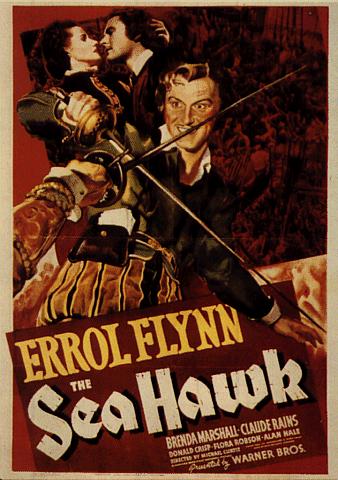
An Errol Flynn pirate movie? Sure, that sounds fantastic. But I’ve already seen Captain Blood! Not to fear, because 1940 heralded yet another Michael Curtiz’ helmed Flynn swashbuckling ADVENTURE! The Sea Hawk.
The Story
Wait, wait, wait. Play this while you're reading. Trust me.
It is 1585 and Geoffrey Thorpe (Errol Flynn) is the dashing captain of the Albatross, an English privateer and his life is pretty awesome. He’s got a ferociously loyal crew, headed up Mr. Pitt (played by his old sidekick Alan Hale Sr.), a fast ship with which he can raid Spanish vessels with bravado, and an almost-first-name relationship with Queen Elizabeth. He’s unfailingly polite, charming, merciful, yet a stern disciplinarian to those who disobey his direct orders.
We open with a Spanish galley delivering a diplomat to England. The Spanish are quite furious with English piracy against their ships and for the Brits funding their enemies. The two nations are not at war, but things are starting to move in that direction, and the surprisingly British-accented Spanish already have a secret plan for invading/conquering England. So really, considering the time this was made, you should really cross out “Spanish” wherever you encounter it in this movie and replace it with “German” since this is fundamentally a WWII propaganda film. C’est la guerre.
Anyway, the diplomat is Don Alvarez (Claude Raines), and he’s bringing along his neice, Doña Maria Alvarez de Cordoba (Brenda Marshall), and she’s got her own servant in tow, Martha (Una O’Connor, and not nearly as annoying as in Bride of Frankenstein). Suddenly, a ship attacks. It’s the Albatross, and the galley being Spanish is all the pretext Thorpe needs to attack. After a rousing battle where ships shoot each other and men swing across riggings, fall in the water, and insult-swordfight, Thorpe’s sea hawks (DUN DUN DUN!) are victorious and capture the crew and diplomats who…were already…headed to…England. Well, uh, Thorpe also frees the English galley slaves the Spanish were using as labor. The Albatross doesn’t HAVE galley slaves, so there. Either that or its not a galley. Thorpe also takes a liking to Doña Maria (who had an English mother, apparently), and is about the only character he ever feels nervous around. Awww, somebody’s twitterpated.
In England, the Spanish raise a big stink about Thorpe’s actions, and they’re aided by Lord Wolfingham, who’s basically Elizabethan Neville Chamberlain with a dose of actual seditious treason thrown in. Elizabeth (Flora Robson) chides Thorpe about his antics, but shares a lot of sentiment about being wary of the Spanish. Thorpe wants to raise a fleet to counter Phillip II’s armada and he proposes to lead a daring raid on Spanish New World territory to “divert” funds to England. She gives him the go-ahead but with the understanding that “if you get caught, its not my problem.”
Well, Thorpe DOES get caught. The raid is a disaster and most of his men are killed. He’s is caught and sentenced to the galley by the Inquisition. This causes all kinds of headaches back in England, as Elizabeth cracks down on her privateers to appease the Spanish, Wolfingham schemes behind her back, and Doña Maria pines for Captain Thorpe.
The Sights
Like Captain Blood, The Sea Hawk is black & white. However, the movie (at least the DVD I watched) did something different. When the action shifts to the New World, it takes on a sepia tone. Then when they get back to Europe, B&W again. Its an interesting little touch. Apparently the film reused most of the sets of another Elizabethan movie that was shot before it (Essex and Elizabeth, also starring Errol Flynn). The sets are quite lavish, particularly the queen’s palace, as are the costumes.
Interestingly, the movie leads off with its big set piece. The naval battle between two ships is taken care of in the first twenty minutes and then there’s a lot of politics and dialogue for most of the movie. Still, that opening fight is really impressive, compounded by the fact that they really shot it in a giant tank on the Warner back lot with two life-sized ships operated by hydraulics. That is friggin’ awesome! Its also great because you can have guys splashing into the water and continuing to swim as they fight. There’s even a sailor who gets “killed” by a grappling hook tossed at him. That doesn’t really add anything thematically or symbolically. I just thought it looked cool and different enough from other pirate movies to make a note of it.
Now there are more action sequences in the film, of course. Thorpe’s escape and capture of the Spanish galley he’s on is the penultimate one that shows him being a clever leader. Then he high-tails it back to England to warn the Queen that the Armada will attack. Of course that would be too easy, so Thorpe needs to sneak back into the palace, where he has a final showdown with the film’s real villain, Wolfingham (Henry Daniell). Wolfingham’s actor was not a fencer (like Rathbone was in Robin Hood) so most of his work was done by a double. Its still a very satisfying duel, and gets some lovely backlighting by candles at moments (Did I just say lovely backlighting in reference to a fight to the death? I need to get out more.)
The Cast
As in Captain Blood and The Adventures of Robin Hood, Flynn is at his Flynniest as a dashing swashbuckler. Its no different here. He’s great fun to watch and has a lot of energy. Brenda Marshall’s love interest does an acceptable job, but she doesn’t do a whole lot except fall in love with Thorpe, question the virtue/goodness of her native Spain, and look pretty. Claude Raines’ Don Alvarez is diminished a bit after Wolfingham rises in villainy, but he gains assorted character touches. He’s very tender and loving of his niece, polite, well-educated, reasonable, and open to discussion. He doesn’t seem to be too privy to Spain’s big war plans and by the end of the movie, he’s goes from evil to neutral on the morality scale. Considering that was mostly through Raines’ body language and dialogue, I’d say its pretty impressive.
Most impressive though is Flora Robson’s turn as Elizabeth. She steals every scene she’s in with a mixture of fiery imperiousness and coy playfulness. It really is great fun to watch, and she gives the character a lot of layers. Her final speech at the end of the movie, rousing the British to muster for war and defend freedom is a really good one, and probably sold a lot of War Bonds.
Perhaps the only real weak link in the cast is Wolfingham. I don’t think that Daniell is particularly bad, its just that Wolfingham is a fairly uninteresting character. He wants the crown of England for himself and is willing to sell out to the Spanish for it. Okay, that’s a pretty vile thing to do, but he does it without being pompously evil like Basil Rathbone was in Robin Hood or greedily evil like Lionel Atwill in Captain Blood (and neither of those characters was particularly deep either). Here its like “Hi, I’m Wolfingham. I’ll be your villain tonight. If you’ll just have a seat I’ll bring out a fight scene for you shortly.”
The Script
Screenplay by Howard Koch and Seton I. Miller. Technically this is a remake of a 1924 film that was based on a Rafael Sabatini novel (like most golden age swasbuckler films). Except the only thing it keeps from the previous version is the name and that its about pirates.
I suppose where points would be negated is from how history is (as usual) cherry-picked and sidelined for various reasons. Here, its for war propaganda. Early on, its clearly obvious that the aggressive, expansionist Spanish are meant to represent Nazi Germany. Obvious historical differences aside, it does have some curious results. History is, of course, much more complicated than casual observers would like it to be, and the historical Armada campaign was not exactly “England=Benevolent, Spain=Bigot,” let alone “England=Good, Spain=Bad.” There really isn’t enough room to go into examples here, so one will have to suffice: Spain wasn’t the only kingdom to have galley slaves. Everybody had them. If you had a galley, you needed galley slaves (though professionally hired rowers also existed, I believe). Spain had them, England had them, the Ottoman Empire had them, the Knights of Malta had them.
So why am I deducting points for the standard drubbing that history gets through adaptation? Its because of how blatant it is. 1940 and all that, and the movie is very entertaining, but it is positively shameless in its propaganda. Which I suppose adds some charm to it and roots it firmly in that time before America entered WWII, but still, the Medieval/Renaissance historian in me just sighs sadly.
The Sounds
Erich! Wolfgang! Korngold!
I should elaborate, I suppose. The opening fanfare for The Sea Hawk blew my hair back and when I saw Korngold’s name during the credits, the note I immediately made was “This is gonna be good.” And oh how right I was. The score is absolutely incredible for this movie. The bombastic cues are epic in scope, but the calmer parts are just as wonderfully rendered, bringing a rich variety of melodies and themes to play. The main theme stuck with me for a while after the end, which is as fine a compliment I can give a film score as any. I think that perhaps his score for this is better than the one he wrote for Robin Hood, and I LOVE the music in Robin Hood.
The Verdict
Watch The Sea Hawk if you get a chance. Come for the opening ship battle, stay for the soundtrack! Good performances, great action and an absolutely incredible score make for one rousing bit of piratey fun, even if its Queen Elizabeth is more like Winston Churchill (symbolically!) than, uh, hmm…
I really wish I hadn’t just pictured Churchill in a frilly collar and red wig.
Trailer over here:
http://youtu.be/6_XIJm0_Wgc


