Showing posts with label Space Opera. Show all posts

Monday, May 13, 2019

Review: Mobile Suit Gundam


Going with this image because Sayla is best girl of the show.
BEST. GIRL.

Hello there, long time no see. Blogging output stalled out for a while, partly because of (positive) changes in work schedules, and also because I've been forging ahead on a pulp novel time permitting. So reading classic SF/F has kind of dropped off for the moment.

But in the name of “research,” I went back and watched Mobile Suit Gundam all the way through.

Mobile Suit Gundam aired on Japanese television in 1979 and birthed a brand new sub-genre of giant robot fiction: the “Real Robot.” Where the 60s and 70s had a thriving “Super Robot” field populated with classics like Tetsujin-28 Go, Mazinger Z, and Getter Robo (worthy in their own ways), Yoshiyuki Tomino's Gundam treated giant robots less as giant superheroes calling out their attacks, and instead as advanced weapons of war against a backdrop of space opera and large scale warfare. More Space Battleship Yamato meets Starship Troopers than Giant Robo/Johnny Socko and his Flying Robot.

In this house we respect Daitarn 3

This isn't a knock on Super Robots. I actually prefer them, to be honest, but Real Robots are damn good too, and Gundam stands at the top of that heap.

Except it wasn't always so. The show was initially a failure, and low ratings led to early cancellation and a mad dash to finish the series at 43 episodes with a dwindling budget. It wasn't until reruns, a compilation trilogy of animated movies in 1981, and perhaps most importantly, the introduction of plastic model “Gunpla” kits in 1980 that transformed Mobile Suit Gundam from a flop to a mega franchise. As far as 40 year old science fiction franchises go, its as important as Star Wars, equally as merchandised, and actually in a much healthier state, currently. (Yes, a holding pattern without much innovation IS healthier than a dumpster fire rapidly bleeding long-time fans).

Back to the show itself: The year is 0079 of the Universal Century. Mankind has set up multiple large space colonies as a unified Earth Federation takes control. One group of Colonies, collectively called Side 3, renames itself to the Principality of Zeon, declares independence from the Federation, and declares war. In rapid succession, nuclear and biological chemicals are heavily used, and Zeon achieves early dominance in space thanks to newly developed mechs called “Mobile Suits.” Oh yeah, and Zeon gassed a neutral colony, killing everyone on it, and then dropped said colony onto Earth, hoping to destroy the Federation's capital. Instead it destroyed a giant chunk of Australia.

This backstory all happened in about 8 months.


The show picks up at the Side 7 colony, where the Federation's top secret Project V mobile suit development is taking place. Amuro Ray, the teenage son of one of the head engineers, is thrust into the cockpit of his dad's mobile suit, the RX-78-2 Gundam, when two Zeon scouts get ahead of themselves and try to destroy the Federation facility.

Stumbling his way through his first couple of fights, Amuro is effectively forced into a combat pilot role alongside the crew and civilians of the carrier White Base, and the makeshift crew:

Bright Noa: A naval ensign forced to take the burden of command when the original captain is fatally wounded.

Mirai Yashima: The daughter of a wealthy family whose father died early in the war, who's glider training makes her the best suited to take the helm.

Fraw Bow: Amuro's childhood friend/sort-of-girlfriend thrust into a Communications/team mom for the orphan kids on the ship role.

Hayato Kobayashi: Amuro's neighbor and friend who's more grounded but less talented. He becomes the pilot of the Guntank, a clunky artillery mobile suit. Think Krillin before Krillin.

Kai Shiden: An abrasive, sarcastic, cowardly loner who gets drafted into a combat role almost against his will. After some significant character development, Kai becomes the second-most dependable pilot on the ship, operating the Guncannon mid-range artillery mobile suit.

Ryu Jose: A stocky pilot cadet and the only combat pilot on the White Base with any actual training to start with. Not a particularly good pilot, but he does his best to keep the crew together. Bounces between a Core Fighter and co-piloting the Guntank.

Sayla Mass: A mysterious blonde girl who's the sister of Zeon ace pilot Char Aznable (oh we'll get to him in a bit) who becomes one of the most well-adjusted members of the crew, first on the bridge, then as a combat pilot in the G-Fighter.

Except these three. These kids are the worst.

The show follows the White Base as it fights its way to Earth, then across the Earth, then back to space as the Federation rallies for an offensive against Zeon's territories. People change, important, likable character die off dramatically, and Amuro grapples with the toll the war is taking on him while he grows as a pilot and eventually awakens as a Newtype (a kind of step in human evolution adapted for living in space that, in practical terms, gives heightened spacial awareness that gives Newtype pilots a significant edge against “Oldtype” pilots, but when ramped up dramatically turns into Acid Trip levels of SPAAAACE MAGIC).

While Zeon's status as the aggressor in the war makes them the default bad guys, the show goes to great lengths to make both sides human. The White Base crew are clearly good guys, but the Federation as a whole is bureaucratic, slow to react, and impersonal, with a few heroic standouts like Matilda, Wakkein, and Sleggar “CHAD OF CHADS” Law. Most of the lower level Zeon troops are decent people fighting for their country and trying to survive. Some, like guerilla warfare/moustache expert Ramba Ral are downright tragic heroes. Even the ruling family of Zeon, the Zabis, isn't all bad. Supreme ruler Degwin Zabi compares his tyrannical son Gihren to Hitler when he tries to scold him for his cruelty. Vice-Admiral Kycillia is a manipulative ice queen. But Admiral Dozle Zabi is a loving father and a soldier's soldier who's only real flaw is his fierce pride, and Garma Zabi is a naive fop at worst.

And then there's Char Aznable.


Building off of a previous Tomino character, Prince Sharkin from Brave Raideen, Char is a dashing masked enemy ace pilot and a viewpoint antagonist who initially comes across as a Red Baron type. But while loyal to Zeon, he's plotting a secret revenge against the Zabi family, for he is Casval Deikun, the missing son of the late Zeon Deikun who founded the Republic of Zeon and who died of sudden and mysterious circumstances allowing Degwin to take over.

Amuro's a good guy trying to do right by the world and his friends, but Char is a deeply compelling antagonist with all kinds of nooks and crannies of character development to dig into. Part heroic war hero, part revenge-driven madman, Char's such an effective character that he's become an archetype. Every subsequent Gundam series has its own variation of a Char Clone: a mysterious, often masked ace pilot who has his own code and agenda that he follows. Char is easily one of the best villains in all of anime.


But here I am talking about the effects of Mobile Suit Gundam and not about the show itself. Its good. Very good, actually. The characters are likable and compelling. The mech designs range from iconic for the Gundam and the Zaku II to the adorably goofy like the Zakrello and the Guntank. The action works well too, considering the late 70s made-for-TV budget, especially the Battle of Jaburo, Battle of Solomon, Duel in Texas Colony (yeah, really), and the Battle of A Bao Qu being major standouts. The animation also nosedives in a lot of places near the end as the show had to wrap things up. Even the pacing is largely solid, with the worst patch being the stretch between the Garma arc and before Ramba Ral shows up. Those episodes have a lot of drawn out filler as Amuro mopes around feeling sorry for himself and going AWOL a couple times.

Beyond just being an Important Show For Anime, Mobile Suit Gundam is genuinely entertaining, and I do recommend it. 43 episodes of a late 70s anime might be asking a bit much, but that's what I hear the compilation movies are for (even if they cut out a ton of stuff like the Texas Duel). Either way, its worth a watch.

Saturday, July 14, 2018

Pulp Review: The Skylark of Space


Star Wars casts a long shadow across science fiction and fantasy. For most people in living memory, it is THE example of the power of Space Opera on audiences. But George Lucas stands on the shoulders of another giant: Alex Raymond, the creator of Flash Gordon, and Raymond stands on the biggest shoulders in all of Space Opera, a humble food engineer specializing in donut mixes from Sheboygan, Michigan, named Edward Elmer “Doc” Smith (1890-1965).

Living in Washington DC after graduating college in 1914 with two chemical engineering degrees, he began writing what would become the very first Space Opera story in 1915, initially co-writing it with Lee Hawkins Garby, the wife of one of his college friends, who agreed to help write some of the romance plot. Working on-and-off on it while he pursued his doctorate, he would finish The Skylark of Space in 1920. After submitting it to various publications for eight years, editor Hugo Gernsback eventually bought the story and began serializing it in the August 1928 issue of Amazing Stories. It was a success, which would spawn three sequels and a hardcover edition (that was significantly edited from the serial) being published in1946.


The Skylark of Space begins innocently enough as an example of the older Victorian “Edisonade” story, where a brilliant and brave young inventor uses his discovery to save the day. Richard “Dick” Seaton is the heroic inventor in question, and on the very first page he discovers that a newly discovered metal (named X), when electrolyzed with copper, releases tremendous energy, which can either be explosive or propulsive. Seaton, along with his best friend Martin Crane (who is a less brilliant scientist, but has more money and business sense) and Seaton's fiance Dorothy Vaneman, experiment with what they can do with the metal, first building a flight harness, and then a spaceship.

Catching wind of them is Marc “Blackie” DuQuesne, a ruthless, but equally brilliant scientific mind in the employ of the sinister World Steel Corporation, a gigantic globalist company infamous for criminal activity that can never be proven in a court of law. DuQuesne steals a sample of X, which begins a quiet arms race that turns into a space race. DuQuesne ends up kidnapping Dorothy, and in the ensuing struggle, she kicks a lever and DuQuesne's prototype ship is launched into deep space.

Seaton and Crane immediately take off after in their own ship, the Skylark, and then it gets nuts.


Suffice it to say that there's another of DuQuesne's kidnapping victims, Margaret Spencer, that Crane gets to fall in love with, and a showdown on a Barsoom-like alien world where the Skylark is ramming through enemy airships like a giant pinball as the wild wonders of Space Opera take swashbuckling shape.

Solution X is pure bullshit, of course, but Smith's scientific background helps the verisimilitude immensely. The protagonists are all scientists or in relationships with scientists. They approach problems like scientists do, and conduct numerous trial-and-error experiments before finding solutions. It just so happens that sometimes the solution is gunning down a bunch of hostile aliens with a weird Darwinian religion that are trying to destroy your ship. Goes with the territory.

DuQuesne is a remarkable villain, and easily one of the best in the history of science fiction. Charismatic, darkly handsome, and brutally honest about his methods and aims, he is clearly a villain, but also a man of reason. He's the farthest thing from stupid, and completely willing to team up with his enemies in order to survive. Doctor Doom written at his best reflects more than a bit of Blackie DuQuesne.

Come to think of it, the “quartet of scientists exploring bizarre worlds” comes back in two major Jack Kirby co-creations, DC's The Challengers of the Unknown, and Marvel's The Fantastic Four. I have no idea what kind of influence Doc Smith might have had on Kirby, but the comics legend was around 11 years old when Skylark was first published, which puts him in the right era to be exposed to it. But that's just speculation.

Smith's real brilliance lies in escalation. The story consistently and satisfyingly ratchets up in tension and scale of conflict in a way where the characters are running for their lives from giant not-dinosaurs on a savage planet because they needed to dig up some X so they wouldn't run out of fuel, and it makes perfect sense why they're there.


“Escalation” is the word that applies to Doc Smith. The Skylark sequels grow in increasingly big directions. His other major series, Lensman, would go even bigger, to the point of weaponizing objects so large that Emperor Palpatine would blush.

But all of that would start here, in The Skylark of Space. Its important as an important work in the evolution of science fiction, but even more importantly, its damn good fun. 

Recommended.

Friday, April 20, 2018

Legends Never Die: Marvel Star Wars Issue 02


Picking up with the Tusken Raider attack, there is a definite change in the quality of the art. Roy Thomas is still the writer and editor, Howard Chaykin remains the illustrator, but the addition of Steve Leialoha as the embellisher (inker) and colorist changes the entire texture of the issue. Leialoha would go on to have a long career, working at Marvel and DC on various titles.

Gone are Chaykin's sketchy in strokes, and the whole issue has a more photo accurate art style in general. I would assume that they received reference photos from Lucas as the movie came closer to release, but that's assumption. There are also more blues in the color palette, adding a cooling balance to the reds and oranges.


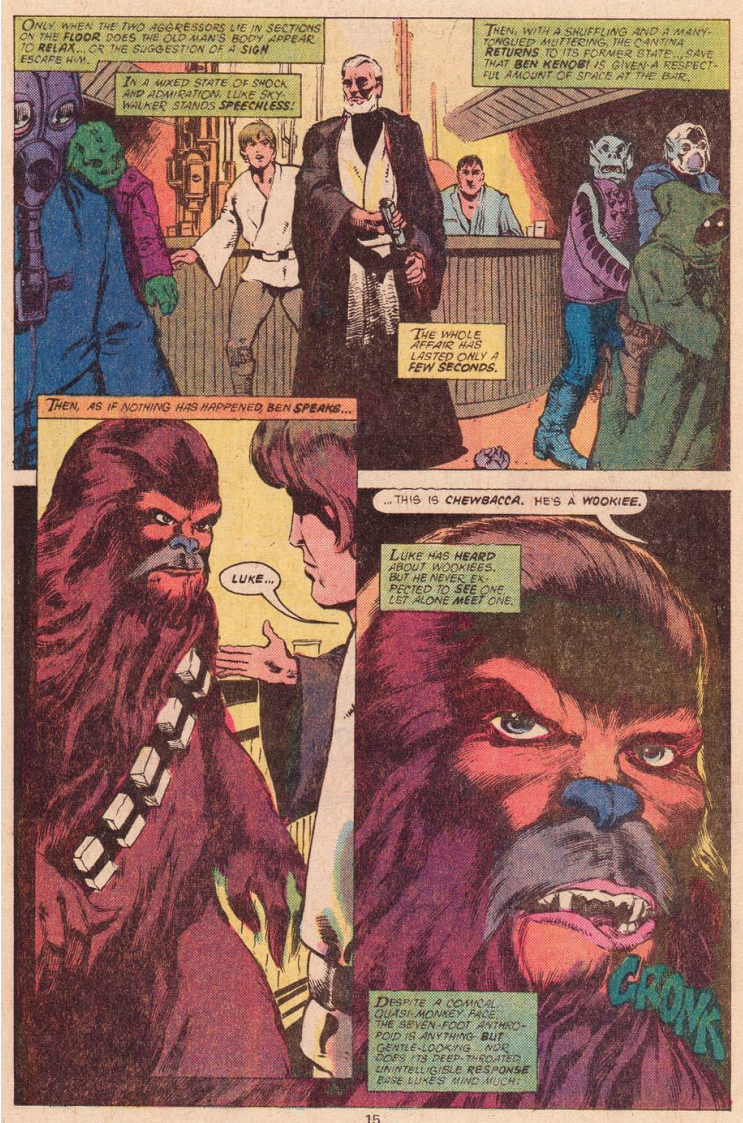
The plot follows along closely with the movie. Ben saves Luke and starts telling him about “The Force.” (Their quotes, not mine). Darth Vader interrogates Leia. Luke & Ben find the wrecked sandcrawler and then Luke's farm is burnt down. They go to Mos Eisley and hire Han Solo and Chewbacca. There is a firefight in the docking bay and they make the jump to lightspeed in the Millennium Falcon.


One point of difference is the deleted scene where Han meets Jabba that was restored in the Special Editions. This was well before Jabba's design was finalized as a giant slug, so here we have a random alien who would later be retconned as Mosep Binneed, Jabba's accountant and occasional face-man.


There's not much to say about the issue. Its a faithful adaptation of that section of the movie and the slight shift in art style is for the better.


Wednesday, April 18, 2018

Legends Never Die: Marvel Star Wars Issue 1


I've spent more time than I really needed to thinking about how to approach the old Marvel Star Wars ongoing from the 70s and 80s. It was one of the original tie-in materials and would end up being a constant thread throughout the Original Trilogy's theatrical run and even outlived it, ending in 1986 with issue 107. That's almost a decade of comics and taken as a whole, its an impressive body of work. Individually, though, it goes in fits and starts, so that's how I figured I wanted to go through the series: Individually, and in fits and starts.

Launching in 1977 right before Star Wars was released (remember, A New Hope was added later), the first issue features scripting and editing by Silver & Bronze Age comics luminary Roy Thomas with art (pencils and inks) by Howard Chaykin early in his career.

The issue covers the beginning of the movie up to the point where Luke is attacked by Sand People in the Jundland Wastes while looking for Artoo.


Like the novelization, the comic script follows an earlier draft of the script than what the final movie would have. There's a lot more Luke on Tatooine stuff, where he witnesses the space battle from the ground and has a farewell meeting with Biggs. Its not something really missing from the movie, but in a medium like comics, the scene adds some good characterization beats for Luke's desire to get off Tatooine.


The art is very 1970s. Vehicles are oddly proportioned and frequently off-model, Chaykin's inks are frequently thick over somewhat sketchy pencils and the colors by Marie Severin are heavy on the reds, oranges and pinks in places. The hyper-stylized color scheme holds together thanks to Chaykin's dynamic poses, but I wouldn't call the art especially great, even for its time. 

Recently, Marvel re-released the six original issues in a “remastered” form with modern coloring techniques and a film-accurate palette, and it just looks like badly proportioned art (It kind of is, but the original coloring helped it stand as a stylistic choice).

The Biggs stuff is nice, the art can be polarizing, but it does feature the best version of Vader choking Admiral Motti, where he casually uses the Force to bring him a cup of coffee while he tortures him.


Tuesday, April 10, 2018

Legends Never Die: The Truce At Bakura


Released at the end of 1993, The Truce at Bakura followed hot on the heels of the Thrawn Trilogy. The first standalone Star Wars novel since Splinter of the Mind's Eye, Bakura is often overlooked in the early Expanded Universe since a lot of the things it introduced weren't really touched upon later and would get swallowed up in the blitz of EU material that was to come in 1994.

Its author, Kathy Tyers, was relatively new at the time. Her first book, Firebird, was published in 1987, with three more novels published before Truce at Bakura, all through Bantam Spectra (which had the Star Wars rights in the 90s).


The book begins immediately after the Battle of Endor. The victorious Rebel Alliance is licking its wounds and taking stock of the situation. Luke is exhausted and badly injured from his confrontation with the Emperor (and his Dark Side lightning), but he's forced into action when an obsolete message pod arrives in the system from an Imperial-held world that has been invaded by aliens. Sensing an opportunity to win over “Hearts and Minds,” Alliance High Command decides to send a small force to rescue the planet, Bakura, and diplomatically sway them away from the now-headless Empire.

An escort carrier and several fighter squadrons are all that can be spared, but Leia Organa is in charge of the diplomatic mission (Han, Chewie & the droids are along for the ride too, of course) and Luke is put in overall military command.

That's right, eagle-eyes. Rebels re-used the Quasar Fire-class in NuCanon

Arriving in the Bakura system, they find a well-developed world that was originally settled by corporate interests and developed a thriving repulsorlift industry. The locals hate droids thanks to an old uprising in the past, but they've only been recently incorporated into the Empire and many don't have a problem with its rule over them. A tentative truce is established to fend off the aliens, the reptilian Ssi-Ruuvi Imperium from the Unknown Regions.

Then all hell breaks loose when the truce is broken.

There's a lot going on inside this book. Luke is badly in need of rest and healing, but the burdens of his obligations (and because Ben's Force ghost told him to go) push him forward. He struggles with command, resisting the temptation of using the Dark Side to make life easier, detecting a Force user among the alien force, and an attraction to a pretty young Imperial senator from Bakura.


Leia's conflicts are more direct. She's got to deal with the Bakuran government that is only partly Anti-Imperial. The local governor proves to be a capable and wily negotiator himself. She does get some great personal moments, like where she wrestles with the knowledge of being Darth Vader's daughter, even going so far as telling Anakin's Force ghost off when he appears asking for forgiveness. She's written a bit inconsistently, too. Part of the agreement of the truce is that the Rebels won't stir up seditious behavior, which is exactly what she does. There's little things like that that stand out.

The new characters end up being some of the most interesting.

Commander Pter Thanas, the man in charge of military defense with his small Carrack-class cruiser, is actually a Good Guy Imperial. So good that he refused to punish an alien planet under his control and was transferred to a sleepy backwater for the rest of his career. He struggles between his duty and his conscience throughout the book.

Governor Wilek Nereus isn't a cartoonishly evil dictator when he's introduced. He rules Bakura with a fairly open hand, while never letting them forget who really rules their Senate. As the fighting worsens, his darker side comes to the surface, and he's revealed as an inveterate schemer with a fondness for poisons and taking the teeth of game he has hunted.

Gaeriel Captison is the pretty young Senator and an Imperial loyalist who fears the reputation of the Jedi and their abilities. She's also deeply religious, and devoted to the Cosmic Balance, which holds that a good deed on one end of the galaxy will be balanced out by a bad deed on the other end. Part of her fear of the Jedi stems from the belief that they heavily upset that delicate balance. Tyers herself is openly Christian (and later in her career would focus on writing Christian Sci-Fi), and the facet of Gaeriel's character isn't treated as a joke or something that overpowers the character, which is nice.


She's also got heterochromia of the eyes and her presence in the Force drives Luke's hormones wild, but she's actually not a mary sue, since she's not good at everything. She's only good at diplomacy. Unfortunately the romance between her and Luke doesn't really work, so its probably for the best that it doesn't work out between them by the end of the book.

The Ssi-Ruuk are an interesting race. Derisively called “fluties” because of their high-pitched language, they're xenophobic, imperialist dinosaur-men who believe that only they have souls. They capture and enslave people to power their technology, forcibly sucking out the life energy and consciousness of living beings (humans are great for this) to power their electronics and droids. This is called “entechment” and it lasts until the machine is destroyed or the poor bastard inside goes completely insane and dies a second death.

Its really quite horrifying.


Among them is a fifteen-year-old human boy named Dev Sibwarra. He's a powerful Force sensitive with strong empathic abilities and he's deeply affected by Stockholm Syndrome in a galaxy that doesn't even have a Stockholm. Poor Dev is a true believer in the Ssi-Ruuk cause and longs to be enteched, despite being abused for even minor failings. He's the presence that Luke sensed, and is part of why Luke drives himself to the physical brink trying to save this kid.

Also, Dev is brown-skinned of the Indian subcontinent variety, but that's secondary because this is how you do diversity without forcing it and publicly patting yourself on the back for inclusivity.


The overall plot is interesting and hustles along briskly, and the space combat scenes are well done. The middle bogs down a bit where it turns into diplomatic posturing. Han doesn't have a whole lot to do, aside from shoving Threepio into Stormtrooper armor at one point and doing space stuff in the Falcon. Some of the side characters, like the crew of the carrier Flurry, are untapped potential.

Its a Luke and Leia focused story that explores bittersweet themes of failure and loss, and sits on the better end of the Expanded Universe spectrum. The Ssi-Ruuk are an interesting, if one-dimensional villain race, and I like them because they're weird.

Not on the top level with Heir to the Empire or Han Solo at Stars' End, but still recommended.

Tuesday, March 06, 2018

Legends Never Die: Lando Calrissian and the Starcave of ThonBoka


In the Fall of 1983, Del Rey published the last of the Lando Calrissian Adventures, Lando Calrissian and the Starcave of ThonBoka. Like the rest of L. Neil Smith's trilogy, it mixes gambling, comedy, Lando trying to find peaceful solutions to problems, Libertarian themes, and a hefty dose of weirdness.

This time, Lando and his astrogator/flight instructor Vuffi Raa meet and befriend a giant space manta that can naturally fly through hyperspace. His name is Lehesu and he's an Oswaft. Lehesu wanders innocently through the Centrality sector, but in doing so he draws the attention of the Centrality and Imperial Navies, who follow him to his home nebula of ThonBoka (literally “Starcave” in their language) and blockade it, slowly starving the Oswaft.


Deciding to help them, Lando runs food through the blockade by conning and gambling his way through the fleet, and plot threads draw to a conclusion. The strange renegades with a grudge against Vuffi Raa are fully explained, Rokur Gepta's origins and the fate of the Sorcerers of Tund are revealed, and we finally get to meet Vuffi Raa's parents. All this, and Lando teaches space mantas how to play Sabacc.

Its a weird, wild ride that takes place almost exclusively in space. There's a brief side trip to Tund, but that's a dead world thanks to Rokur Gepta. Lando is either onboard spaceships or is floating around in a space suit. The banter between Lando & Vuffi Raa remains a huge part of the series' charm and even their goodbye is handled with bittersweet wit.


Much like Han Solo and the Lost Legacy, there's a melancholy edge to this story. Lando's adventures in the Centrality are coming to an end, and he's going to go off with enough treasure to buy himself a city and an urge to settle down and become a legitimate businessman. The party's over and Lando needs to return to the Galaxy at large for the movies to take their course.

Its a satisfying conclusion to a fun ride. Not quite as quick-paced as The Han Solo Adventures, but Lando's a different kind of scoundrel. Han's general solution to problems is to shoot his way out, and Lando only kills two people in this entire trilogy. Instead, this trilogy hammers home the theme that Lando is a weirdness magnet, which would carry through into later stories.

I recommend it, but its not essential tier like Daley's Han Solo trilogy or Zahn's Thrawn Trilogy. In the 90s this trilogy was also reprinted as an omnibus, which is a good way to get it.

Monday, January 01, 2018

Legends Never Die: Lando Calrissian and the Flamewind of Oseon


Published in late 1983, Lando Calrissian and the Flamewind of Oseon, was the second in the Lando trilogy.

Following the Rafa adventure, Lando, now with moustache, finds himself with a hold full of valuable life crystals, but finds himself unsuited to the life of an honest merchant. Forms, fees, pirate attacks, repairs and unfavorable prices have depleted his wealth. Plus, someone is very clearly trying to kill him with sabotage, so he turns back to his primary moneymaking skill: gambling.

He arrives in the Oseon system, which is made of two things: mining asteroids and pleasure asteroids. After a successful night at the Sabacc tables, he's attacked by a strange old man and kills him in self-defense (Lando's first kill in the trilogy). The local governor is sympathetic to the self-defense claim, but Oseon has a strict no guns policy among civilians, and the penalty is death. He offers a deal: Lando will ferry a local police officer (no nonsense cop Bassi Vobah) and an Imperial narcotics agent (the flustered avian Waywa Fybot) to an asteroid of “the single richest being in the galaxy” Bohhuah Mutdah. Mutdah has apparently been buying the highly illegal drug lesai and having it shipped during the Flamewind, a regular seasonal flare of solar radiation that drew millions to the system to see the pretty lights but also made navigation almost impossible.


Fortunately, Lando and Vuffi Raa are able to get through (the little starfish-shaped droid turns out to be an excellent flight instructor), and the following string of betrayals and deceptions leads to the revelation that the architect of it all was the Sorcerer of Tund, Rokur Gepta, who is really, really mad at Lando for fouling up his plans in the last book.

This is probably the most Libertarian book in the series. Lando's distaste for government and law enforcement shines through, so much that Lando never once entertains the idea of charming Bassi, the local cop sent with him. Even the sympathetic governor is presented as well-meaning but largely impotent compared to his orders. Waywa Fybot, the Imperial Narc, is treated as a joke at first, seeing as he's a two and a half meter tall yellow birdman.


Sabacc remains important, but takes a back seat to the intrigue. Lando and Vuffi Raa's relationship has settled into an amiable partnership, with “And don't call me master” becoming Lando's de facto catchphrase of the trilogy.

The jokes keep flying fast, including the mention of a constellation called the Silly Rabbit, but its gets serious when it needs to, and the climax shows just how petty and dangerous Rokur Gepta can be.


Probably my personal favorite of the Lando Calrissian Adventures, I definitely recommend it for fans of smooth-talking gamblers who keep ending up in bizarre situations. 

Monday, October 30, 2017

Legends Never Die: Han Solo and the Lost Legacy


Han Solo and the Lost Legacy caps off Brian Daley's Han Solo trilogy, and was published four months after The Empire Strikes Back was released.

Frozen in carbonite, book trilogy ended. 1980 was a rough year to be Han Solo.

After making haste out of the Corporate Sector, Han, Chewie, Bollux and Blue Max are bumming around a backwater sector called the Tion Hegemony doing odd jobs like working for a flying circus.

Adventure comes calling in the form of one of Han's old academy instructors turned treasure hunter: Trooper Badure. Badure's recruits Han to get to the planet Dellalt to find a long-lost treasure ship, The Queen of Ranroon. The ship belonged to a fabled pre-Old Republic conqueror, Xim the Despot, and is said to be guarded by a legion of his deadly war robots. The ship has been the stuff of spacer legends for generations.

After a high-speed chase across a university, Han agrees and meets the rest of Badure's team: Hasti, a miner who's sister discovered the clue to the treasure's location and was killed for it, and Skynx, an eager Ruurian historian who's just about the most adorable fuzzy caterpillar person in the galaxy.


Dellalt proves to be a dangerous world, with a criminal mining operation, a reclusive group of deadly cultists in the mountains, and centuries-old war robots that are just as deadly as their reputation.

And then Gallandro shows up with a grudge against Solo for being humiliated in Han Solo's Revenge.

Considering Raiders of the Lost Ark came out a year later in 1981, the comparisons are inescapable. A character played by Harrison Ford goes on a hunt for ancient treasure and has to deal with angry natives and hostile armies. Probably coincidental, but the pulp element convergence here is striking.

Gallandro himself works as a stand-in for the sinister Setenza from The Good, The Band and the Ugly. His moustache is a little more flamboyant, but there's a lot of Lee Van Cleef in the character. He is one of the few people in the galaxy that Han is legitimately frightened of.


Like the rest of the trilogy, Daley's action sequences are fast-paced and exciting. The aforementioned university chase (which itself has a lot of similarities to one of the few bright spots in Kingdom of the Crystal Skull), then there's a mountain chase on a giant metal disc, and a large-scale battle at the climax where everyone's fighting everyone as the war robots advance.

This time, though, there's a tinge of melancholy throughout. Its been a fun ride, but the party's coming to a close. Han makes more mistakes. Hasti, the potential love interest, rejects his advances, saying she wants something real and not a love-em-and-leave-em type. The ancient labor droid Bollux has a touching conversation about obsolescence and free will with the war robot commander. Skynx the academic is rushing to get as much adventure and knowledge into his life before he matures to a full adult and turns into a near-mindless butterfly. Bollux and Blue max have to leave Han by the end because they're not in the movies.


The passage of time undercuts everything in this book, and by the end, Han & Chewie have managed to piss off everyone important in the Corporate Sector and Tion Hegemony, so they bounce around the idea of doing a simple spice run for Jabba the Hutt.

The Han Solo Adventures are a blast to read and can be found individually or in omnibus formats. If you're of a tabletop persuasion, its essential reading for a Scum & Villainy type of game. Highly recommended and essential Expanded Universe reading.


Brian Daley would continue on with a few Star Wars projects, but not more novels. He wrote the script adaptations for the Star Wars Radio dramas (1981, 1983 and 1996, respectively). The audio dramas are really quite good, by the way, and expanded on a few themes that weren't in the movies.


Daley himself died in 1996 of pancreatic cancer shortly after recording of the Return of the Jedi radio drama wrapped. According to his official website, which is still up as a memorial to him, some of his ashes were to be scattered at the Little Big Horn Spirit Gate memorial to help defend it from inter-dimensional threats. 

Tuesday, September 12, 2017

Legends Never Die: Han Solo's Revenge


Han Solo at Stars' End was published in early 1979. The sequel, Han Solo's Revenge followed in late 1979. Whereas Stars' End ended up a prison break story, this turns into almost a James Bond style adventure/mystery.

It begins with Han and Chewie (and the droids Bollux and Blue Max) operating a movie theater on a desert planet for easy credits. Unbeknownst to them, they've accidentally created a religious experience for the desert natives by showing a documentary of a water world. The scheme ends in a hurry when they try to show a different movie and they're back in space, desperate for cash.


The solution comes in a simple, lucrative smuggling operation. One catch: Han finds out it involves running slaves. Han & Chewie are rogues, but they absolutely refuse to get involved with any slavers. The immediate situation resolved, an angry Han Solo sets out to find the slavers and get the money they still owe him.

To that end, Han runs into one Fiolla of Llord, a beautiful, idealistic and resourceful woman who's also a Corporate Sector Assistant Auditor-General trying to track down the very same slaving ring. Meanwhile Chewie has his hands full dealing with a persistent skip tracer named Spray, who shoves his way onto the Falcon, intending to repossess it once all the shooting stops.


Shootouts on a luxury spaceliner, planet hopping, a bomb on the Millennium Falcon, a high speed swoop bike chase scene five years before the speeder bikes of Return of the Jedi, and an encounter with Gallandro, the deadliest gunslinger in the Corporate Sector, if not the entire Galaxy.

Much like Stars' End, Revenge runs at a rapid clip of action sequences, betrayals and more action sequences. Comic relief is also strong, as Bollux and Blue Max continue to provide their mix of competence and comedy, while Spray becomes an amusing foil for Chewie.


The real standout is Fiolla, one of the first genuinely memorable Expanded Universe female protagonists and love interests for Han. (Jessa from Stars' End counts too, but she's only there at the beginning and end of that story). Resourceful, witty, and occasionally naive in contrast to Han's practical cynicism, she's great. If one were feeling woke, it could be pointed out that she is a non-Caucasian female hero in a Star Wars story from 1979 and it was no big deal because the franchise was always diverse, but that would shatter the narrative.

She's also a genuinely good cop, which makes a strong contrast to the hard edge the Corporate Sector Authority had in the first book. Tyrants like Viceprex Hirken aren't the only employees in the Authority, which adds a nice layer of nuance.


I absolutely recommend Han Solo's Revenge for fast-paced scum and villainy action, adventure and romance. 

Monday, May 22, 2017

Heroes, Failures, and The Force Awakens


I wasn't planning on going on another tear against Star Wars NuCanon, but I think I figured out what bothered me the most about The Force Awakens.

Its not the uninspired soft reboot of A New Hope.

Its not the emotionless impact of major, even world-destroying, events or the abysmally small sense of scale of the film.

Its not even Rey's lack of character development and Mary Sue red flags.

Its the fact that it reduces the heroes of the original trilogy to failures in order to prop itself up.

Lando Calrissian goes from shady gambler to respectable business man to baron-administrator to treacherous coward to redemption seeking friend to noble general willing to risk his life for a greater cause. In old Canon he somewhat retires from his military rank to pursue grand financial adventures, but retains close ties to the New Republic. (Yes, I'll be using examples from Legends continuity, deal with it). He's nowhere to be seen in TFA, presumably off doing low-level gambling stuff and business ventures again.

Leia Organa goes from a driven diplomat, senator, warrior and leader, royalty times two: first to Alderaan and to Naboo (as goofy as its executive branch may be). She's a crack shot and a sharp wit who never gives up and would become instrumental in the formation of the New Republic. In Legends she became a mother of three powerful Jedi (hey, Jacen was an adult when he fell to the Dark Side) and was able to successfully juggle between spending time with them and with her duties as Chief of State of the New Republic, and having galaxy-spanning adventures AND training in the use of the Force and got her own lightsaber.

Here? She's in charge of a rag-tag military front called “The Resistance” using cast-off military hardware to not look like a New Republic operation. She's reduced to a crackpot former Senator trying to warn people Ron Paul style about how the Empire wasn't really finished yet, and yet her Resistance is unable to prevent a massive terrorist attack that destroys the solar system that the New Republic government is in. “But she's a General now! That's so much more badass than a Princess!” A) That's debatable, especially since by rights she should be a Queen and B) She failed to steer the New Republic in a better direction and she failed to protect it from an outside threat. Her life's work, the Alliance to Restore the Republic? Failure.

Luke Skywalker goes from a wide-eyed farm boy and bush pilot to military officer to brash Jedi trainee to moody mystic to becoming the big damn hero of the galaxy through his ability to forgive the sins of his father. From there he continues in a military capacity for a while before rediscovering Jedi documents and re-opening the Academy and training a new generation of Jedi Knights. He eventually finds love and starts his own family. Sure there were some bumps along the way, but the New Jedi Order endured as a shining beacon of light in a violent galaxy.

NuCanon? Less than thirty years after the destruction of the second Death Star, one of his own students turned on the academy and wiped out the next generation of Jedi. In response, Luke goes off into seclusion, abandoning his friends, family, even droids after a single disaster. This is the man who stared down the Emperor and refused to kill him. This is the man who clung to the bottom of a floating city after having his worldview shattered by the revelation that his nemesis was his father. This is a hero of supreme willpower and perseverance who goes into hiding because wannabe Darth Vader and his Ginyu Force killed his students. His life's work, bringing balance to the Force and restoring the Jedi Knights? Nothing but ashes.

Han Solo probably gets the worst of it (if only because Luke has a grand total of seven seconds on-screen in TFA). He starts as a smuggler, gambler and rogue for hire. Courting danger and the next payday he looks out for himself and Chewbacca because that he has. Then he runs into a crazy old mystic and his apprentice, then a space princess, and then discovers something greater than just getting paid. He discovers friendship, loyalty, love. Good people worth fighting for. A woman worth sacrificing himself to risky carbon freezing for. An evil government worth overthrowing. Out of all the original trilogy characters, Han's easily the most likable thanks to Harrison Ford's raw charisma, but also because he has the strongest character growth out of anyone. There's never any doubt that Luke or Leia will succeed, but Han's always got that cloud of potential failure over him. In Legends, he stays a general longer than Luke. He's still running off on crazy adventures, only this time he's doing it for the New Republic and for his wife, the Chief of State. He's a loving father of three kids. All while still managing to step on the toes of authority whenever he can and rubbing elbows with his old smuggling buddies. He's reached a fulfillment to his life that he never thought possible.

NuCanon has Han regressing back to being a lowlife smuggler bumming around the galaxy as a deadbeat dad. Then he picks up some dumb young kids and gets caught up in their adventure, awakening his long-dormant heroism. He tries to pass some knowledge on, and then gets killed by the son he very obviously never connected with. An Everyman hero without Space Magic getting by on his wits and courage losing every good thing he ever attained (including the Falcon) before one last gasp at heroism and a pathetic death at the hands of his own failure of a son. His failure is the most depressing of all because its the most complete.

I'm sure there's something to be said about cultural mores and so on in regards to the difference between what the Expanded Universe did with the characters in the 90s-00s compared to now. There's also something to be said about how everybody wants to write about a plucky group of rebels overthrowing an evil government to replace it with a good government, but nobody ever seems to write about a plucky group of heroes fighting against incredible odds to protect the good government that the previous rebels installed.

This piece is already long enough, so I'll leave you with this: look at the last shot of Return of the Jedi. Now think about everything that these characters have achieved amounting to nothing.


Leaves a bad taste, doesn't it?

Yeah.


On the bright side, at least they didn't drop a moon on Chewie this time around.