Showing posts with label 60's Movie. Show all posts

Monday, October 02, 2017

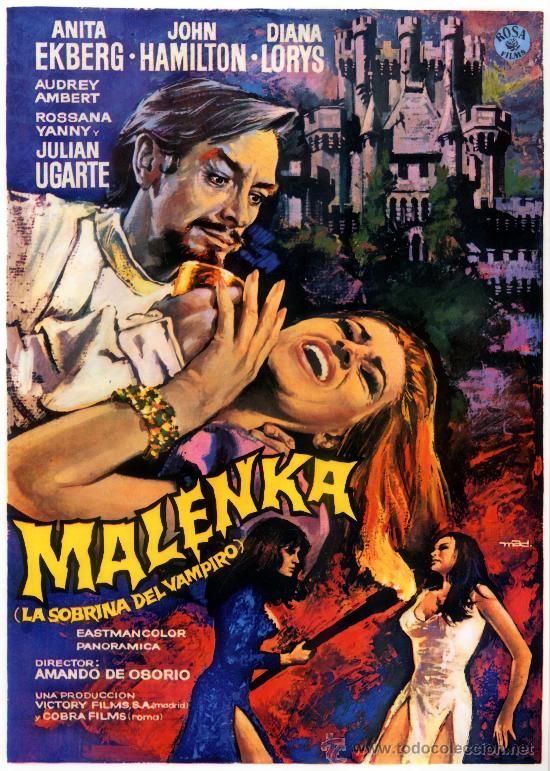
Octoverride '17: Fangs of the Living Dead (1969)


After a long absence, the Octoverride is back, though I can't promise it won't be nothing but wall-to-wall schlock this year.

1969 brought us today's piece of European Horror Schlock. Fangs of the Living Dead AKA Malenka AKA Malenka, the Vampire's Niece AKA Malenka: La Nipote del Vampiro AKA Malenka: la Sobrina del Vampiro AKA The Vampire Girl. Yeah.

This one's going to have SPOILERS because there's not much else to discuss.

It was an Italian-Spanish co-production that tapped into the then-popular horror plot of “Young(ish) person inherits an old, spooky castle in a town of weirdos and travels there, encountering HORRORS” much like in Horror Rises From the Tomb.

Here, we are introduced to Sylvia Morel, played by Swedish model and actress Anita Ekberg. Sylvia has no job or background to really speak of, but she receives a letter from an uncle that she's inherited the family estate in Walbrooke (which is in some vaguely Carpathain region). She decides to go there and fill out the necessary paperwork two weeks before her wedding to Dr. Piero Luciani (played by Gianni Medici as “John Hamilton”). He's not thrilled about the idea, but their mutual friend and incredibly Italian comic relief sidekick Max (César Benet as “Guy Roberts”) sees no harm in it.

Sylvia arrives in Walbrooke, stops for a drink in a local tavern run by sisters Bertha (Diana Lorys) and Freya (the strong-jawed Rosanna Yanni, who was also a producer of the film). We get hints that Bertha is ill with anemia before the Count's coachman and goon, Vladis (Fernando Bilbao) arrives to drive her to the castle.

At the Castle, Sylvia learns that her uncle, the Count Walbrooke (Julián Ugarte), is a weird recluse with perfect hair and an obsession with Sylvia's grandmother Malenka, who looked just like Sylvia and was played by Ekberg in an overly long flashback sequence. Sylvia also meets Blinka (Adriana Ambesi as “Audrey Ambert”), who lives in the castle, dresses in lingerie, and gives off a rapey vibe when she tries to sweet talk Sylvia into leaving her room. The Count drags Blinka out of Sylvia's room and starts whipping her in the dungeon, where its revealed to Sylvia that Blinka is a vampire. And so is the Count.

The Count wants Sylvia to call off the wedding because “Something Something Family Curse,” and he starts manipulating her to try and turn her into a vampire.

Piero & Max arrive to find out what's going on and they speak with the innkeepers. Bertha is in some kind of relationship with the Count and dies the next day from bite wounds. She rises from the grave, and it all comes down to a climactic showdown in the castle's dungeon where the Count chains a shirtless Piero to a cross and explains that he's trying to drive Sylvia into thinking she's a vampire so she can be declared insane and the Count can then claim the inheritance. Then Blinka and Bertha get into a catfight, which buys Sylvia (who had been pretending to be under the Count's power) enough time to free Piero, who then does the unheroic thing of stabbing the Count with a flaming torch, which then prompts the Count to age rapidly into a papier-mâché skeleton, which then burns up in a pretty decent scene.

Its my understanding that there are two endings to the film. The first, follows the “hoax” plot to its conclusion, and the shorter one for American audiences, which features the burning vampire skeleton. Not having seen the first ending, I still prefer the idea of vampires trying to run an inheritance fraud scheme, mainly because its more original. “Supernatural Goings-On Were All A Hoax To Drive Someone Insane For Money” is a much more cliché plot twist than people realize. 

So what's good about it? Honestly, not a whole lot. There are some fantastic and atmospheric shots, usually in the castle crypt, and the twist of “inheritance fraud vampires” is wonderfully goofy. Other than that, the movie is ill-paced with frequently bad acting, especially during reactions to scares. The biggest star of the film, Anita Ekberg, was a major beauty icon in the 50s and early 60s, even having a major role in Fellini's La Dolce Vita, but there's little allure in a middle-aged sex symbol playing a character that feels written like they're in their early twenties.

Not recommended. 


Monday, October 03, 2016

"I am Torgo. I take care of the place while the Master is away."


So yes, Manos: The Hands of Fate is an infamous little movie from 1966 that is often mentioned in conversations about the "Worst Movie Ever Made." While I don't think its the actual worst movie ever made (that's a matter of personal taste), it is a colossal turkey that earns its reputation.

Written, produced, directed and starring Harold P. Warren, an insurance and fertilizer salesman from El Paso, Texas, the movie was famously made on a bet with a Hollywood location scout named Stirling Silliphant, who would himself go on to great acclaim as the screenwriter of such classics as In the Heat of the Night, The Towering Inferno, The Poseidon Adventure, and, uh, Over the Top. The bet was that Warren could complete a low budget horror film on his own.

After a tumultuous production and failing miserably in the Southwest, the film languished in obscurity until the famous MST3K episode aired in 1993. After that, it turned into a Z-movie icon, eventually spawning a mobile game, a blu ray digital remaster, and a successful crowdfunded project for Manos Returns, which is due some time this year if IMDB is correct. Much like Troll 2, its not exactly obscure anymore, but that doesn't change the fact that its still awful.

What's it about? 

After eight minutes of driving around the El Paso countryside, a family on vacation get lost looking for Valley Lodge. The father, Mike, is played by Hal P. Warren himself. The mom is Margaret, played by Diane Mahree, who would later find success in fashion modeling, and their daughter, Debbie, played by Jackey Neyman, but dubbed into incomprehensibility. They stop at a house that “wasn't there before” first to ask for directions, then for lodging as night approaches. The caretaker is a twitchy and awkward man with strange knees (whether he was supposed to be a satyr or “like a hunchback, only hunchknees” seems a bit ambiguous, since I've seen both reported. Doesn't really matter, anyway.) He's named Torgo, and played by John Reynolds, a troubled young man who was apparently on LSD during filming and committed suicide at the age of 25 a month before the movie was released to theaters. 

So that's depressing.

Torgo's weird as hell, speaking in halting sentences and stumbling around with his own theme song. He takes care of the place while the Master is away, and while reluctant to allow the family to stay, he lusts for Margaret.

The Master is played by Tom Neyman, and is the leader of a mysterious and vague cult of possibly immortal, possibly undead people. He worships an abyssal being of primordial darkness named Manos that has a hand motif, and his cult centers their worship around a macabre bonfire where they sit, talk, argue, and eventually get into a catfight around. Essentially the Dark Souls of movies.

I'm only half joking. The similarities might be purely coincidental, but they are striking.

Tom Neyman is essentially the unsung hero of this movie. In addition to being the villain, his daughter played Debbie, his dog played the devil dog, he helped make Torgo's knees, built some of the props and his wife designed most of the costumes. He also gives the best performance of the movie, for what its worth.

I've noticed that in the best worst movies made, there's always some person with talent that is applying genuine effort to elevate the movie above its massive failings. Here, its clearly Neyman who gave it his best effort.


So what doesn't work? Saying “Everything” is a cop out, and also untrue. The editing is bad, with long and short cuts jumping around the place and long stretches of boredom that help drag its run time over 60 minutes. The cinematography is bad, with mostly dull scene composition, flat interior lighting and absolutely horrible exterior night lighting. There's the occasional flash of an interesting shot, but it passes just as quickly as it arrived. The acting is bad, with flat deliveries of dull dialogue. The female characters have it worse, with weird delays in their reactions and awkward expressions and just generally weird timing issues with their delivery. The audio itself was bad, and every sound, including dialogue, was added in post production, with voice recording occasionally being drowned out by sound effects. The smooth jazz soundtrack also doesn't fit the tone of a legitimate horror movie at all, with its flutes and saxophones and pianos.

So what's good about it? Or at least “good” with air quotes?

Torgo has become such an iconic character because he's so damn weird. He's a filthy creepy pervert that peeps through windows, yet he's the most sympathetic character because its obvious he's an unwilling servant of the Master who's fed up with being treated like dirt for a very long time.

The Master himself chews the scenery and glowers like a madman. There's even a kernel of a moody, mysterious horror film buried at the core (brigadoon house, strange cult, creepy caretaker, supernatural goings-on, etc), but the execution is so un-salvageable that it adds to the boredom and, oddly, its bizarro charm.

Like so many of its Z-level kin, Manos: The Hands of Fate ends up being a trainwreck that is simultaneously boring and utterly surreal.


Do I recommend it? As a movie that fulfills the basic requirements of entertainment, no, HELL NO. For the certain masochistic subset that has conditioned itself to find joy in weird cinematic failures this is absolutely essential, like a rite of passage. 


Saturday, May 12, 2012

“It's too bad Mothra has no alarm clock.”


1966. Godzilla vs. the Sea Monster AKA Gojira, Ebirâ, Mosura: Nankai no daiketto. Godzilla fights a giant prawn on an island owned by spy movie villains.

Story
So, we open with a ship getting sunk by…something. Next, the brother of one of the missing sailors wants to go search for him. He and his generic, interchangeable buddies sneak onboard a fancy yacht and run into a shady fellow who doesn’t admit to being, but pretty clearly is, a famous jewel thief. They wake up the next morning out at sea since the brother decided to take the boat looking for his missing brother and they reach an island ruled by the terrorist group Red Bamboo. The island also has a giant prawn named Ebirah that sinks ships when they come close. Our heroes get stuck on the island but hook up with a slave resistance movement. And for some reason Godzilla is asleep on the island. The big guy wakes up eventually and fights the sea monster, the island, which is volcanic, becomes unstable and the giant moth Mothra shows up because the good guys need some kind of way to leave the island.

Visuals/Effects
Directed by Jun Fukuda. There’s not really much to recommend this movie. Godzilla vs. Megalon has better production values. Ebirah isn’t exactly A-Class when it comes to Godzilla foes because, let’s face it, there’s little intimidation to be had from a giant, delicious-looking prawn. And then we get Mothra, one of the other Major kaiju, but she just kind of feels tacked on as a deus ex machina to get the humans to safety. The monster fights are also fairly dull, with Godzilla and Ebirah tossing a rock back and forth at one point.  I’ve read that originally this was supposed to be a King Kong movie, so a shift in the production of the film probably didn’t help either.

Writing
Written by Shinichi Sekizawa and there’s quite a few dashes of James Bond in this movie. Secret island stronghold run by a terrorist organization? I’d say it qualifies. Easily the most interesting character is the jewel thief, because he’s a competent crook who gets thrust into a position of leadership and ends up rising to the challenge. It’s rather neat and he is essentially the only character to get some actual characterization. The rest of the movie though…rather forgettable and rather random. Mothra’s presence? Random. Godzilla’s presence on the island? Also random. Godzilla fighting a giant condor? Very random. Godzilla kind of taking a fondness to one of the main females? Random and creepy.

Sound
Original music by Masaru Satô (who worked with Akira Kurosawa on, lets be honest, much better films than this). The music channels the James Bond vibe, which is actually kind of cool hearing a groovy spy-sound in a Godzilla movie.

Conclusion
The few interesting moments in Gojira, Ebirâ, Mosura: Nankai no daiketto don’t really overcome the general blandness of the film. I had to watch it twice to really figure out the plot, and even then a lot of stuff doesn’t make sense (Mothra is on the island Because, for instance). Certainly a lesser Godzilla film.


*Note* Classical music not actually in the picture.

Monday, October 31, 2011

“Quickly! Into the air, zombie bird man!”

And at last its time to close out October the same way it was begun. With Boris Karloff. In 1967, the good folks at Rankin/Bass released into theaters a feature-length monster movie done in the same animation style as Rudolph the Red-Nosed Reindeer. Except instead of annually overplayed Christmas joy, it was a swingin’ celebration of misanthropic movie monster madness. Its Mad Monster Party?

Story
Its simple really. Dr. Baron von Frankenstein is getting on in years and wants to retire from the whole “Mad Science” business. So he decides to throw a party for all of his friends/relatives at which he will name his successor. Among the invitees is an unassuming pharmacy clerk who’s a long-lost nephew, and the intended heir. The monsters involved then try to scheme and backstab their way into getting this guy out of the way.

Characters
Baron Boris von Frankenstein: Boris Karloff! Dr. Frankenstein lives on a Bond Villain’s island and has developed what is essentially anti-matter that can blow up ANY matter it touches. So yeah, that whole “law of conservation of mass” thing? Irrelevant now. And he’s actually one of the nicer characters. The model he voices looks a little like his Frankenstein’s Monster around the forehead.

Felix Flankin: Allen Swift voices Frankenstein’s nebbish nephew who works in a pharmacy and has a catastrophic case of allergies. Nearsighted and generally oblivious to the nature of the monsters.

Francesca: Gale Garnett voices the Doctor’s mind-bogglingly proportioned (essentially Christina Hendricks) assistant with a sultry voice. She wants to inherit Frankenstein’s fortune, and can scheme with the best of them.

The Monster/“Fang”: He’s mute and strong, and a henpecked husband.

The Monster’s Mate: Phyllis Diller voices the Monster’s bride if instead of a bird-like, screaming woman, it was Phyllis Diller and the two settled down.

Dracula: Allen Swift (Allen Swift pretty much voices everybody else in the movie, so I’ll leave it off to save time) voices Dracula…oddly. I can’t quite place the accent, but its not Bela Lugosi-like. The design kind of makes me think of Sid Caesar, which…is random.

The Invisible Man: The Invisible Man walks around in a smoking jacket and fez and speaks like Sydney Greenstreet.

Dr. Jekyll/Mr. Hyde: Pretty much your standard Jekyll/Hyde thing, except he sure loves drinking his transformative serum out of the flask hidden in his cane.

The Mummy: Mummy’s got some sweet dance moves.

The Werewolf: He howls a lot and likes stowing aboard ships to not have to pay.

The Creature: The Gill-Man, basically. He garbles and gurgles a lot.

Quasimodo: Also mute, he and the Mummy become roomies for a while. I’d pay to see more of that. One’s a mummy, the other’s a hunchback. They fight crime.

Yetch: He’s basically a zombie version of Peter Lorre, which…is a bit odd, since he’s not playing a Lorre character. Anyway, Yetch is Frankenstein’s butler/steward/whipping boy who’s madly in love with Francesca and his limbs tend to fall off a lot.

“It”: Not referred to by his real name because of copyright reasons, “It” is the one guest Frankenstein didn’t want to invite because he always made a mess of things. A giant, hairy, ape-like mess who likes girls and tall buildings.


Visuals/Effects
Directed by Jules Bass, it’s the same “Animagic” style that marks other Rankin/Bass productions. However, it’s a refreshing difference from the Christmas ones, and the art department gets to go wild with crazy designs. A lot of the designs were based on the Mad Magazine artist Jack Davis. There’s a lot of physical comedy and there’s a hell of a lot of intricate and detailed work for the sets, and the movie delivers a few things I’ve never seen before, like a squadron of zombies flying biplanes.

Writing
Written by Arthur Rankin Jr., Len Korobkin, Harvey Kurtzman, and maybe Forrest J Ackerman, though there’s varying stuff I’ve read about Forry actually being involved or not. The script really, really, really feels a lot like an issue of Mad Magazine, which makes sense because Kurtzman founded it. Be ready for a lot of puns, a lot of physical comedy, and a lot of saucy that slips in under the radar.

What, me worry?
Sound
Original music by Maury Laws. The extremely James Bond-esque title song is by Ethel Ennis, with a few songs by Phyllis Diller and Gale Garnett dashed in for good measure. The soundtrack is actually quite amazing, with the swingin’ jazz combo sound working surprisingly well for a group of monsters that date back to the turn of the century. The songs aren’t quite as memorable as the Christmas special ones, but they’re not bad by any means.

Conclusion
Mad Monster Party? is actually quite awesome and I was pleasantly surprised by it. Yes a lot of the jokes fall flat and Felix’s character is not a particularly bright or likable protagonist, but the movie oozes style, features good-natured camp, throws in pretty much every major monster, and has ZOMBIES FLYING BIPLANES. If you don’t think that’s awesome, then you have murdered your inner child and there’s no hope for you. Totally recommended.


Mummy's got a theme song, yo.

Monday, October 10, 2011

“I couldn’t have an ordinary ghost on my hands, I got a rummy! A big, ugly, booze-soaked rummy!”

After last week, I’d say we’re done with mummies. OR ARE WE?? This next film carries a lot of nostalgia for me, since it was on a VHS that encompassed most of what I loved as a kid. Disney, ghosts, pirates, the 60’s aesthetic (before I knew how to spell “aesthetic”), and comedy. It’s time for 1968’s Blackbeard’s Ghost.

Plot
After an opening title crawl boasting about how badass a villain Blackbeard the pirate was, we head to the coastal town of Godolphin. The new track coach drives into town one night and will be staying at the Blackbeard Inn, a suitably piratey establishment run by a group of kindly old spinsters called the Daughters of the Buccaneers who claim to be the descendants of Blackbeard's crew. A local nightclub owner has bought their mortgage and is trying to run them out so he can build an off-shore casino.

Our hero arrives during a fundraiser, buys an old warming pan to impress a female professor at the college, gets assigned to Blackbeard’s old bedroom and accidentally sits on the warming pan, breaking it. Inside the handle, he finds an old fragment of parchment containing part of the spell book of Aldetha Teach, one of Blackbeard’s wives who was burned at the stake for witchcraft and cursed him to spend eternity in limbo until he displayed a shred of human kindness. Naturally he ends up summoning Blackbeard from said limbo and has a raging alcoholic ghost that only he can see tagging along as he tries to get his track team in shape for the Broxton Relay, steal the football coach’s girlfriend, and find a way to keep the Daughters of the Buccaneers from being kicked out of their home.

Characters
Steve Walker: Dean Jones (star of most of the Herbie the Love Bug related projects and other Disney films) is our hero. A straight-laced, teetotaler of a track coach, he’s a decent, charitable fellow but also a fish out of water in Godolphin. He inherits the worst track team in the state (his shot putter, Gudger Larkin, looks like he weighs 90 pounds soaking wet) and only has a few weeks before the big relay. Blackbeard is a huge annoyance for him (and causes people to think he’s gone crazy like the previous track coach) and he tries to get the old salt to do a selfless act.

Edward Teach/Captain Blackbeard: You can tell Peter Ustinov was having an absolute blast as Blackbeard. More of a poltergeist than a regular ghost, since he can affect the mortal world (like stealing bottles of hooch, stealing a motorcycle, stealing fat wads of cash, and steali--, er, punching goons in the face), Blackbeard is gleefully reprobate and tries to teach Steve to loosen up and have some fun. He lies, he cheats, and he has mood swings like a spoiled child, Ustinov’s Blackbeard is a hoot in this and reason enough to watch the film.

Jo Anne Baker: Suzanne Pleshette is a psychology professor at Godolphin College. Steve meets her when he mistakenly thinks she runs the kissing booth at the Buccaneer fundraiser. She’s spunky and dedicated to saving the Blackbeard Inn. After Steve picks up Blackbeard, she kind of volunteers to keep an eye on him and see if he’s really crazy. Initially she’s dating the football coach, Purvis, but he’s a smug jerk with no personality.

Emily Stowecroft: Hey, its Elsa Lanchester! A good few decades removed from Bride of Frankenstein, she plays the leader of the Daughters of the Buccaneers and when Steve meets her, she’s reading fortunes in a tent in full-blown crazy lady mode. She also provides incredibly hammy exposition (which is difficult to do) and is great fun to watch.

Silky Seymour: Joby Baker plays our villain. Black suit, goons, and a pencil-thin moustache, he’s stereotypically evil and plays the part with oily smugness. He encourages gambling but naturally cheats when it goes against him.


Visuals/Effects
Directed by Robert Stevenson (who was behind the camera for numerous Disney pictures, like Mary Poppins), the film’s strengths are set design (for the Blackbeard Inn) and special effects, which are pretty good for 60s live-action. Doesn’t hurt that most of the scenes are set at night to better cover the wires. There’s quite a few fun scenes where Blackbeard takes an active role in the shenanigans, such as stealing a police motorcycle, interfering in the track meet, and being a trump card in the final brawl between Steve and Silky’s goons (there’s even a nice finger-gun shootout).

Writing
Based on the book by Ben Stahl. Screenplay by Bill Walsh & Don DaGradi. The screenplay mixes a whole lot of plot elements in but keeps things well connected, but right after the track meet the movie slows down quite a lot before rallying for the ending. The real draw is Blackbeard misbehaving and trying to show a spark of human goodness so he can move on from limbo.

Sound
Original music by Disney regular Robert F. Brunner. The score is actually quite good, throwing in a lot of nice piratey touches like concertinas and harpsichords. The few songs in the film (because this is Disney, after all) are also quite catchy.


Conclusion
Pacing issue aside, I’m glad that it wasn’t mere rose-tinted glasses that led to fond memories of Blackbeard’s Ghost. Its actually a very solid family film that is 100% carried by Ustinov’s gleeful scenery chewing. If for no other reason, the movie’s worth watching for that.


Can't find a trailer, but you get the idea.

Friday, April 22, 2011

“How about making me vice president in charge of cheering you up?”

You’ve probably noticed that I’ve got a fondness for movies from past decades. Over the course of viewing and contemplating films for this here project, I’ve come to realize that I’ve got a particular fondness for the 1980s, 1930s, and (with relevance to today’s entry) the 1960s. While I am far from anything close to a hippy, I’ve got to admit there’s a definite appeal to the cocksure swagger of a good 60’s movie. 1963’s Charade, which I’ve seen quite a few times in my life, certainly qualifies.
Story
Regina "Reggie" Lampert (Audrey Hepburn) is a wealthy young woman who’s on holiday in the Alps and plans on divorcing her husband when she returns home to Paris. He beats her to the punch by getting himself thrown from a train to his death in the pre-credits sequence. At his funeral, a colorful band of shady looking types (Tex Panthollow (James Coburn), Herman Scobie (George Kennedy), and Leopold W. Gideon (Ned Glass)) make sure he’s dead and Regina starts wondering just what’s going on. She gets called in to the American Embassy by a CIA Agent named Hamilton Bartholomew (Walter Matthau) who explains that during WWII, her husband was part of a group of people who stole a hefty sum of money that technically belongs to the US government. Her husband stole the money from them, but being as he was the only one who knew where it was, a treasure hunt with deadly consequences commences. Oh yes, and along the way Reggie meets the charismatic and mysterious “Peter Joshua” (among other names) (Cary Grant), who’s reason for wanting to find the money changes as often as he changes names.

That’s really about all that I can say about the plot without stumbling into spoiler territory. Just trust me when I say that the plot twists fly fast and thick in this film, but they all make sense by the end of the movie. Basically, if Alfred Hitchcock had ever decided to make a romantic thriller in the 60s, this is the movie he would have made.

Visuals/Effects
But it’s not Hitchcock who directed this. It was Stanley Donen (who’s done all sorts of big films like Singin’ in the Rain, Seven Brides For Seven Brothers, Damn Yankees and some films that aren’t musicals). The visuals and pacing of the film are both outstanding. Paris looks great (as it usually does) and the pacing is lightning quick as we move from scene to scene with a near-manic urgency (which works perfectly for the mystery). Characters seldom get a chance to catch their breath, and when they do, well, its basically for Hepburn and Grant to have fantastic chemistry together as their characters struggle to trust each other as they fall in love. Also, the final chase scene and showdown is exceptionally tense and well-edited, so bonus points for that.

Writing
Screenplay by Peter Stone and based on the story “The Unsuspecting Wife” by Peter Stone and Marc Behm. Funny thing is, the writers shopped the story around first, got no bites from Hollywood, so they published it as a novel under a different title and lo and behold, the studios went for it. Say what you will about the film industry’s lack of originality, but it has always been like that.

The story works great. Yes, its based on the old plot of “we need to find the money before its too late!” but it handles that plot with a deft touch that throws in romance and some legitimately nice twists. Dialogue is great in this too, as character verbally spar with aplomb.

About the only complaint I have with the movie lies with one character, Jean-Louis, the little son of Reggie’s best friend. He shows up at a few intervals with an important part to play, but I don’t know if it’s the writing or the fairly bad dubbing on his voice, but he is annoying as all hell.

However, the character work on Regina herself is outstanding and worth noting. She’s vulnerable and in way over her head, but she is anything but helpless. She doesn’t run around with a gun in her hand, but she’s incredibly smart and resourceful, often figuring things out for herself just as often as she finds herself in trouble. Just a fantastically well-realized and believable female lead character.

Sound
Original music by Henry Mancini. You can’t go wrong with Mancini and this is very much a truism for this movie. Action sequences have a lot of percussive beats that drive things forward quite nicely as well.

Conclusion
Charade is one of those movies that I love deeply and can watch frequently. It works equally well as a Romantic Comedy as it does a crime thriller and it’s great seeing Coburn and Matthau on screen, but the real heart and soul of the movie belongs to the interaction between Cary Grant and Audrey Hepburn, and they’re both fantastic in this. Hepburn in particular is radiant and I dare any heterosexual male out there to not fall in love with her even a little bit after watching this. Wholeheartedly recommended.